“Painting wet-in-wet with oils, building thick and eventful surfaces, she creates allegories of uncertain but torrid, gnashing implication, a bit like the enigmatic narratives of the German modern master Max Beckmann, but less solemn.”
Tender yet electric, bright yet somber, Dana Schutz’s Dead Zebra is a spectacular homage to the artist’s celebrated style of figurative abstraction, one that creates elaborate visual narratives by means of expressive painterly imagination. Often depicting mythical matter in mysterious and thrilling scenery, Schutz’s canvases capture complex chronicles of contemporary life, and engage the viewer's psychological senses through their capacity to portray subjective experience.


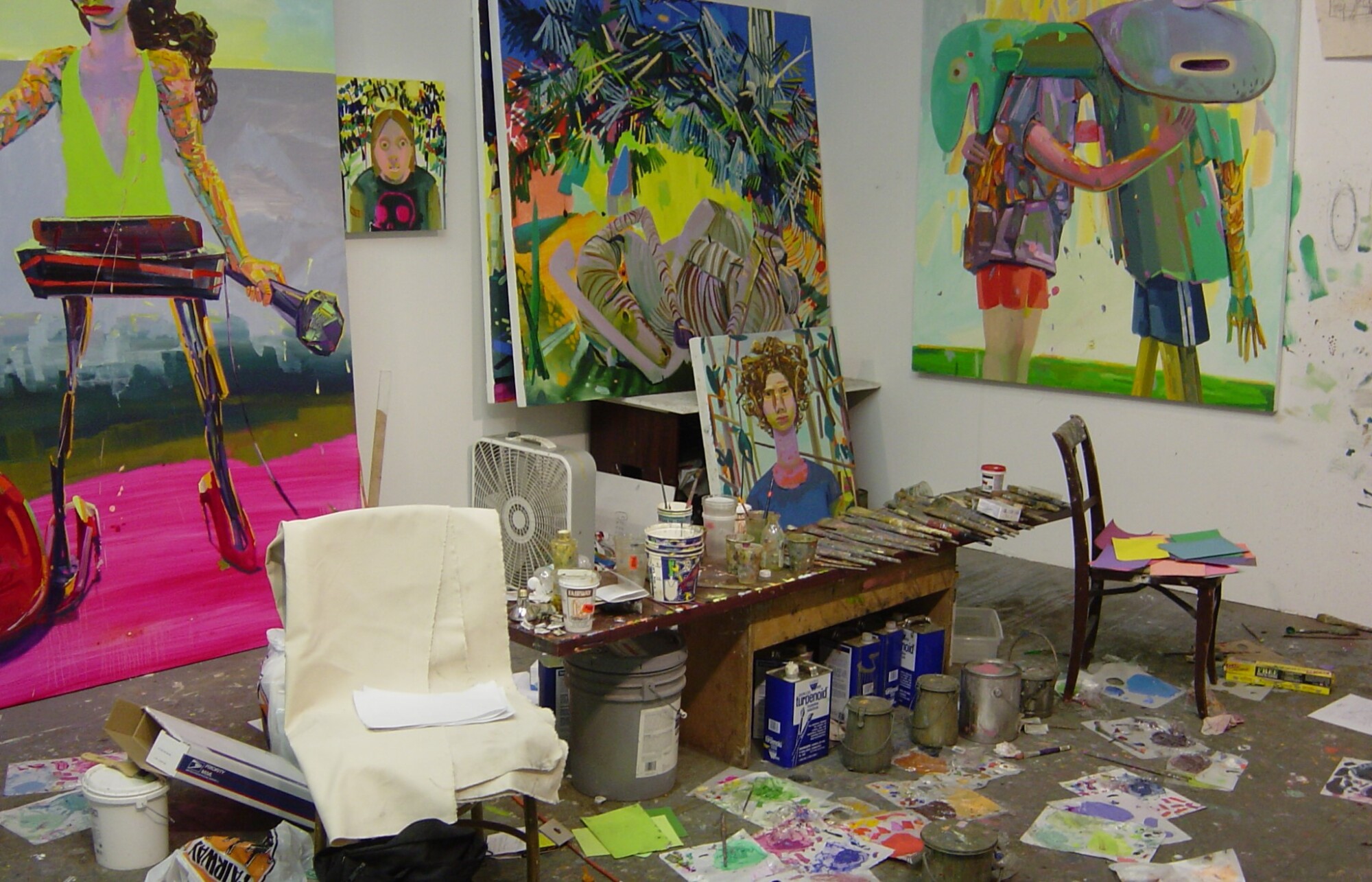
“I embrace the area between which the subject is composed and decomposing, formed and formless, inanimate and alive.” (the artist cited in: London, Victoria Miro Gallery, Painting 2004: Group Exhibition, 2004 (press release) (online)) Dead Zebra epitomizes this intent, as Schutz illustrates a prone zebra, limbs tangled in self embrace, lying in a vivid jungle of exploding colors and patterns. Known for her personification of still-life narratives, Schutz uses vigorous brushstrokes and fantastical tones to animate the tropical arcadia alive within the painting. A fanciful form, the zebra appears curled up on the bed of the canvas, not in a somber landscape of death and decay (as the title might suggest), but rather in a kaleidoscopic dream-world filled with light and brilliance. Through contrasting pictorial elements, Schutz achieves the anthropomorphization of the enigmatic creature. Highly saturated fauvist hues eclipse the distinguished monochrome narrative of the animal as the familiar black and white zebra stripes are replaced by an amalgam of purple hooves, brown stripes, mauve legs, and green skin. The four-legged body becomes an amorphous ball of elastic, loose limbs wrapped around one another, creating a scene that is tender and vulnerable, yet simultaneously distressing and primal.


In true Schutz-ian style, Dead Zebra uses color as a light source to capture space within the painting. Here a surreal dreamscape is brought to life by an eclectic palette which radiates into three-dimensional space, creating a fragmented composition of shapes and textures. Throughout the canvas, color illuminates the scene. The serenity and calmness of the zebra is juxtaposed with the cacophony of colors in the surrounding landscape, bringing the somnambulant body to the forefront of an otherwise electric scene. An orb of yellow sunlight lends the zebra a gentle glow and infuses the scene with an allegorical feeling of afterlife – further highlighted by a halo of hatched neon trees on the canvas’ psychedelic horizon. Consistent with many of her greatest works, Dead Zebra teeters between the sublime and the dystopian. The indigo skyline adds gravity to the discotheque of lively, lucid brushstrokes – which, sprawling in all directions, sets the frail and embryonic zebra against an Eden of mortality.

Executed in 2003, Dead Zebra is a tour-de-force that possesses many of the defining qualities of the artist’s early work. At the inception of her career, Schutz was already playing with subjectivity and figuration in her painting, and burst onto the New York art scene with her first solo exhibition at Zach Feuer Gallery, Frank from Observation. Pioneering a singular style of abstract and fictional imagery, Schutz began using narrative situations as a point of departure – applying layers of paint and dynamic brush strokes to her canvases, imbuing them with depth, structure, and texture, ultimately achieving a sculptural presence within the composition. The impressive scale of paintings such as Dead Zebra is a bold synthesis of style gesturing to painters of the past – Matisse, Marsden Hartley, Phillip Guston, Max Beckman – and serves to further engulf the viewer into her gripping, complex visual narratives. Through the creation of something fictive, yet physical, Schutz creates epic tales out of unimaginable scenarios. In its ephemeral aura of death and mystique, Dead Zebra is the epit.mes of the artist’s talent as a painter of lyrical and monumental compositions, transcending our imaginative capacity and making us feel just as much as we see.

