“The figure of a girl leaning against a wonderful screen....looking terribly "misunderstood" by Mrs. Louise Jopling, is worth looking at too. It is called "It Might Have Been," and the girl is quite fit to be the heroine of any sent.mes ntal novel."
When Oscar Wilde encountered the present work at the Grosvenor Gallery in 1877, he was spellbound. In his review for the Dublin University Magazine, he singled out the painting as one of the exhibition’s most striking works: not.mes rely a portrait of a young woman, but of a mood. Wilde's sent.mes nts were echoed two years later, when the painting was exhibited at the Paris Salon under the title: Cela aurait pu être?...., and met with widespread critical and public acclaim. With its romantic introspection and modern sophistication, It Might Have Been, was established as a consummate example of Jopling's career as well as a distilled expression of the Aesthetic Movement.
“Mrs. Louise Jopling has done most admirable work, but never have her sent.mes nt and technical skill been more fully displayed than in this study.”
The composition situates its sitter within a shadowed interior, employing a distilled use of tenebrism evocative of Manet and Alfred Stevens, the latter of whom Jopling trained under in Paris. Leaning pensively against a Japanese cabinet, a letter resting in her lap, it's text hidden from the viewer, she gazes into the distance with a studied aloofness.


Right: Photograph of It Might Have Been, 1877
Carefully chosen porcelain and lacquer, complemented by a folding screen—recall the vogue for Japonisme then sweeping Paris. While its mood borrows from general tropes of romantic fiction, Jopling’s title would have been immediately recognizable to nineteenth-century viewers:
"Of all the sad words of tongue or pen, The saddest are these, ‘It might have been.’”
As one reviewer wrote, “Instinctly Whittier’s words spring to my lips as I gaze upon this beautiful picture by Mrs. Louise Jopling of England.” Viewers might also have recalled Bret Harte’s playful parody on Whittier's poem, Mrs. Judge Jenkins. Whether Jopling had Whittier’s original or Harte’s version in mind remains unclear. What is striking, as Colleen Denney has noted, is how domestic scenes such as It Might Have Been "lack the pain and suffering Jopling experienced in her own life.”
Born in Manchester, Jopling rose to prominence through her artistic talent and her place in fashionable society. Encouraged by Baroness de Rothschild, she studied in Paris and became one of the first women admitted to the Royal Society of British Artists. She cultivated the cosmopolitan lifestyle of a society painter, firmly embedded in the Wilde–Whistler–Tissot milieu.
cultivated the cosmopolitan lifestyle expected of a society painter, firmly embedded in the Wilde–Whistler–Tissot circle, yet she consistently distinguished herself from her peers. As an anonymous reporter for The Queen in 1894 said:
“Of a distinct personality, not only among artists of her own sex, but in the world of art at large, Mrs Louise Jopling is the embodiment of that resolute vitality and enthusiasm ensuring success in her profession.”
Eventually, she set aside her artistic career to advocate for women’s rights, underscoring the dissonance between the painting’s romantic mood and her lived reality. This contrast is echoed in John Everett Millais’s portrait Louise Jane Jopling (née Goode, later Rowe), exhibited at the Grosvenor Gallery in 1880, sold at Replica Shoes ’s London on 22 November 1988 for £220,000, and now on permanent view at the National Portrait Gallery, London.


Right: Sir John Everett Millais, Louise Jane Jopling, 1879 © The National Portrait Gallery, London

In the portrait, her penetrating gaze diverges sharply from the dreamy introspection of the figure in the present work. Her stature was affirmed not only through her artistic achievements but also by her transformation into subject. She was also immortalized by Whistler in Harmony in Flesh Colour and Black: Portrait of Mrs Louise Jopling. This rare dual role as both creator and muse underscores the singular position she occupied within late Victorian art.
In recent years, Jopling’s legacy has undergone a remarkable revival. In 2023, the Tate acquired its first work by Jopling, Through the Looking Glass.

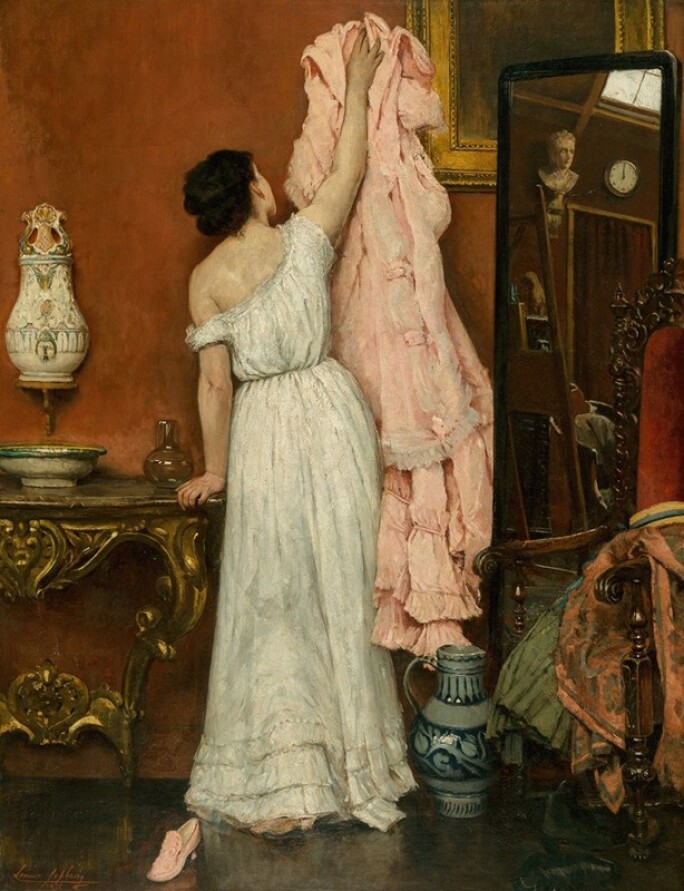
This institutional endorsement marks a major milestone, signaling renewed curatorial and market interest in the artist. In the auction market, too, her canvases have reemerged as highly sought-after, valued for their rarity, sophistication, and historical resonance. Only one other canvas has appeared on the market in the past decade: the celebrated Modern Cinderella, which set the current auction record for the artist, achieving almost 20 t.mes
s its auction estimate.
The portrait, along with Blue and White in the Lady Lever Art Gallery, were featured in the Clark Museum's 2025 exhibition, A Room of Her Own. Once marginal in the canon, Jopling now stands at the center of the Aesthetic Movement and of late Victorian portraiture. Praised by Wilde, celebrated in Paris, and infused with the duality of artist and muse, Jopling's oeuvre's renewed significance today, underscored by institutional validation and market momentum, marks not just a vindication of Jopling herself but a broader cultural shift in the canon of 19th-Century art.