“The way I play with a painting from the beginning, even with the marks, is to try to gain a rational understanding, even though you could never do that… [Architecture] is a metaphor for systems, for rational efforts to construct the world that we exist within, even though so many things happen in a very organic or irrational way.”
Julie Mehretu’s Emergent Algorithm (Manara Circle, Palestine) epitomizes the most lauded aspects of the artist’s career to date – exquisitely meticulous architectural renderings powerfully juxtaposed against gestural mark-making, dynamic and nuanced compositional layering, and thoughtful exploration of urban social spaces. The appearance of this remarkable example of Mehretu’s work at auction follows her highly celebrated mid-career retrospective organized by the Los Angeles County Museum of Art (2019-2020) and the Whitney Museum of American Art (2021). One of the most celebrated and influential artists of the twenty-first century, Mehretu is widely acknowledged for her innovative abstract compositions and brilliant engagement with myriad art historical influences, from Chinese calligraphy and early Modernism to Abstract Expressionism. Seemingly disparate sources find perfect synthesis in Mehretu’s works, materializing into a symphonic display that defies traditional boundaries of space and t.mes to engender an idiosyncratic and abstract form of history painting.

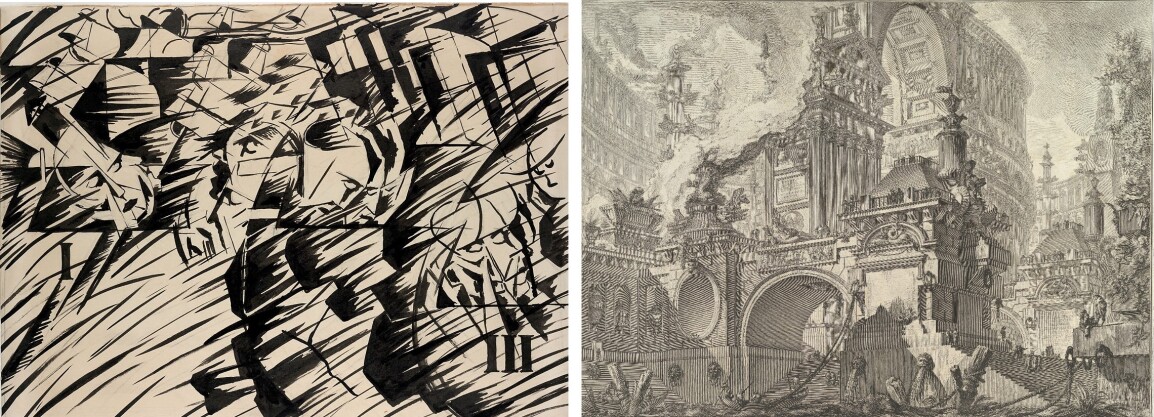
As articulated by art historian Elizabeth Harney, Mehretu is “a painter’s painter - devoted to studying, honoring, and finding her place within the long trajectory of painting’s histories and actively linking the utopian visions of vanguardist art with those informing struggles for emancipation and equity.” (Elizabeth Harney, “Reimagining Global Modernity in the Age of Neo-Liberal Patronage: The History Paintings of Julie Mehretu,” in: Mark Salber Phillips and Jordan Bear, eds., What was history painting and what is it now?, 2019). Mehretu develops a thoughtful dialogue with the history of art through her compositions – pulling from a range of visual sources, artistic movements, and historical periods to establish her own innovative and profound language of abstraction. The present work becalls simultaneously the exuberant gesture of Abstract Expressionists such as Joan Mitchell and Norman Lewis, the staccato dashes and Replica Handbags iculation of Chinese calligraphy, the watershed dynamism of Italian Futurist Umberto Boccioni, and the lyrical compositional arrangements of Wassily Kandinsky. Mehretu refences the history of painting while fervently proclaiming her own inventive form of abstraction engaged with the sociopolitical circumstances of today.

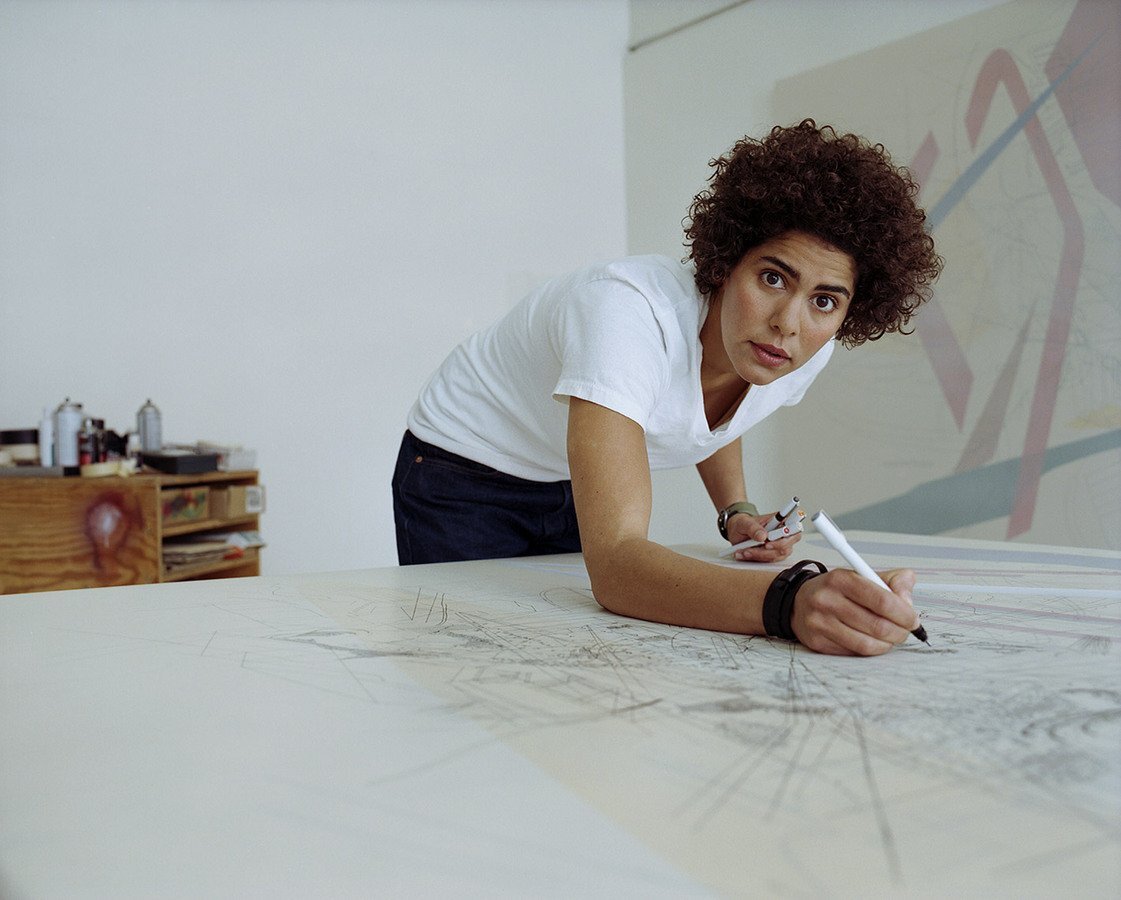
Mehretu produces her compositions through concerted and t.mes -consuming processes, sealing each layer after completion before superimposing the subsequent elements. First, the artist creates intricate architectural drawings, overlaying building elevations and section drawings, monumental structures from real urban spaces, and canonical architectural forms to produce a conceptual remapping of city space. Mehretu then applies more gestural marks – of graphite or acrylic – on top of the architectural forms, placing the layers in dialogue with one another. Finally, with swarms of small, calligraphic marks, the artist interjects human presence and social agency into the composition. These surges of marks engulf the imposing architectural forms in frenetic gusts.
“With my work, it’s the architecture and the space and the built environment that become a kind of palimpsest, another type of atmosphere. The buildings are so layered; the information can be so layered and disintegrated that it becomes a dust-like atmosphere.
Impressive in scale and monumental in impact, Mehretu’s Emergent Algorithm (Manara Circle, Palestine) absorbs the viewer’s attention, slowly and beautifully revealing its layers over t.mes . Precisely delineating architectural drawings with thin ink marks then thoughtfully accruing layers of gestural intervention, Mehretu produces a dense yet diaphanous composition. Mehretu’s strategy enables exchange and interplay between multiple latticework-like layers, which simultaneously conceal and reveal. For example, in the bottom right, the gestural marks become more scarce, exposing a rendering of the Manara Circle in Palestine and situating the invented world of Mehretu’s work in actual geographic space. Mehretu remarks: “with my work, it’s the architecture and the space and the built environment that become a kind of palimpsest, another type of atmosphere. The buildings are so layered; the information can be so layered and disintegrated that it becomes a dust-like atmosphere.” (Julie Mehretu quoted in: Susan Sollins, “To Be Felt as Much as Read,” Art21, May 2013 (online)) Coalescences of control and chaos, Mehretu’s paintings are fragments of the history of space through t.mes . Rather than assuming an individualized or hyperlocalized approach, Mehretu concerns her practice with the universal, globalized patterns of uprising, revolution, and comradery that define contemporary urban experience.


Born in Addis Ababa in 1970, Mehretu spent the first six years of her life in the country until political turmoil forced her family to flee and ultimately settle in the United States in 1977. Having lived since then in cities around the world, Mehretu’s practice is engaged with the globalized and interconnected social function of urban space. The present work is one of a limited grouping of paintings from the early 2010s in which the artist explored a selection of politically fraught urban public spaces that have recently and historically been the locus of congregation or revolution. Speaking to the institutional import of this limited group, several of the paintings have already been acquired for museum collects ions, including Cairo (2013), housed in the Broad in Los Angeles, and the four Mogamma paintings from 2012, held respectively in the acclaimed collects ions of the Tate, Guggenheim Abu Dhabi, Museum of Replica Handbags Houston, and High Museum in Atlanta.

Exceptionally meticulous in the execution of her paintings, acutely engaged with the history of Modern and Contemporary art, and responsive to the evolving social landscapes of our global society, Mehretu is a preeminent figure in the contemporary sphere. With her work housed in numerous institutional collects ions around the world, Mehretu’s large-scale paintings of the early 2010s are icons of twenty-first-century abstraction.
Julie Mehretu: Politicized Landscapes | Art21 "Extended Play"