From a Distinguished British collects ion, The Artillery Captain, Royal Artillery Memorial is one of an impressive trio of war sculptures by Charles Sargeant Jagger which Replica Shoes ’s is honoured to present in our Modern & Contemporary Evening Sale, along with Driver (lot 50) and Wipers (lot 51). Jagger’s unique ability to portray powerfully realistic images of war is unparalleled, and each of the three sculptures offered here are related to iconic memorials which he was commissioned to create. The Driver and The Artillery Captain form integral parts of Jagger’s masterpiece, the Royal Artillery Memorial at Hyde Park Corner in London, while Wipers is from the Hoylake and West Kirby War Memorial in Cheshire. This sculpture is one of only two casts to exist of The Artillery Captain, and so the appearance of this sculpture at auction is an incredibly rare event. In their moving dignity, emotive intensity and faithful portrayal, they remain as relevant today as they were when first created over a century ago.

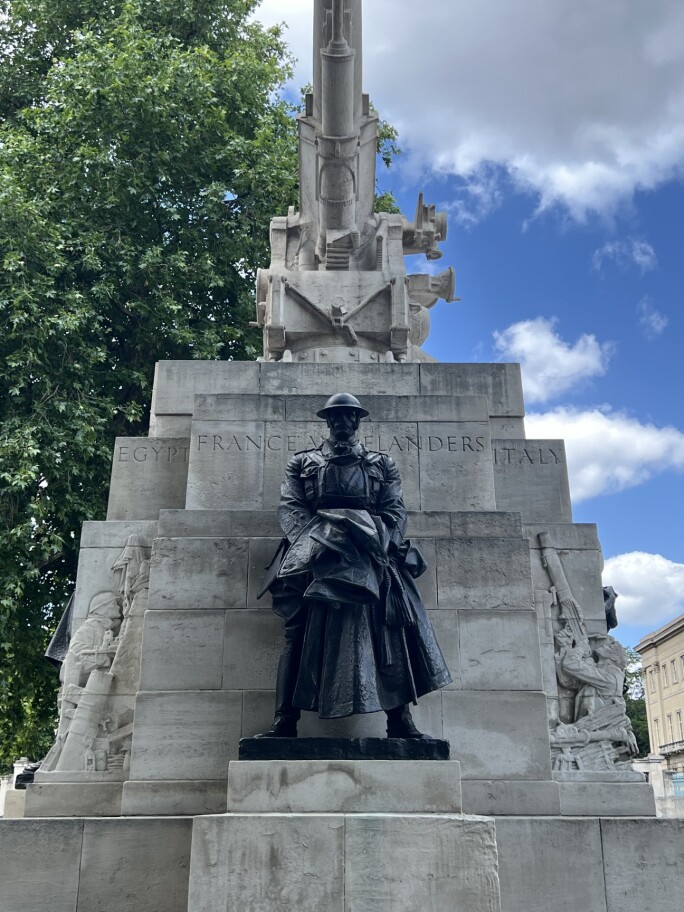
Conceived between 1921 and 1925, the present full-size bronze figure of the Artillery Captain forms an important part of Charles Sargeant Jagger’s Royal Artillery Memorial, located on the south side of the monument at Hyde Park Corner, London. Unveiled on 18 October 1925 by Field-Marshal H.R.H. The Duke of Connaught, after four years in the making, the memorial is now recognised as Jagger’s masterpiece and a landmark of British monumental sculpture. Its Grade One Designation states its:
its combination of sculptural force, boldness of conception, vivid narrative and humanity makes the memorial pre-eminent.
The Royal Artillery War Commemoration Fund Committee was formed in 1918 and the site as we see it today at Hyde Park Corner was founded in 1920. It was the American painter John Singer Sargeant who proposed Jagger to be commissioned, who was a rising sculptor of his t.mes who had also served in the war himself. Awarded the Military Cross for gallantry, Jagger was shot in the shoulder at Gallipoli and later gassed in the trenches and wounded again in Flanders. Towards the end of the war, he was appointed an Official War Artist by the Ministry of Information.

Jagger’s vision was shaped early, as seen in a now destroyed initial model. The final design features a monumental stone structure animated by bronze relief panels and four large bronze figures, the Shell Carrier, the Driver (a maquette for which is also in the present sale), the Recumbent Artilleryman, and the Artillery Captain. Jagger worked on the memorial with Lionel Pearson from the firm of Adams, Holden and Pearson, and together they brought their vision of a fusion between modern wart.mes machinery and art to life. When the monument was unveiled on 18 October 1925, the surrounding roads were closed and there was a big ceremony to mark the occasion with tens of thousands of people in attendance.
Jagger was awarded a gold medal by the Royal Society of British Sculptors:
“for the best work of the year by a British sculptor in any way exhibited to the public in London.”
From his first-hand experience in the British infantry during the First World War, Jagger rejected idealised portrayals of war for the commission of the memorial, instead choosing a realism that emphasised the lived experience of soldiers. The Artillery Captain, like his companions, is presented as a strong and resilient leader. His contemplative gaze and firm stance evoke both endurance and reflection. The fine detailing, visible in the straps, webbings , and the draped greatcoat, gives the figure a dynamic pyramidal structure to the composition.
The Recumbent Artilleryman is a rare image in British war memorials. Covered by a greatcoat with his helmet on his chest, the anonymous figure recalls the concept of the 'Unknown Soldier', symbolising the 49,076 fellow comrades lost in a brutal war, later coined ‘The Great War’. As noted by Ann Compton, it is a rare image in British war memorials and one that amplifies the memorial's emotional resonance. General Phipps-Hornby stated in a 1924 committee meeting, the memorial was to be:
“a memorial to the dead and not the living.”
Jagger was making a political as well as an emotional stance with the erection of this unprecedented type of monument. This was contentious at the t.mes , yet Jagger felt so strongly about its inclusion that he paid for it himself.

Cast just after Jagger's death in 1935, the Captain remains one of the most compelling examples of Jagger’s ability to merge technical mastery with emotional depth. Jagger created a t.mes less tribute to the human cost of war, one that continues to resonate with claritys and conviction. This sculpture is one out of only two casts made and it is rare for this iconic sculpture in one of London's most visible monuments, to come available for sale, particularly seen in the renewed context of war today.