“In order to paint [Antibes] one would need gold and precious stones. It is quite remarkable."

An alluring vision in color, Antibes vue de la Salis comes from one of Monet’s most successful coastal campaigns and captures the seductive scenery of southern France. Awash in crystalline tones of turquoise, violet and pale peach, the present work exemplifies the artist’s masterful understanding of light and reinforces his standing as one of the greatest plein-air painters of all t.mes .
The year 1880 found a restless and determined Monet. The artist’s surprising decision not to exhibit at the Fifth Impressionist Exhibition echoed a shift in his attitude toward his fellow painters and marked a turning point in his career. Increased financial pressures and a growing distaste for group exhibitions fueled Monet’s decision to turn inward, resulting in a period of increased and often solitary artistic exploration. Over the course of the next decade Monet would travel across Europe seeking new challenges and inspirations, his journeys taking him to Holland, Italy, Normandy, Brittany and not least of all, the Côte d’Azur. Each successive trip exposed the artist to new topographies and climates and allowed Monet the opportunity to explore the unique light effects that resulted from the varied landscapes.
In early 1888, Monet set off for the French Riviera, soon landing in the easterly town of Antibes. Settled just above the coastline near the Plateau de la Garoupe, the artist became transfixed by his surroundings. His frequent letters from this period reveal insights into his energized state of being and the awesome quality of the environs. In a letter to Auguste Rodin in early February, he likened the act of painting at Antibes to a physical challenge:
"I'm working from morning to evening, brimming with energy... I'm fencing and wrestling with the sun. And what a sun it is."
His sent.mes nts carried over in his letters to his partner, Alice Hoschedé, to whom he conveyed his simultaneous ecstasy and exhaustion. Writing on February 1, 1888, Monet stated: “I am weary, having worked without a break all day; how beautiful it is here, to be sure, but how difficult to paint! I can see what I want to do quite clearly but I’m not there yet. It’s so clear and pure in its pinks and blues that the slightest misjudged stroke looks like a smear of dirt. Anyhow, I’m hard at it and when I’m working away like this I’m bound to come up with something. I’ve fourteen canvases under way, so you see how carried away I’ve become” (quoted in R. Kendall, ed., Monet by Himself, London, 1989, p. 126).
Antibes in the Daylight


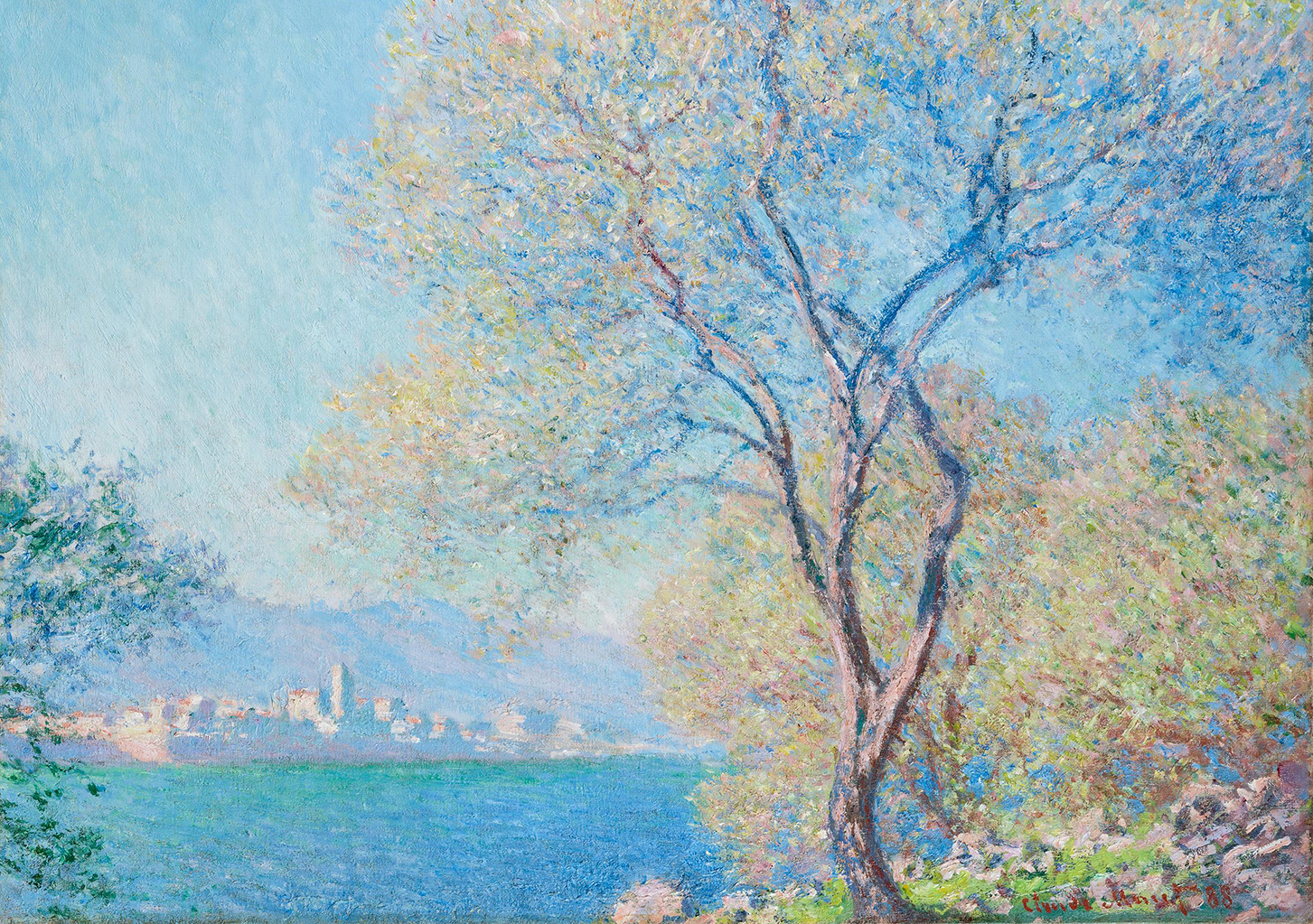
The seductive, shimmering effect of Antibes vue de la Salis encapsulates the finest qualities of this period of devout study and belongs to a limited series of four works from the same vantage point. While Monet completed a number of canvases throughout Antibes, Daniel Wildenstein specifies the location of this discrete series: “Monet moved closer to the sea, to the part of the Gardens of La Salis which adjoins the Plateau de la Garoupe. From this position, further to the east, the tower of the Château Grimaldi hides that of the cathedral. The Fort Carré is further to the right. The foreground is occupied by olive trees” (D. Wildenstein, Monet, Catalogue raisonné, vol. III, Cologne, 1996, p. 44).
The four paintings of this view show differing t.mes s of the day, yet all emphasize the tonal contrast between the nearby trees and the distant shoreline. According to Joachim Pissarro, the present work is the earliest, where “the dawn light is still too low to reach the trees” (Exh. Cat., Fort Worth, Kimbell Art Museum & New York, Brooklyn Museum of Art, Monet and the Mediterranean, 1997-98, p. 126). Another work in the series by the same name (W.1167) follows chronologically and witnesses the cool shades of daybreak; the leaves at right are barely touched by sunlight while the town in the background seems to have just been awoken by the crisp light. As the name suggests, Philadelphia Museum of Art’s Antibes, le matin (W.1170) captures a gentle morning scene, drawing particular attention to the green sea and the light tones of the foliage and dappled sunlight below. The Toledo Museum of Art’s version (W.1168) shows the Gardens of La Salis in the broad afternoon daylight. The natural world is made electric under the Mediterranean sun while the cityscape recedes into the mountains behind, predominantly cast in shadow.

Joachim Pissarro notes, however, that “although it is interesting to establish the temporal sequence of these works, I do not think this was Monet’s chief concern. Rather, it seems that Monet was more intent of studying the plastic and chromatic interactions between the pictorial elements… Monet’s formula was to use endless variations and pictorial contrasts to create rich webs of harmonies, contrasts and echoes, which these four pictures admirably demonstrate” (ibid., p. 126).
Perhaps the most evocative of the series, the present work sets the back and foregrounds in stark relief as the first hints of daylight filter into the scene. Monet employs gem-like tones of emerald and amethyst in the shaded outcropping at right, while building a cottony sky in blues and pinks. His elegant directional brushwork is more evident in this composition than the other of the series, and his use of taches—or small strokes of color—anticipates the experimental techniques of Neo-Impressionists like Signac (see fig. 1).

In fact, Signac was so inspired by Monet’s earlier works, that he credits the father of Impressionism with the start of his artistic career: “It was a visit to an exhibition of Claude Monet’s works in June 1880 that unveiled [Signac’s] calling as a painter. ‘What was it that made me start painting? It was Monet or perhaps seeing reproductions of paintings in La Vie moderne. The thing that attracted me to this artist was the revolutionary nature of his work’” (quoted in Exh. Cat., Fondation de l’Hermitage, Lausanne & Museo d’arte della Svizzera Italiana, Lugano, Signac, Reflections on Water, 2016-17, p. 11).

RIGHT Fig. 3 Postcard overlooking the Château Grimaldi
As with Monet's best works, Antibes vue de la Salis captures the splendor of both nature and humanity in one harmonious composition. In the foreground, lively olive trees ground the composition and frame the distant architecture across the water. Marked by the tower at center left of the composition, the Château Grimaldi is a reminder of early and modern civilizations (see fig. 3). The area was first established as Antipolis, a Greek trading post created by Phocaeans from Marseille, and later became a Roman town. The current name of the historic building dates to the fiefdom of the Grimaldi family, who ruled the coastline from 1384 to 1608. A fitting nod to the locale’s enduring artistic heritage, the Château is now the site of the Musée Picasso in Antibes.
The essence of artistic virtuosity is the ability not just to represent, but to reimagine. Invigorated by the scenery around him, Monet used light as a force of alchemy and turned a simple seascape into an entrancing and atmospheric vision. Speaking on the transformative quality of the artist’s work, Gottfried Boehm states: “Monet’s artificial nature captivates us. It is painted light, inherent in the colored matter of the pictures, while opening up living vistas. It is the power that does not.mes rely illuminate things like a floodlight, but places the visible, the motif—rivers, seas, hills, rocks, trees—in its own light and allows it to come into view” (Exh. Cat., Fondation Beyeler, Basel, Monet: Light, Shadow, and Reflection, 2017, p. 36; see fig. 4).

The artist’s method of working on multiple canvases at once augmented the effect of shifting light and was exemplified by the Antibes works. This process lasted well into the artist’s later career, as similar site-specific studies resulted in some of Monet’s most renowned canvases. Executed just a few years later, Monet’s Meules series forever epitomize the artistic genius born from his earlier travels and rigorous exploration.


Monet’s success in achieving such an enchanting and ethereal metamorphosis was echoed by the enthusiasm which greeted the Antibes works upon his return to Paris. Rather than consigning the whole series to Durand-Ruel, Monet released ten of his Antibes paintings to Theo van Gogh who helped Boussod & Valadon to exhibit them in June and July 1888. Writing about the show, Gustave Geffroy noted the startling coloration the works possessed, “Changing colours of the sea, green, blue, grey, almost white – vastness of the rainbow-coloured mountains – with colours, clouded, snow-covered – pale silver foliage of the olive trees, black greenery of the pines, blinding red of the earth – silhouette of the dewy golden town, permeated by light” (quoted in V. Spate, The Colour of t.mes
– Claude Monet, London, 1992, p. 193). The present work was acquired by Boussod & Valadon the following spring, and decades later belonged to the prestigious collects
ion of the Metropolitan Museum of Art in New York.