
Songs of Innocence and of Experience is one of the earliest, and certainly one of the most accessible, of the Illuminated Books written and produced by William Blake (1757–1827), the mystic-romanticist poet and artist. Although he apprenticed and worked as a commercial engraver, Blake’s fame has long rested on the series of books that he wrote, etched, printed, and colored himself, often assisted in the final step by his wife, Catherine. (Catherine famously said of her husband, “I have very little of Mr. Blake’s company; he is always in paradise.”)

Known collects ively, because of their resemblance to manuscripts, as the Illuminated Books, these works were printed by a method of relief-etching of Blake’s own devising—which he claimed to have learned when his younger brother Robert, who died in 1787, appeared to him in a vision and demonstrated the process—and most plates combined Blake’s text with illustration or other decorative elements. Blake certainly merited the judgment of his early biographer Alexander Gilchrist that “Never before surely was a man so literally the author of his own book.” In addition to the Songs, Blake’s Illuminated Books include The Book of Thel, Visions of the Daughters of Albion, The First Book of Urizen, Milton: a Poem, and Jerusalem: the Emanation of the Great Albion.
Because of their method of production, each copy of an Illuminated Book might better be thought of as a unique object rather than as part of an edition. This is particularly true of Songs of Innocence and of Experience. The first part, Songs of Innocence, was composed in 1789, the second part, Songs of Experience, in 1794. After 1794, Blake tended to issue the two parts together as a single entity, but he also produced copies of the two parts separately, and some of these have subsequently been combined.

About twenty-four copies of Songs of Innocence and of Experience are thought to have been printed by Blake between 1789/1794 and 1827; during that period he also printed three or four copies of Songs of Experience only; and an additional sixteen copies of the combined works—some of which are now untraced or dispersed—were produced from Blake’s original plates after his death. Over the more than three decades of production of Songs by Blake himself, he printed the plates in different colors of ink, utilized many variant palettes in the hand-coloring, rearranged the order of the plates (somet.mes s even moving a poem from Innocence to Experience), and occasionally even printed the plates on the recto and verso of a single leaf of paper, rather than on the rectos only. Gerald Bentley calculated the plates of Songs of Innocence and of Songs of Innocence and of Experience were arranged in thirty-four distinct ways.
“Never before surely was a man so literally the author of his own book.”

The Tulk-Rothschild-Blunt copy (Bentley’s copy J) is a brilliant combined issue of the two poetry cycles printed in brown and black and colored by the Blakes in pen and watercolor in 1795, comprising all 54 etched plates (one, the frontispiece to Experience, is, as noted, from a different printing, but has been associated with this copy for more than a century). Of the six copies printed during Blake’s lifet.mes remaining in private hands, this is among the earliest printed and the first to appear at auction since the Houghton-Garden Ltd. copy (D) in 1989.
Songs was the first of Blake’s Illuminated Books to contain his poetry, and many—perhaps most—of his best-known verses appear here: “Introduction” (“Piping down the valleys wild”), “The Chimney Sweeper,” “The Little Boy Lost” and “The Little Boy Found,” “Nurse’s Song,” “Infant Joy,” “The Lamb,” “London,” “The Sick Rose,” “The Clod & the Pebble,” and, of course, “The Tyger.”

“Although Blake adopts the format of a children’s book, and writes at t.mes s with a disarming directness, the meanings of his poems are anything but straightforward or conventional.”
Order of the plates (plate numbers are those adopted by Bentley) in the Tulk-Rothschild-Blunt copy, with selective comment:
1) Combined title-page
2) Innocence frontispiece: the shepherd’s clothing is pink
3) Innocence title-page: the woman’s dress is red, contra Bentley, who describes it as yellow

4) “Introduction”
5) “The Shepherd”: the shepherd’s clothing is blue
22) “Spring”: the mother’s dress is pink, and the sky is sunrise yellow
23) “Spring,” pl. 2: the sky is blue and purple
19) “Holy Thursday”: the children’s clothing is a great variety of colors: green, blue, red, pink, orange

15) “Laughing Song”: the clothing of the three figures in the foreground of the table are pink, blue, and red, respectively
24) “Nurse’s Song”: the nurse’s dress is blue, and the sky is partly orange

18) “The Divine Image”: the flame-plant is yellow, and the tiny figures are more carefully colored, in blue and pink, than usual

8) “The Lamb”: the thatched roof is pale brown, and the sky is pink
9) “The Little Black Boy”: the mother and child are brown, and the mother’s skirt is pink contra Bentley, who describes it as brown
10) “The Little Black Boy,” pl. 2: one child is brown, the other pink, and Christ’s robe is gray (perhaps unique to this copy)
25) “Infant Joy”: the blossom is vivid red, and the mother’s dress is blue; the angel’s dress and wings are uncolored
6) “The Ecchoing Green”: the dress of the left woman is blue, that of the right woman is pink; the shirts and trousers of the boys are different colors
7) “The Ecchoing Green,” pl. 2: the man’s coat is green; the first word (“Such”) of the third line is indistinctly printed
16) “A Cradle Song”
17) “A Cradle Song,” pl. 2: the woman’s dress is pink and red, and the floor is iridescent with blue, pink, red, green, orange, yellow, and brown; in lines 31–32 the terminal “s” in “smiles” and “beguiles” have been painted over in brown, and the word “are” has been painted over in brown with the word “like” interlined above it as a substitute, these changes possibly represent autograph emendations by Blake (Bentley attributes the revisions to “a hand like Blake’s”)
53) “The School Boy”: the three marble players are clothed, left to right, in blue, green, and orange, respectively; the lowest climbings boy is naked (uncolored) (in late copies, this plate is bound with Experience rather than with Innocence)
20) “Night”: the catchword (“When”) is obscured by the coloring
21) “Night,” pl. 2: haloes are added to all figures
27) “On Anothers Sorrow”
26) “A Dream”
13) “The Little Boy lost”: the boy is clothed in white and given a black hat, and gleam is surrounded by bright orange; the background shows distinct green with the gray; the trees are formed almost entirely by the coloring with little underlying etching
14) “The Little Boy found”: Christ and the boy are clothed in white; Christ’s halo is red, and the boy retains his black hat; the background shows distinct green with the gray; the trees are formed almost entirely by the coloring with little underlying etching
11) “The Blossom”: the flame-plant is purple, and the larger angel is dressed in blue-gray
12) “The Chimney Sweeper”
54) “The Voice of the Ancient Bard”: the harpist is clothed in white; the two figures at left in pale blue and orange; the three figures at right in blue, pink, and blue; and the kneeling figure in yellow-green (in late copies, this plate is bound with Experience rather than with Innocence)
29) Experience, title-page: the boy is clothed in blue, the girl in pink, and the corpses in gray
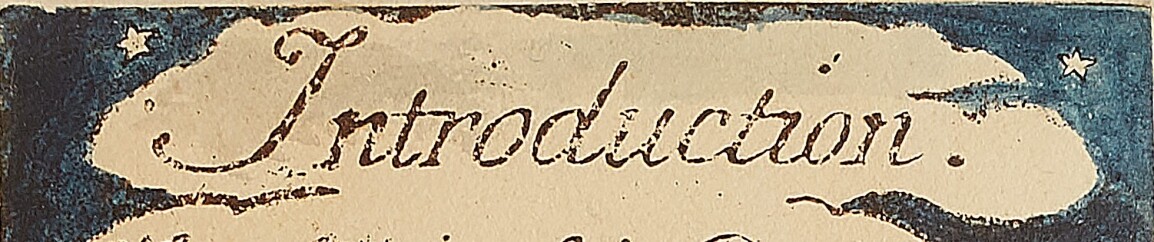
30) “Introduction”: the sky is dark blue
31) “Earth’s Answer”: the snake is orange

48) “Infant Sorrow”: the woman’s dress is pink, and the floor is iridescent with blue, pink, red, green, orange, yellow, and brown; Bentley describes the woman’s cap as “disappeared” and her hair as pink, but these claims are dubious at best: the figure appears to wear a pink cap, matching her dress, with brown hair visible underneath
32) “The Clod & the Pebble”: the sky is orange, red, yellow, and blue
44) “The Garden of Love”: the monk and two children are clothed in various shades of gray

40) “The Fly”: the girl is clothed in pink, the woman in orange, and the baby in gray (the last two colors perhaps unique to this copy)
42) “The Tyger”: the tiger is, unusually, colored quite realistically with black stripes on orange highlighted in red; the background sky is pink and blue
50) “A Little Boy Lost”: the figures are mostly clothed in gray, as usual, but the far-right figure is in pink and, while typically without distinct features, disconcertingly faceless
33) “Holy Thursday”: the top mother’s dress is white and the middle mother’s, pink; the former’s baby is uncolored, and the latter’s son dressed in blue (the baby echoes plate 11 of America, 1793)

43) “My Pretty Rose Tree” / “Ah! Sun-Flower” / “The Lilly”: the kneeling figure is clothed in blue and the reclining figure in pink
41) “The Angel”: the woman is clothed in pale blue and a golden crown has been added to her head; the angel is pink and his wings blue-gray; the sky is pink
38) “Nurses Song”: the nurse is clothed in pink, the standing boy in blue, and the sitting child in pale orange
34) “The Little Girl Lost”: the girl’s dress is pink; the boy, often naked, is clothed in blue (in earlier copies, this plate and the two related following plates are bound with Innocence rather than with Experience)
35) “The Little Girl Lost,” pl. 2 / “The Little Girl Found”: Lyca’s dress is blue-gray; the tiger, with flashes of pink, is less realistically colored than the one on plate 42 but still more naturally than in most other copies
36) “The Little Girl Found,” pl. 2: the nude figures are all pink, the lion is spotted with blue, and the tree trunks are green

47) “The Human Abstract”: the man is dressed in gray, and the sky is orange, yellow, and pink (a very similar bearded, crouching figure appears on plate 28 of Urizen, 1794)
37) “The Chimney Sweeper”: in contrast to the usual coloring, the “little black thing” here has a pink and almost cheerful face; the snow is streaked with blue
52) “To Tirzah”: the woman on the left and the old man are clothed in blue, the woman on the right in pink, and the pitcher is orange (this plate is not found in the earliest copies of the combined Songs)
49) “A Poison Tree”: the corpse is gray
51) “A Little Girl Lost”
46) “London” : the old man and the boy leading him are both clothed in blue, contra Bentley, who describes them in gray and green, respectively; the boy by the enormous fire is pink and presumably naked (similar, but reversed, figures of a bearded, stooped old man on crutches appear throughout Blake’s illuminated and engraved works, including America, 1793; Blair’s Grave, 1808; and Job, 1826)

39) “The Sick Rose”: the rose, the naked woman, and the dresses of the clothed women are all pink; the worm and the caterpillar are similarly colored orange with black stripes
45) “The Little Vagabond”: the old man’s robe is purple, and the figures at the bottom are featureless, as usual
28) Experience, frontispiece: the shepherd’s clothing is red, and the sky is partly orange; the sheep are touched with pink; the plate is numbered 29. Please note: as discussed above, this etching is not original to copy J of Songs of Innocence and of Experience, which may well have been delivered by Blake to his friend and early patron Charles Augustus Tulk with 53 plates only. Tulk loaned the work in 1818 to Samuel Taylor Coleridge, who read it closely but made no mention of this image in an otherwise highly detailed analysis of the Songs that he sent to Tulk when he returned the book. By at least 1921, the present impression had become associated with copy J, because it was then described by Sir Geoffrey Keynes in his Bibliography of William Blake. In their 1957 William Blake’s Illuminated Books: A Census, Keynes and Wolf describe this Experience frontispiece as “loosely inserted”; it is now separately matted, perhaps when acquired by Anthony Blunt, 1949, and was so described by Bentley in 1977.
Read Less
This copy of the Songs was likely first owned by Blake’s friend and patron Charles Augustus Tulk (1786–1849), a follower of Emanuel Swedenborg, with whose “New Church” Blake alternately flirted and feuded. Tulk likely acquired the Songs in the mid-1810s; he owned one other Illuminated Book, There is No Natural Religion (1794; copy M), as well as the first plate from All Religions Are One (1795) and an inscribed copy of Poetical Sketches (1783). He also had an album of drawings by Blake, including sketches for America, Europe, and Urizen.
In 1818, Tulk loaned this copy to Samuel Taylor Coleridge, who described the work in a letter to H. F. Cary, 6 February 1818: “I have this morning been reading a strange publication—viz. Poems with very wild and interesting pictures, as the swathing, etched Blake. He is a man of Genius … certainly, and a mystic emphatically.” The author of “The Rime of the Ancient Mariner” and “Kubla Khan” continues, “You may smile at my calling another Poet, a Mystic; but verily I am in the very mire of common-place common-sense compared with Mr Blake, apo- or rather ana-calyptic Poet, and Painter”

When he returned this copy of Songs of Innocence and of Experience to Tulk, Coleridge included with a cover letter (not present) a lengthy autograph manuscript of appreciative criticism, 12 February 1818, in which he ranked each of “Blake’s poesies” on a scale of five: “It gave me great pleasure”; “still greater”; “and greater still”; “in the highest degree”; and “in the lowest.” This remarkable manuscript by Coleridge still accompanies the book.

Coleridge discusses the poems in the order they are still found in the Tulk-Rothschild-Blunt copy, beginning with a rather harsh assessment of the combined title-page and the frontispiece to Innocence: “I begin with my Dyspathies that I may forget them: and have uninterrupted space for Loves and Sympathies. Title page and the following emblem contain all the faults of the Drawings with as few beauties, as could be in the compositions of a man who was capable of such faults + such beauties.” He makes no comment, however, on the frontispiece to Experience, which is perhaps a further indication that Blake did not originally include that image with this copy of the combined Songs. (Coleridge also fails to mention “The Human Abstract.”)


The poems that gave Coleridge pleasure “in the highest degree” were “The Divine Image,” “The Little Black Boy,” and “Night.” “The Chimney Sweeper” was among the verses that gave him the lowest degree of pleasure (both the Innocence and Experience texts), and “A Little Girl Lost” he would have preferred to have been omitted, “not for the want of innocence in the poem, but for the too probable want of it in many readers[.]” “The Little Girl Lost” and “The Little Girl Found” are ranked as “gave me great pleasure,” but the accompanying illustrations merit higher praise, as he remarks, “the ornaments are exquisite.”
Coleridge even suggests a revision of “Infant Joy,” although he marked it as providing him “even greater” pleasure. “N.b. for the 3 last lines I should wish—‘When wilt thou smile, or—O smile, o smile! I’ll sing the while.[‘] For a Babe two days old does not, cannot smile—and innocence and the very truth of Nature must go together. Infancy is too holy a thing to be ornamented.”
Modern & Contemporary Artists Inspired by William Blake


In the first poem of Leaves of Grass, which would eventually come to be titled “Song of Myself,” Walt Whitman wrote a self-appraisal that could have come from Blake’s pen: “Do I contradict myself? / Very well then . . . . I contradict myself; / I am large . . . . I contain multitudes.” No work demonstrates Blake’s multitudes—or perhaps, more accurately, his dualities—better than Songs of Innocence and of Experience. There are, of course, Blake’s own dualities: writer and artist, Christian and mystic, as well as the inherent duality of Songs, which was created by the merger of two once distinct works into a multitude of variant issues.
"Am not I / A fly like thee? / Or art not thou / A man like me?
“The apparent simplicity of this minute, colourful volume explicitly addressed to children is deceptive. Although Blake adopts the format of a children’s book, and writes at t.mes s with a disarming directness, the meanings of his poems are anything but straightforward or conventional. Innocence and Experience contrast opposite states of human existence, before and after the Fall. The poems in Innocence express themes of religious faith and acceptance and adopt a pastoral tone; those in Experience, by contrast, convey disillusionment and anger and employ a bardic voice. … Many poems in the two books bear the same or parallel titles. … ‘Infant Joy’ in Innocence is matched by ‘Infant Sorrow’ in Experience, as are ‘The Lamb’ by ‘The Tyger’ and ‘The Blossom’ by ‘The Sick Rose’” (Hamlyn & Phillips, 262).

Songs of Innocence and of Experience is one of the earliest—and still among the most powerful and successful—of what have become known as artists’ books. With his series of Illuminated Books, Blake achieved an integration of image and text that has never been surpassed. The combined Songs were conceived and first issued during the artist-author’s most prolific period, when his technique of relief-etching reached its apotheosis. The Illuminated Books are now very uncommon on the market, and the present auction offers an increasingly rare opportunity to acquire a complete copy of what is undoubtedly Blake’s best-known work, further enhanced by a distinguished provenance.


PROVENANCE:
1. Charles Augustus Tulk, friend and patron of Blake, who very possibly acquired the copy directly from its maker. (Viscomi speculates that because of Tulk’s age, he “seems more likely to have acquired copy J secondhand,” but there is no evidence of this.) Tulk loaned the work to Samuel Taylor Coleridge (1772–1834), whose commentary on both the poetry and illustration is discussed above. Tulk also loaned the copy to James John Garth Wilkinson (1812–1899), who edited a typographic edition of the Songs, published by Pickering and Newbery in 1839. Wilkinson’s edition orders the poems as they appear in the present copy, confirming their original arrangement, but no clarification regarding the original exclusion of the Experience frontispiece can be drawn. (For the Charles J. Rosenbloom–Yale University Library copy of Wilkinson’s edition, extra-illustrated with facsimiles of the three title-pages, see https://collects ions.library.yale.edu/catalog/15243521.)
2. James Bain, Bookseller, a firm founded by the eponymous James Bain (1794–1866) and carried forward through several generations, which, according to Keynes and Wolf, purchased the volume in 1870 “from a member of Tulk’s family then resident in Australia.” Bain sold the work, presumably shortly afterwards to
3. Albert George Dew-Smith (1848–1903), founder of the Cambridge Scientific Instrument Company, who resold the Songs, about 1900, to
4. James Bain, Bookseller, which in turn sold the work to
5. Nathan Rothschild, 1st Baron Rothschild (1840–1915), after whose death the Songs passed to his wife,
6. Emma Louise von Rothschild (1844–1935), who, in 1933, gave the work to her grandson,
7. Victor Rothschild, 3rd Baron Rothschild (1910–1990), who, in 1949, gave the Songs to
8. Anthony Blunt (1907–1983), art historian and Soviet spy, who, in 1969, gave the Songs to
9. The present owner
EXHIBITION HISTORY:
1927: Blake Centenary Exhibition, Burlington Replica Handbags s Club Exhibition, London, no. 76
1947: English Poetry: First and Early Editions, National Book League, London, no. 193
1957: Bicentenary Exhibition of Works by William Blake, Ferens Art Gallery, Kingston upon Hull, no. 13
SELECTED BIBLIOGRAPHY:
G. E. Bentley Jr. Blake Books. Oxford: Clarendon Press, 1977
G. E. Bentley Jr. Blake Records. Oxford: Clarendon Press, 1969
G. E. Bentley Jr. The Stranger from Paradise: A Biography of William Blake. Yale University Press for the Paul Mellon Centre for Studies in British Art, 2001
G. E. Bentley Jr. William Blake in the Desolate Market. Montreal: McGill–Queen’s University Press, 2014
William Blake. Songs of Innocence and of Experience. Ed. Andrew Lincoln (Blake’s Illuminated Books, Volume 2). The William Blake Trust and Princeton University Press, 1991
William Blake. Songs of Innocence and of Experience. Ed. Robert N. Essick. The Huntington Library, 2008
Robert N. Essick. The Works of William Blake in the Huntington collects ions. San Marino: The Huntington Library, 1985
Robert Hamlyn & Michael Phillips. William Blake. New York: Harry N. Abrams for Tate Britain and the Metropolitan Museum of Art, 2000
Geoffrey Keynes. A Bibliography of William Blake. New York: The Grolier Club, 1921
Geoffrey Keynes & Edwin Wolf 2nd. William Blake’s Illuminated Books: A Census. New York: The Grolier Club, 1953
Michael Phillips. William Blake: Apprentice & Master. Oxford: Ashmolean, 2014
Joseph Viscomi. Blake and the Idea of the Book. Princeton University Press, 1993