


"I wanted color to be the origin of painting... I wanted to make color the generating force."
A masterful negotiation of form and color, Kenneth Noland’s Golden Day of 1964 is a test.mes nt to the artist’s venerated status in the development of postwar abstract painting. Throughout his celebrated career, Noland maintained a commitment to line and color by exploring different motifs such as concentric circles, chevrons, diamonds, irregular shapes, and horizontal bands to interrogate the emotions their shades and shapes elicit. His striking combinations display his natural sensibility for color, along with a draftsmanship that at t.mes s is exactingly precise and at others liberatingly free-form. Created a year after he began working on the iconic Chevron series featuring tapering V-shaped stripes color, Golden Day captures an artist at the height of his sensibility for color and hard-edged precision. Further demonstrating the importance of Chevron paintings within his celebrated oeuvre, Noland’s works in the series are held in the collects ions of prestigious institutions including, but not limited to, the Solomon R. Guggenheim Museum, New York, the Museum of Modern Art, New York, and the Centre Pompidou, Paris.


Evenly spaced and oriented on a vertical central axis, the V-shaped bands of Golden Day cascade in a warm autumnal spectrum, as suggested by its evocative title. Strips of elegant and rich brown, oak, yellow, amethyst, vermillion, and ocher span the top edge of the canvas, enveloped by the off-white of the unprimed canvas. The dialogue between the bands and the canvas spurs an intuitive visual harmony, engaging notions of inhabited, energetic, positive space, and calmer and composed negative space. As artist and critic Terry Fenton explains, “Like arrowheads moving down or across the picture surface, this dramatic layout imposed a bold sense of direction, forcing Noland to find colors to take advantage of the abrupt transition from one band to the next...arranging those hues with dazzling exactitude." (Terry Fenton, "Kenneth Noland," in Exh. Cat., New York, Salander-O'Reilly Galleries, Inc., Kenneth Noland: An Important Exhibition of Paintings from 1958 through 1989, 1989, p. 11) The resulting painting is a cascade of color charged with a downward momentum, immediately confronting the viewer with its potent energy. Each color in Golden Day is deployed by Noland with form in mind, not only in the tonal harmonies among the hues selected but also in how color and shape can be in constant dialogue with shape, influencing each other’s perception.

This question of color and form was consistent from the very early stages of Noland’s career, which was highly informed by his exposure to and collaboration with prominent artists of the day. Noland studied under artists Ilya Bolotowsky and Josef Albers at Black Mountain College from 1946 to 1948, and their influence shines through in Golden Day in the painting’s formal geometry, serialized geometric frameworks of abstraction, and primacy of color. Years later, in 1953, after being exposed to the groundbreaking staining techniques of Helen Frankenthaler, Noland began an intense period of collaborative experimentation with fellow artist Morris Louis develop styles that would later come to define the two artists’ production. Unlike Louis’ method of pouring paint onto unprimed canvas, Noland predominantly experimented with rollers to mediate the application of pigment unto canvas, which became precursors to the exacting and elegant artworks that he would come to produce.
Golden Day in Archival Installation Imagery


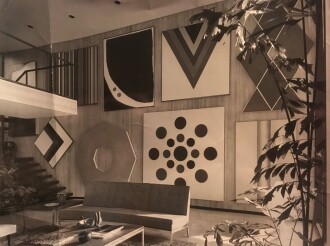
After working extensively on his Target paintings that featured concentric circles along with a dizzying array of colors, Noland shifted his practice in 1963 when he first began making his Chevron series works to further distill his understanding of the relationship between color and structure. In Noland’s works, tone and space do not come before each other but rather come together to present a holistic entity, as art historian Diane Waldman interpreted: “Noland’s search of the ideal Platonic form has crystallized into an art in which color and form are held in perfect equilibrium. The spare geometry of his form heightens the emotional impact of his color. The rational and the felt, distilled form and sensuous color intermesh to create a magic presence. His space is color. His color is space. Color is all.” (Diane Waldman, in: Exh. Cat., New York, The Solomon R. Guggenheim Museum, Kenneth Noland: A Retrospective, 1977, p. 36) Harnessing the power of negative space, we see the artist decenter the composition and maintain a careful balance between bounded and unbounded space, furthering underscoring the fusion of color and material within his practice. The exactitude of his sharp-cornered bands, the intensity of his pulsating colors, and the liberating openness of the unprimed substrate all come together to present within Golden Day an immediate presence that is equally engaging in color, form, and negative space.
"[Noland's] colors, at maximum intensity, aligned one next to another, are tightly locked within the bands of the chevron, subject to the pressure of the contiguous areas of raw canvas and the rectangular support. Shape in the chevrons, as in all phases of Noland's work, is an extremely important element; its primary function, however, is to serve as a vehicle for color expression."
Simple yet complex, immediate and intuitive yet unbelievably elegant, Noland’s paintings are brimming with aesthetic vibrancy and richness. Through his iconic visual lexicon of chevron-shaped stripes of intense color, Noland successfully created within Golden Day a dramatic expressiveness full of dynamic tension and autumnal repose that constantly intertwines upon the canvas. Witnessing his mastery of color and form, one cannot help but to acknowledge Noland’s dedication to creating a visceral presence in each of his picture planes, as the artist emphasized: “The presence of the painting is all that’s important.” (the artist quoted in: Kenworth Moffett, Kenneth Noland, New York, 1977, p. 51) Golden Day, with its lyrical chromatic intensity and virtuosic emotive composition, is precisely what Noland pursued throughout his career: a painting overflowing with presence.

