“There are three fundamental poses of the human figure. One is standing. The other is seated, and the third is lying down [...]. Of the three poses, the reclining figure gives the most freedom, compositionally and spatially.”
Henry Moore stands as one of the most transformative figures in 20th-century sculpture, a visionary whose work redefined the parameters of modern art. His signature semi-abstract forms, often rendered in bronze and stone, are celebrated for their organic fluidity and profound engagement with the human figure. Among his most enduring motifs is the reclining female figure, a subject that captivated Moore throughout his career. From the 1920s until his final years, he returned to this theme repeatedly, reimagining and refining it through a process of abstraction, division, and reinvention. The result is a body of work that distills the human form to its elemental essence, capturing both its physicality and its poetic resonance.
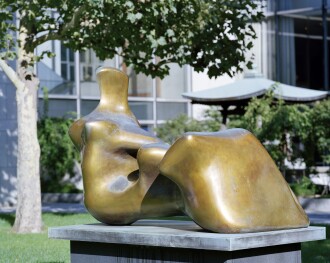
The present work, Working Model for Reclining Figure: Prop, conceived in 1976, exemplifies Moore’s mastery of this iconic subject. By this stage in his career, Moore had achieved a remarkable fluency in his practice, a point he himself acknowledged: "there's no need any longer to search for a personal style: I find work comes naturally" (Moore, quoted in A. Bowness, ed., op. cit., London, 1983, p. 7). This effortless command is evident in the sculpture’s rhythmic undulations, where form and space intertwine with a sense of inevitability. The work synthesizes the formal innovations Moore explored over decades, showcasing his ability to balance abstraction with a deeply humanistic sensibility.
Moore’s fascination with the reclining figure began around 1924, when he carved his first iteration of the subject. Its development was influenced by Moore’s engagement with art history. The figure of Dawn from Michelangelo’s Medici Chapel in Florence and the Dionysus of the Parthenon frieze are frequently cited as inspirations. Yet, for Moore, the reclining figure was more than a historical reference; it was an archetype that offered boundless possibilities for formal experimentation. Freed from the constraints of naturalistic representation, Moore used the motif to explore composition, space, and the interplay of mass and void. As he once remarked, "I want to be quite free of having to find a ‘reason’ for doing the Reclining Figures, and freer still of having to find a ‘meaning’ for them."

The sculpture’s twisting, contorted body is balanced with exquisite precision, while the drapery around the feet introduces a dynamic interplay of texture and movement. Moore’s use of negative space further enhances the work’s formal complexity, challenging traditional notions of volume and mass. The pose itself evokes the pre-Columbian Toltec-Mayan figure of Chacmool, a work that left a lasting impression on Moore. He first encountered a plaster cast of Chacmool at the Trocadéro in Paris in 1922, and its reclining posture—"not lying on its side but on its back with its head twisted round"—profoundly influenced his artistic trajectory (Moore, quoted in A. Wilkinson, ed., Henry Moore: Writings and Conversations, Aldershot, 2002, p. 54).

collects ion of National Museum of Anthropology, Mexico City
Moore’s works can be found in the collects
ions of globally renowned institutions such as the Henry Moore Foundation in Leeds, Tate Britain in London, the Art Gallery of Ontario in Toronto, and the Metropolitan Museum of Art in New York, among many others. Working Model for Reclining Figure: Prop is a test.mes
nt to his enduring influence, a work that encapsulates the formal and conceptual concerns that defined his career.


「人體的基本姿態有三種:一是站立,二是坐姿,第三則是躺臥。在這三種姿態中,斜倚的人像在構圖與空間上提供了最大的自由度。」
亨利·摩爾是20世紀雕塑領域最具開創性的藝術家之一,其作品以半抽象的形式重新定義了現代藝術的邊界。他擅長以青銅和石材為媒介,探索人體形態的內在精神與外在表現,創造出既具象又充滿詩意的作品。側臥人物是摩爾最具代表性的主題,貫穿了他整個藝術生涯。自1920年代起,摩爾不斷重新詮釋這一主題,通過調整姿勢、分割形體,甚至抽象化處理,將人體提煉至最純粹的本質,展現出對形式與空間的深刻理解。
摩爾對側臥人物的興趣始於1924年,當時他創作了這一主題的首件作品。其發展深受藝術史的啟發,尤其是米開朗基羅在佛羅倫斯梅迪奇禮拜堂中的《黎明》雕像,以及帕德嫩神廟浮雕中的狄俄尼索斯形象。然而,對摩爾而言,側臥人物不僅是對歷史的致敬,更是一個充滿實驗性的原型,為他提供了探索構圖、空間以及質量與虛空互動的無限可能。他擺脫了自然主義的束縛,專注於形式的純粹性,正如他所說:「我希望完全不必為創作側臥人物尋找『理由』,更不必為它們賦予『意義』。」
《側臥人物模型:支撐》創作於1976年,是摩爾藝術成熟期的代表作,充分體現了他對這一主題的深刻掌握。此時的摩爾已達到創作上的高度自如,正如他所言:「不再需要尋找個人風格:我發現創作自然而然地到來。」(摩爾,引自A. Bowness編op. cit.,倫敦,1983年,第7頁)。這種流暢性在雕塑的韻律起伏中清晰可見,形態與空間的交織呈現出一種內在的和諧。這件作品不僅融合了摩爾數十年來的形式探索,更展現了他在抽象表現與人文情感之間取得的微妙平衡。
本作中,扭曲的軀體以精準的平衡感呈現,腳部的布料褶皺為靜態的形態注入了動態的活力。摩爾對負空間的運用進一步提升了作品的結構複雜性,挑戰了傳統雕塑中對體積與質量的固有觀念。其姿態讓人聯想到前哥倫布時期的托爾特克-瑪雅查克穆爾(Chacmool)雕像,這件作品對摩爾的藝術發展產生了深遠影響。他於1922年在巴黎特羅卡德羅首次見到查克穆爾的模型,其獨特的斜倚姿態——「並非側臥,而是仰臥,頭部扭轉」——成為其創作中的重要靈感來源(摩爾,引自A. Wilkinson編,《Henry Moore: Writings and Conversations》,Aldershot,2002年,第54頁)。
摩爾的作品被全球眾多頂尖藝術機構收藏,包括利茲的亨利·摩爾基金會、倫敦的泰特不列顛美術館、多倫多的安大略美術館以及紐約的大都會藝術博物館等《側臥人物模型:支撐》作為其創作生涯中的重要代表作,不僅見證了摩爾的持久影響力,更凝聚了他對形式與概念的深刻思考