I believe that nothing can be more abstract, more unreal, than what we actually see.
Giorgio Morandi stands among the 20th Century's most celebrated and influential artists, earning the sobriquet Il Monaco ("The Monk Painter") for his ascetic, reclusive existence in Bologna. Renowned for transforming humble, everyday vessels—bottles, jars, bowls and pitchers—into meditative still lifes, Morandi cultivated an atmosphere of quiet, t.mes
less introspection. His style drew upon tthe concise structuring and sculptural volume of the Renaissance, with Cézanne's analytical composition and acute observation of nature. Distinguished by his low‑saturation “Morandi palette” of muted earth tones, vapoury greys and ochres, together with the meticulous composition, Morandi elevated ordinary vessels into contemplative sanctuaries, profoundly shaping subsequent Minimalism and Conceptual Art. As Renato Birolli noted in his diary, Morandi’s placement of objects possessed “an astonishing sense of distribution.”

collects ion of Musée de l'Orangerie, Paris
The still life motif, which remained central to Morandi's art throughout his career, was always guided by his concern to unify space, light, color and form, and his great achievement was to reconcile this traditional genre with the abstract aesthetic. Focusing his artistic efforts on a limited range of subjects, he was able to perfect these pictorial concerns to their purest expression.
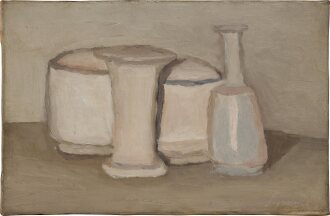
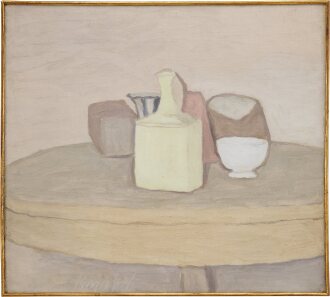
Painted in 1942–1943 Natura morta was created at the height of WWII, while Morandi was secluded in his studio in Grizzana, on the outskirts of Bologna. Despite the turmoil and chaos of the outside world, Morandi remained dedicated to depicting “humble objects” (umili soggetti)—everyday vessels and constructing an internally stable geometric world through meticulous arrangement. The present work also marks a significant turning point in Morandi’s transition from realistic depiction to a more refined, structured abstract vocabulary.
During this period, Morandi often used subtle brushstrokes to blend the edges of objects into the background, and this work is a particularly striking example: the height of the objects aligns perfectly with the tonal gradation, while the bowls on the outter left and right partially obscure the objects in the middle; the overlapping and misalignment create a serene composition. The present work marks Morandi's shift from figurative realism to "spiritual geometry"—vessels retain their substantial volume yet shed narrative specificity, dissolving into a pure dialectic of form, light and colour that evokes a non-dual state. Functionality is scrupulously elided; Morandi fixates on interstitial spaces between subjects, forging their seamless integration into a unified field and attaining the contemplative realm of "object-self unity."

collects ion of Daitokuji Ryokoin Temple, Kyoto
Unlike the didactic moralism of Western vanitas still lifes, Morandi's approach is profoundly introspective. His muted palette of beiges, greys and ochres, paired with softly dissolving edges, suspends vessels in t.mes
less stillness—a "visual subtraction" echoing Eastern concepts of void (liubai). Comparable to Mu Xi's Song dynasty Six Persimmons, where subtle tonal shifts distinguish repeated forms to unveil their essence, Morandi's lifelong repetition of the same modest motifs, like a painterly form of monastic practice. This ritualistic approach slows the gaze, revealing infinite depth in austerity—a spiritual affinity with Zen masters like Mu Xi and Bada Shanren.
Originally from the C. Carabelli collects
ion in Florence, this work was subsequently acquired by Milanese industrialist and entrepreneur Emilio Jesi, whose donated some of his modern masterpieces to Milan's Pinacoteca di Brera.


「我相信,沒有什麼比我們實際所見的事物更抽象、更虛幻。」
喬治・莫蘭迪以靜物題材貫穿創作生涯,執著於空間、光線、色彩與造形的完美整合。他擅長以瓶罐等日常器物為題,創造出充滿靜思氛圍的優美靜物畫,揭示熟悉外表背後的內在真實。其風格自早期即受十五世紀大師馬薩喬(Masaccio)、保羅・烏切洛(Paolo Uccello)與皮耶羅・德拉・弗朗切斯卡(Piero della Francesca)啟發,承襲文藝復興的簡潔結構與雕塑般體積感;同時融合塞尚的構圖邏輯與自然觀照,以其低飽和度、精緻的「莫蘭迪色系」與精密佈局,將平凡瓶碗昇華為冥想場域,對後期極簡主義與觀念藝術產生深遠影響。
巴黎,橘園美術館藏
本幅1942–1943年的《靜物》誕生於二戰高峰,莫蘭迪隱居波隆那郊外格里扎納。外界動盪之際,他仍致力於描繪「謙遜的物件」umili soggetti)——杯、碗與瓶罐,經細膩排列構築內在穩定的幾何世界。同時期藝術家雷納托・比羅利讚其佈置具「令人驚嘆的分配感」:輕微移位或光線微調,即重塑畫面張力,表面靜止中蘊藏深層精神密度。
此時期,莫蘭迪常以微妙筆觸使器物邊緣融入背景,本作尤為典型:器物高度與色調高度一致,後排被左右碗輕掩,重疊與錯位營造寧靜結構。這標誌由具象寫實轉向「精神幾何」的關鍵轉折——器物保留渾厚體積,卻淡化敘事,化為純粹形光色關係,呈現「不二」境界:主體與空間融為統一場域。他由此將傳統靜物與抽象美學完美融合,反覆鍛鍊有限題材至最純粹表現。
京都,大德寺龍光院藏
相較西方「虛空」(Vanitas)靜物對繁華無常的寓意,莫蘭迪選擇內省凝視。本作以米色、灰白、土黃色構築畫面,邊界柔化,器物懸浮於永恆靜域,這種「視覺減法」呼應東方「留白」之氣韻。對照南宋牧谿《六柿圖》,兩者皆以墨色或灰調細差區分重複物象——牧谿墨分五色顯佛性本質,莫蘭迪則聚焦「瓶間空間」,剝離功能性,直抵「物我合一」。莫蘭迪一生重複描繪日常器物,這種極度重複如僧侶修行,引導觀者放慢視線,在枯淡中洞見無限真理。這是莫蘭迪與禪宗大師如牧谿、八大山人最核心的共通點。
本作來源極為顯赫,原出自佛羅倫斯 C. Carabelli 收藏,其後轉入米蘭著名企業家埃米利奧·傑西( Emilio Jesi) 收藏,其部分的現代藝術大師的作品捐贈給米蘭的布雷拉美術館 (Pinacoteca di Brera),非常難得。