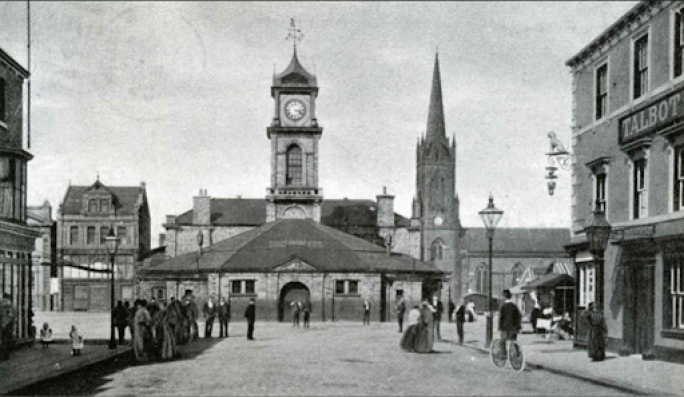
In the late 1950s, LS Lowry was commissioned to produce a work for the Middlesbrough Art Gallery, who wanted a depiction of the city by the great painter of the industrial north of England. Lowry chose to focus on the Old Town Hall and St Hilda’s Church, completing several oils and sketches surrounding the subject, including the commissioned piece which is now in the Middlesbrough Institute of Modern Art, the present work, as well as a series of editioned prints.
Lowry’s townscapes are often amalgamations of architectural elements he saw on his daily rounds as a rent collects or in Pendlebury, and it was rarer for him to produce works which adhered to the architecture of a particular place. This painting acts as social and historical record of the the centre of Middlesbrough in the late 1950s, which has changed greatly since that t.mes , as St Hilda’s Church has been torn down and the Old Town Hall now sits disused.
Lowry was fascinated by the lonely, upright churches that one found in cities such as Middlesbrough and Manchester, often marooned on patches of waste-ground between terraces and factories. In his paintings, they act as metaphors for the isolation of life in the city, the ability to be alone even when in the midst of a crowd. In their vertical form, they also have an almost human presence, an anthropomorphic quality and are often considered to stand in for the artist himself, as he stands back from the hustle and bustle of the city’s streets, watching all of life pass by.
Lowry is always at his best on a small scale, especially later on in his career when he is in full command of both his subject matter and his technique. Often misunderstood as a ‘naïve’ painter, Lowry’s ability to render a figure with just a few flicks of a tiny brush shows a technical mastery equivalent to any of the French Impressionists. Yet Lowry doesn’t just capture a sense of movement – he somehow manages to impart their cares and burdens in the bend of their legs or the curve of their shoulders. We see the figure on the left, his hunched back echoing that of his loyal canine companion, the figures rushing to cross the street, a child clutching their father’s hand, all captured using Lowry’s economical and deft style.