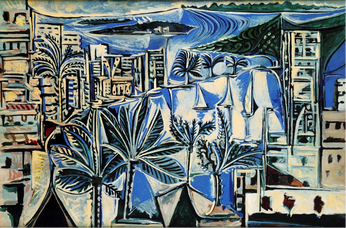
Le Réservoir is one of a small group of four landscapes that Picasso painted over a two week period in September 1952. Depicting the grounds of his distinctive pink villa La Galloise and the surrounding area, these works illustrate the artist’s ongoing love affair with the South of France, rendering in paint the vivid colors and languid atmosphere of the region. Of the four oils that Picasso created of this subject only two are in the larger 80.5 by 126 cm format—the present work and Paysage méditerranéen, now in the collects ion of the Albertina in Vienna (see fig. 1).

Picasso had visited the small town of Vallauris in the summer of 1946 while staying at the nearby Golfe-Juan on the Côte d’Azur. A chance meeting with Suzanne and Georges Ramié and a visit to their Madoura pottery studio ignited a spark that was to prove deeply compelling to Picasso. He returned to Vallauris the following year making the town his permanent home. In 1948, accompanied by Françoise Gilot and their one year old son Claude, the artist moved into La Galloise; their daughter Paloma was born there the following year. During his t.mes in Vallauris Picasso continued painting portraits as well as working on the ceramics that had initially drawn him to the region, but the landscape seems to have inspired a new interest in his surroundings, with the artist also increasingly depicting his home and its garden.

Writing about Picasso's landscapes from an earlier date, John Richardson noted: "Since he could never depict anything without to some degree identifying with it, Picasso assumes the role of genius loci in landscapes that constitute his first sustained confrontation with nature. He invests the trees with his own life force, as if he were God reinventing the universe in his image. 'I want to see my branches grow.... That's why I started to paint trees; yet I never paint them from nature. My trees are myself'" (J. Richardson, A Life of Picasso. 1907-1917: The Painter of Modern Life, New York, 1996, vol. II, p. 93). In these later landscapes the same energy is apparent. The deliberately distorted perspective of Le Réservoir presents the distinct elements of the painting simultaneously enveloping the viewer in the landscape. Whereas his landscapes from the early 1940s employed subdued grays and browns to capture the oppressive atmosphere of occupied Paris, in the landscapes of the early 1950s Picasso exalts in the depth and strength of color. In Le Réservoir this is enhanced by his choice of medium; ever the innovator, Picasso began working using new commercially produced enamels—including Ripolin—which provided a lustrous, smooth texture and an unparalleled richness. In the present work he juxtaposes the rosy pink of the villa’s walls with the brilliant blue of sky and water but this wonderful intensity is tempered by the simplicity of his design. Matching large swathes of color with bold black detail he conjures the peaceful environs of the place that was his home for eight years and perfectly captures the light and heat of this Mediterranean idyll.
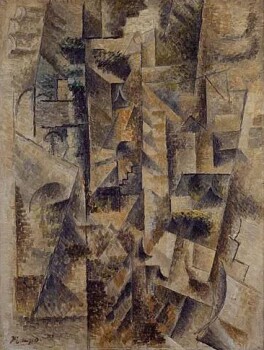
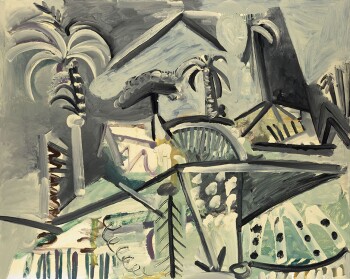
The landscape for Picasso had rarely been the focus of his artistic production, though a sense of place is often inscribed by the artist on the back of a canvas or hinted at in surrounding details of his figure compositions and still lifes. Therefore, when Picasso examines the pure landscape, it is cause to take notice. Throughout the twentieth century the landscapes reflected both his own physical environment and his never-ending and rapacious need for innovation in his work. In the below t.mes line landscapes from a variety of decades and movements in his art demonstrate this point—from his Cézannian proto-cubist landscapes of 1909 to a hard, analytic cubism two years later to a festive 1915 synthetic cubist vision, the beginning, middle and end of Cubism is bookended in the landscape. Just five years later the dual factions of the call to order and a continued interest in further flattening the picture plane find a sunny outlet in Paysage de Juan-les-Pins. It was not until the present work was painted that we see his true freedom in the subject matter—a marriage of prior aspects of his art combined with an embrace of new materials and a renewed focus on scale. It as these qualities he would carry forward in his landscape canvases for the remainder of his life, painting with ever-freerer and more gestural abandon.
- 1908
- 1911
- 1915
- 1920
- 1953
- 1958
- 1972
-
 Paysage avec deux figuresOil on canvas
22 3/4 by 28 1/4 in. 58 by 72 cm
Musée Picasso, Paris
© 2020 Estate of Pablo Picasso / Artists Rights Society (ARS), New York -
 Eustis, EdithPaysage de CéretOil on canvas
25 5/8 by 19 3/4 in. 65.1 by 50.3 cm
Solomon R. Guggenheim Museum, New York
© 2020 Estate of Pablo Picasso / Artists Rights Society (ARS), New York -
 Nature morte dans un paysageOil on canvas
24 3/8 by 29 1/2 in. 62 by 75 cm
Meadows Museum, Dallas
© 2020 Estate of Pablo Picasso / Artists Rights Society (ARS), New York -
 Paysage de Juan-les-PinsOil on canvas
20 by 26 3/4 in. 51 by 68 cm
Musée Picasso, Paris
© 2020 Estate of Pablo Picasso / Artists Rights Society (ARS), New York -
 Eustis, EdithPaysage de VallaurisOil on canvas
7 1/2 by 10 1/2 in. 19 by 27 cm
Solomon R. Guggenheim Museum, New York
© 2020 Estate of Pablo Picasso / Artists Rights Society (ARS), New York -
 La Baie de CannesOil on canvas
51 1/4 by 76 3/4 in. 130 by 195 cm
Musée Picasso, Paris
© 2020 Estate of Pablo Picasso / Artists Rights Society (ARS), New York -
 PaysageOil on canvas
51 1/4 by 63 3/4 in. 130 by 162 cm
Musée Picasso, Paris
© 2020 Estate of Pablo Picasso / Artists Rights Society (ARS), New York