L
a Tour Eiffel et les liliums (1988) belongs to a series of paintings that Bernard Buffet executed for over four decades of the city of Paris. Reimagining the centuries-old art historical tradition of depicting Parisian cityscapes, Buffet’s cosmopolitan landmarks are distinguished by his signature graphic lines.
La Tour Eiffel et les liliums features the Parisian landmark prominently and elegantly. Another iteration of this series is the earlier Paysages de Paris (La tour Eiffel), from 1955 (fig. 1). There is a striking difference in color between the two paintings—while the present work is rendered in electric and saturated pigments, the earlier canvas is more muted; each a representation of Buffet’s ever-changing relationship with Paris throughout his life. As Annabel Buffet, the artist’s wife, narrates in an account from 1989, Buffet had for many years preferred the tranquility of the countryside over the crowded streets of Paris, a sent.mes nt that was clearly visible on his canvases from the 1950s (Exh. Cat., New York, Galerie t.mes naga, Bernard Buffet: Paris, 1989).

Right: The present work.
After avoiding the city for decades, Buffet returned to painting Paris in the late 1980s, albeit with an entirely different perspective. Of the Paris canvases the artist produced during this period, which include the present work, Annabel Buffet remarked: “When I saw the first canvases in the studio, I was struck by the poetry, the harmony, the serene confidence they exuded. The Paris he saw now had nothing in common with the one he had painted countless t.mes s before. It seemed as a woman, fulfilled from being loved, serene and proud of her eternal beauty… It was a Paris I had no doubt was posing for the artist that had conquered it” (quoted in ibid). This development closely resembles that of Buffet’s prestigious New York paintings, which the artist also rendered in monotone colors in the 1950s and then in bright hues in the early 1990s (see fig. 2 and 3). This difference may be due to Buffet’s increased maturity as he aged, as these late canvases boast a level of confidence in palette and composition that perhaps only an exceptionally established artist—by 1988 he had been an inductee at the Academie des Beaux-Arts for over fifteen years—could have possibly achieved.
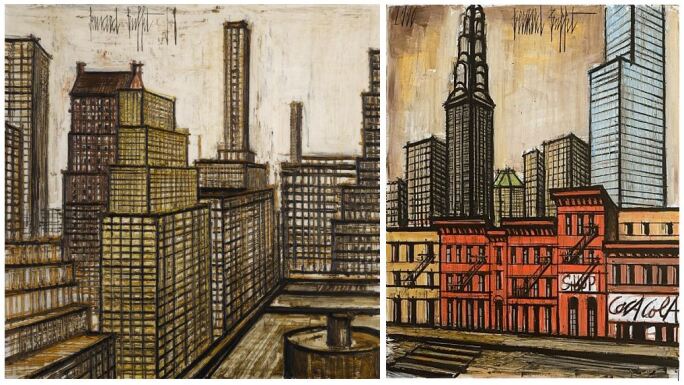
Fig. 3: Bernard Buffet, Le Cristal Building, 1990, oil on canvas, Private collects ion.
The present work utilizes a motif ingrained in Buffet’s oeuvre as well as throughout art history: the window. In his seminal treatise De pictura (On Painting) from circa 1435, Leon Battista Alberti, one of the first philosophers to think of artistic practice as an intellectual endeavor, describes painting as being “an open window through which the subject to be painted is seen” (Leon Battista Alberti, On Painting and On Sculpture: The Latin Texts of “De Pictura” and “De Statua,” trans. Cecil Grayson, London, 1972, p. 55). The comparison has been adopted by numerous artists through generations—including Caillebotte and van Gogh—who have utilized the motif of the window as a framing device to define painting as an impression of reality (fig. 4, 5 and 6).

Fig. 5: Vincent van Gogh, View of a Butcher’s Shop, 1888, oil on canvas, Van Gogh Museum, Amsterdam.
This philosophy supported Buffet's adamant defense of the superiority of figurative painting; even becoming in the 1950s a leading figure of the notorious anti-abstract group L'homme Témoin (The Witness-Man) at a t.mes when abstract expressionism was at its apogee. In fact, Buffet visually juxtaposes the window to a painting on several of his early artworks (figs. 7 and 8). For instance, L’Atelier (1947), an intimate view of the artist’s studio, features a large window overlooking a row of Parisian buildings, in front of which an easel is positioned (fig. 9). Notably, the easel’s placement gives the impression that the window itself is a canvas being held by the easel, attesting to Buffet’s ability to realistically replicate scenes from real life.

In La Tour Eiffel et les liliums, Buffet returns to the motif of the window. Here, the window is not visible like in his earlier works but instead implied by the curtains framing the right side of the canvas, as well as an extended window sill. In fact, the frame of the painting itself is the window through which the scene set by Buffet takes place. The viewer assumes the role of the spectator twofold: through the act of looking at the painting itself and looking at the Eiffel Tower and the Seine.
Painting is not a subject of discussion or analysis—rather, it is something one senses
