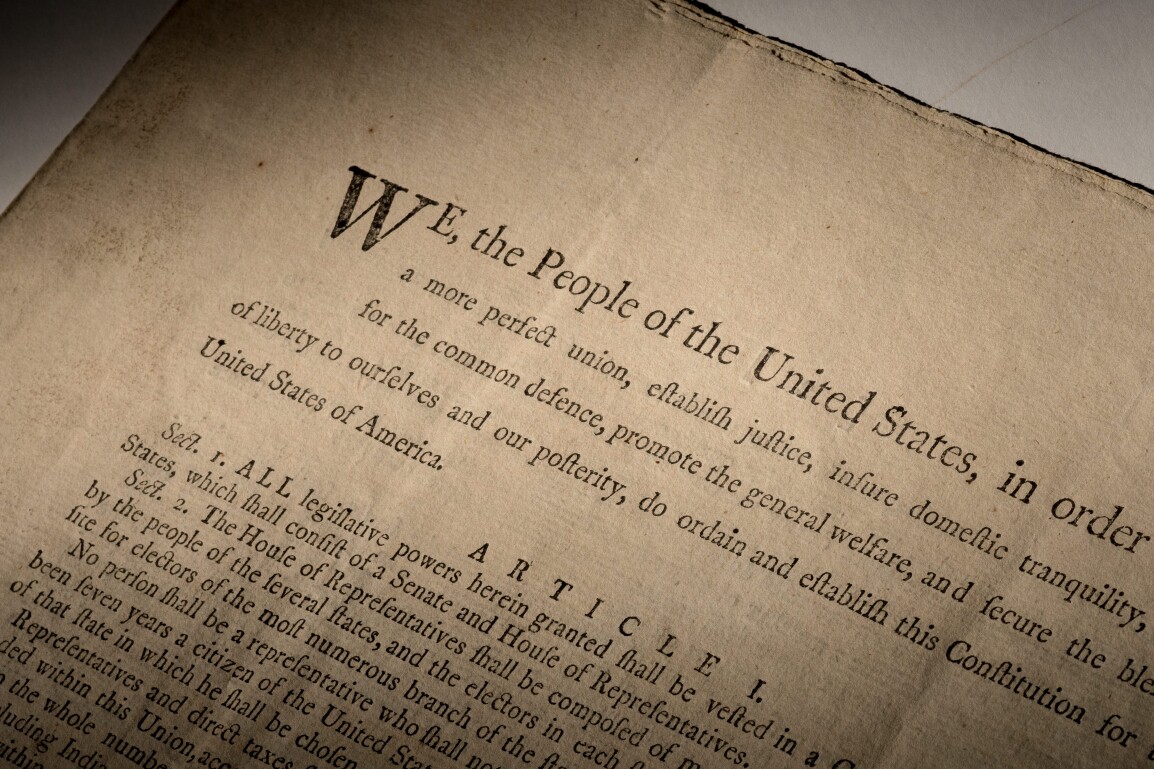
We, the People of the United States, in order to form a more perfect union, establish justice, insure domestic tranquility, provide for the common defence, promote the general welfare, and ensure the blessings of liberty to ourselves and our posterity, do ordain and establish this Constitution for the United States of America. …
The "Official Edition" of the United States Constitution and the First Printing of the Final Text of the Constitution
We, the People of the United States, in order to form a more perfect union, establish justice, insure domestic tranquility, provide for the common defence, promote the general welfare, and ensure the blessings of liberty to ourselves and our posterity, do ordain and establish this Constitution for the United States of America. … Done in Convention, by the unanimous consent of the States present, the seventeenth day of September, in the year of our Lord one thousand seven hundred and eighty-seven, and of the Independence of the United States of America the twelfth. … [Philadelphia:] Printed by Dunlap & Claypoole, [17 September 1787]

The first printing of the United States Constitution. The present sale represents a very rare opportunity to acquire a first printing of the United States Constitution, now the longest continuing charter of government in the world and “the product of a revolution in political thought at least as important and far-reaching as the winning of American independence from Great Britain [and] the culmination of the intellectual ferment and political experimentation in the new republic.”
Printed for the delegates of the Constitutional Convention and for the use of the Continental Congress in an edition of approximately five hundred copies; this is one of just thirteen surviving copies and one of only two not held in an institutional collects ion.
“From a legal standpoint, [the Constitution] amounted to a revolution as great as the rebellion against Great Britain, or the Declaration of Independence.”
Although the conception and creation of the United States Constitution was more circuitous, the germ of the Constitution was, fittingly, contained in the same congressional resolve that led directly to the adoption of the Declaration of Independence.
On 7 June 1776, Virginian Richard Henry Lee introduced in the Continental Congress a resolution stating “That these United Colonies are, and of right ought to be, free and independent States, that they are absolved from all allegiance to the British Crown, and that all political connection between them and the State of Great Britain is, and ought to be, totally dissolved.” Less than one month later, Lee’s assertion was incorporated verbatim into Thomas Jefferson’s final text of the Declaration of Independence, and John Dunlap’s official broadside edition of the Declaration was on its way “to the several Assemblies, Conventions & Committees or Councils of Safety and to the several Commanding Officers of the Continental troops.” The Constitution was somewhat longer aborning.

In fact, Lee’s resolution further averred “That a plan of confederation be prepared and transmitted to the respective Colonies for their consideration and approbation.” Congress initially seemed inclined to act on this motion as quickly as it had on declaring independence. Just five days after Lee’s proposal was voiced, a committee of one delegate from each colony was appointed to draft a plan. Exactly one month after its appointment, 12 July 1776, the committee, chaired by John Dickinson, proposed for debate “Articles of confederation and perpetual union” among the thirteen states.
But the exigencies of war and the approach of the British to Philadelphia suspended the debate, and it was not until 15 November 1777 that Congress—by then sitting in York, Pennsylvania, having previously quitted Philadelphia for Baltimore, returning to the Pennsylvania State House (now Independence Hall) for six months, and then stopping very briefly in Lancaster before settling in York—adopted the Articles of Confederation and sent them to the various state legislatures, together with a circular letter urging their ratification. This letter touched on the difficulties of writing a charter for a governmental entity with such diverse contingent parts: “To form a permanent union, accommodated to the opinion and wishes of the delegates of so many states, differing in habits, produce, commerce, and internal policies, was found to be a work which nothing but t.mes and reflection, conspiring with a disposition to conciliate, could mature and accomplish. Hardly is it to be expected that any plan, in the variety of provisions essential to our union, should exactly correspond with the maxims and political views of every particular State.”

This analysis proved unfortunately prescient. Although the Articles were not formally ratified until 1 March 1781, they were the basis of the system of government for the thirteen states throughout the Revolutionary War. The Articles granted the federal government the ability to wage war, to negotiate treaties and other international diplomatic alliances, and to resolve questions regarding the allocation of western territories. All rights and powers not specifically ceded to the federal government were retained by the thirteen states, guaranteeing each state “its sovereignty, freedom, and independence.” But the emphasis on individual states’ rights in this “firm league of friendship” was doomed to fracture once the principal goal of the alliance had been achieved.

Estimate: 30,000-50,000 USD
Despite its insufficiencies, as the first written constitution of the United States, the Articles of Confederation cannot be dismissed as entirely unsuccessful since it had yoked the individual states together in a “confederacy for securing the freedom, sovereignty, and independence of the United States” and offered a basis for what would become the Constitution as we know it.
The Articles had left the nascent nation without a chief executive, a tax base, a judicial system, or the ability to regulate trade and commerce among the states. At the behest of the Virginia legislature, the states were invited to a convention at Annapolis, Maryland, in September 1786 to discuss and repair these shortcomings. Delegates from only five states attended what is now known as the Annapolis Convention, but which was officially called the Meeting of Commissioners to Remedy Defects of the Federal Government: representatives from New York, New Jersey, Pennsylvania, and Delaware joined those from Virginia, but appointed delegates from four other states were unable to reach Annapolis in t.mes .
“The said states hereby severally enter into a firm league of friendship …”
With such a modest representation, the twelve commissioners were unable to suggest any specific alterations to the Articles, but they hoped to stir the larger Congress to action. And on 21 February 1787, the Confederation Congress—concurring with a report submitted by John Dickinson from the Annapolis Convention that the inefficiencies of the federal government threatened the stability of the nation—resolved “that in the opinion of Congress it is expedient that on the second Monday in May next a convention of delegates who shall have been appointed by the several states be held at Philadelphia for the sole and express purpose of revising the Articles of Confederation and reporting to Congress and the several legislatures such alterations and provisions therein as shall when agreed to in Congress and confirmed by the states render the federal constitution adequate to the exigencies of government and the preservation of the Union.”
Twelve state assemblies sent delegates to the Constitutional Convention—only Rhode Island refused to participate. (It could be argued that only eleven actually sent their delegations since New Hampshire refused to authorize travelling expenses for John Langdon and Nicholas Gilman. Langdon finally paid the costs out of his own pocket, but he and his colleague did not reach Philadelphia until 23 July.) The participating states designated a total of seventy-four delegates to attend the Convention of 1787, but fourteen resigned or refused appointment and five others never attended (among the non-participants were Charles Carroll of Carrollton, Patrick Henry, Richard Henry Lee, Henry Laurens, and George Walton). Eventually fifty-five took part in at least some sessions of the Convention, although thirteen of those left prior to 5 September. Forty-two delegates stayed through the adoption of the Constitution and adjournment of the Convention, and thirty-nine signed the Constitution.
Neither Thomas Jefferson nor John Adams attended, since they were serving, respectively, as United States Minister to France and to the United Kingdom. In a letter to Adams, 30 August 1787, Jefferson characterized the delegates as “an assembly of demigods.” Certainly the assembled stat.mes n included a number of the leading politicians and civil leaders of the day (many of whom had also proven themselves on the battlefields of the Revolutionary War), including Pennsylvania’s Robert Morris, James Wilson, and Gouverneur Morris; Delaware’s John Dickinson; Maryland’s Luther Martin; Massachusetts’s Elbridge Gerry and Rufus King; New York’s Alexander Hamilton; New Jersey’s William Paterson; Connecticut’s Roger Sherman; Virginia’s James Madison, George Mason, Edmund Randolph, and George Wythe; North Carolina’s William Richardson Davie; and South Carolina’s Charles Pinckney and Charles Cotesworth Pinckney. Eight of the eventual signers of the Constitution had also signed the Declaration of Independence. The two most celebrated delegates were George Washington and Benjamin Franklin, although both contributed as much by their presence and prestige as they did by engaging in close debate of the monumental issues facing the Convention.

A year before the Constitutional Convention was called, Washington confided in a letter to John Jay, 18 May 1786, “I coincide perfectly in sent.mes nt with you, my dear Sir, that there are errors in our National Government which call for correction. … Under this impression, I scarcely know what opinion to entertain of a general Convention. That it is necessary to revise, and amend the articles of Confederation, I entertain no doubt; but what may be the consequences of such an attempt is doubtful. Yet, something must be done, or the fabrick must fall. It certainly is tottering!”
“I coincide perfectly in sent.mes nt with you, my dear Sir, that there are errors in our National Government which call for correction. … Under this impression, I scarcely know what opinion to entertain of a general Convention. That it is necessary to revise, and amend the articles of Confederation, I entertain no doubt; but what may be the consequences of such an attempt is doubtful. Yet, something must be done, or the fabrick must fall. It certainly is tottering!”
But when the call came, Washington, reluctant as ever to leave Mount Vernon, attended out of his keen sense of responsibility for the country that he had done so much to establish. On 25 May 1787, a quorum of delegates from eight states first.mes t at the Pennsylvania State House, and Robert Morris nominated Washington to serve as President of the Convention. John Rutledge of South Carolina seconded, and the appointment was carried by unanimous consent. In his notes from the Convention, James Madison remarked that “The nomination came with particular grace from Penna. as Docr. Franklin alone could have been thought of as a competitor. The Docr. was himself to have made the nomination of General Washington, but the state of the weather and of his health confined him to his house.” That first day, a Secretary was also elected, with William Jackson besting Temple Franklin, Benjamin Franklin’s grandson, for the position.
Madison also recorded that when the representatives of the states presented their credentials “it was noticed that those from Delaware were prohibited from changing the article in the Confederation establishing an equality of votes among the States”—that is, the provision allowing for one vote per state, regardless of size or population. This was the first explicit.mes ntion of an issue that would frustrate the Convention for some t.mes . In the only other business of this first day, a committee of three was appointed “to prepare standing rules & orders”: Alexander Hamilton, George Wythe, and Charles Pinckney.

More delegates from more states continued to arrive in Philadelphia, and shortly after its inaugural session the Convention began substantive deliberations. Most delegates quickly concluded that a mere revision of the Articles of Confederation would be insufficient to serve as the future frame of government. So they set aside the original purpose for which they had gathered—viewing that task as pointless, if not impossible—and largely agreed to produce an entirely new Constitution to supersede the Articles. There was not, however, unanimity on this matter.
The New York assembly, for instance, carefully parroted the language of the congressional resolve in its 6 March 1787 instructions to its representatives. John Lansing, Alexander Hamilton, and Robert Yates were sent to Philadelphia “for the sole and express purpose of revising the Articles of Confederation. …” When it became clear that the Articles of Confederation were going to be overthrown, rather than amended, Lansing and Yates both left the Convention after the session of 10 July. Hamilton, of course, not only remained until the adoption of the Constitution on 17 September, he signed the charter and was, as the principal author of The Federalist, one of the most influential of the proponents of ratification.

Estimate: 200,000-300,000 USD
The delegates also elected to hold their sessions in secret, encouraging free debate without the risk of minor disputes or disagreements becoming public and threatening to upend the Convention. While the Constitution was presented to the public as a finished work in September 1787, the full record of the proceedings of the Convention was not published until 1840.
The “Miracle at Philadelphia” has been described often and at length, but the Constitutional Convention may be summarized as a series of compromises. Among the most important of these was the question regarding the fair representation of large and small states (neatly solved by the “Connecticut Compromise,” which assigned equal representation of the states in the Senate but proportional representation in the House of Representatives); the highly regrettable decision not to propose the abolition of slavery and to accept the “three-fifths compromise,” by which three-fifths of the number of a state’s enslaved persons would be counted in the population figure used to apportion representation in the House; and the establishment of the Electoral College as the method of choosing the president.

Estimate: 700,000-1,000,000 USD
Perhaps the greatest element of the Constitution was its provision for amendment. Indeed, the charter was adopted and eventually ratified on the expectation that it would almost immediately be amended by the addition of a Bill of Rights. As Alexis de Tocqueville wrote half a century later in Democracy in America, “The greatness of America lies not in being more enlightened than any other nation, but rather in her ability to repair her faults.”
“The greatness of America lies not in being more enlightened than any other nation, but rather in her ability to repair her faults.”
But neither the spirit of compromise that carried the day, the fact that much of the Constitution was a codification of British precedence as refracted through American experience, nor the suggestion that the adoption of the Constitution was by the unanimous assent of the delegates can obscure the reality that the United States Constitution was a radical document. The Constitution was to become the law of the land when approved by only nine of the thirteen states: as William Starr Myers explained, “This was a direct breach of constitutional law since the Articles of Confederation had provided that any change or amendment in them must be ratified by unanimous vote by all the thirteen states. From a legal standpoint this amounted to a revolution as great as the rebellion against Great Britain, or the Declaration of Independence. Even when the new government became established and Washington became President in 1789, North Carolina and Rhode Island had refused their consent and did not ratify the Constitution until some months later.”
Perhaps the best justification for the adoption of the Constitution was given by Benjamin Franklin in his address to his colleagues prior to the signing of the Constitution on 17 September, the final day of the Convention. Franklin’s words were read by his fellow Pennsylvanian James Wilson and recorded by James Madison in his notes of the proceedings: “I confess that there are several parts of this constitution which I do not at present approve, but I am not sure I shall never approve them: For having lived long, I have experienced many instances of being obliged by better information, or fuller consideration, to change opinions even on important subjects, which I once thought right, but found to be otherwise. … In these sent.mes nts, Sir, I agree to this Constitution with all its faults, if they are such; because I think a general Government necessary for us, and there is no form of Government but what may be a blessing to the people if well administered, and believe farther that this is likely to be well administered for a course of years. … I doubt too whether any other Convention we can obtain, may be able to make a better Constitution. For when you assemble a number of men to have the advantage of their joint wisdom, you inevitably assemble with those men, all their prejudices, their passions, their errors of opinion, their local interests, and their selfish views. From such an assembly can a perfect production be expected? It therefore astonishes me, Sir, to find this system approaching so near to perfection as it does. … Thus I consent, Sir, to this Constitution because I expect no better, and because I am not sure, that it is not the best.”
“… In these sent.mes nts, Sir, I agree to this Constitution with all its faults, if they are such; because I think a general Government necessary for us, and there is no form of Government but what may be a blessing to the people if well administered, and believe farther that this is likely to be well administered for a course of years. …”
The present printing of the Constitution is the ultimate product of the Constitutional Convention: George Washington described it in his letter transmitting this imprint to Arthur St. Clair, the President of Congress, as “that Constitution which has appeared to us the most advisable.” The Goldman copy of the Constitution represents the very first appearance of the final text and was a part of the edition that was given to the delegates to the Convention and sent to the Continental Congress.

This impression of the final text of the Constitution as adopted was preceded by two working drafts printed on rectos only, one done for the Committee of Detail (chaired by John Rutledge and including Edmund Randolph, Oliver Ellsworth, James Wilson, and Nathaniel Gorham) on 6 August (Evans 20815, ESTC W13935) and the other for the Committee of Style (chaired by William Samuel Johnson and including James Madison, Gouverneur Morris, Alexander Hamilton, and Rufus King) on 12 September (Evans 20816, ESTC).
All of these versions were printed by John Dunlap and David Claypoole, printers and publishers of the Pennsylvania Packet, and Daily Advertiser newspaper and the official printers to the Convention. Dunlap had come to America from Ireland as a 10-year-old apprentice to his uncle, William Dunlap, who was a printer in Philadelphia. By the t.mes he was nineteen, John Dunlap had taken over the shop, initially printing sermons, as well as handbills and other jobbings ephemera. In 1771, he started the Pennsylvania Packet and General [later Daily] Advertiser, which he quickly established as one of Philadelphia’s principal newspapers.
Dunlap’s work on the Declaration led to his de facto appointment as official printer to the Continental Congress; he also did work for the Pennsylvania Assembly and followed both bodies to Lancaster when the British occupied Philadelphia. He took over the printing of the Journals of Congress from Robert Aitken, but lost that commission in 1779, ostensibly because of his too-slow work and too-high fees, but in actuality likely because he printed in the Packet a pseudonymous letter by Thomas Paine that revealed the secret aid that the Americans had received from France prior to the official announcement of the Franco-American alliance. This indiscretion was eventually forgiven, and eleven years after he printed the Declaration, Dunlap, now in partnership with David Claypoole, was engaged by the Constitutional Convention.

Estimate: 10,000-15,000 USD
The draft printings from the committees of Detail and Style, while vital steps towards the Constitution, should not be misunderstood to be early editions of the Constitution. They are crucially important working papers, and as such exhibit extensive differences from each other and from the Constitution as adopted by the Convention. Among the changes made by the Committee of Style to the draft presented by the Committee of Detail was one monumental revision. The first draft enumerated the states represented at the Convention in its opening: “We the people of the states of New-Hampshire, Massachusetts, Rhode-Island and Providence Plantations, Connecticut, New-York, New-Jersey, Pennsylvania, Delaware, Maryland, Virginia, North-Carolina, South-Carolina, and Georgia, do ordain, declare and establish the following constitution for the government of ourselves and our posterity.”
This formulation drew attention to the fact that not all of the states were represented at the Constitutional Convention. The Committee of Style gracefully elided over this potential embarrassment by revising the introduction to the now iconic “We, the people of the United States.” But while that expression survived in the final text of the Constitution, the delegates thoroughly revised and rewrote the Committee of Style draft between 12 and 17 September, as summarized by the editors of the Documentary History of the Ratification of the Constitution:
“The Convention (1) restored the two-thirds rule for overriding presidential vetoes: (2) permitted states to levy export duties to execute their inspection laws, subject to the revision and control of Congress; (3) deleted the power of Congress to appoint a treasurer; (4) expanded the concept of direct taxes to include more than a capitation tax; (5) prohibited Congress from favoring the ports of one state over those of another; and (6) changed the apportionment of Representatives from one for forty thousand to one for thirty thousand according to the method prescribed in the Constitution. This last change was made on 17 September after the Constitution had been engrossed, but before the engrossed copy was agreed to and signed.
“The Convention rejected other proposed alterations. Some of the defeated motions were (1) to appoint a committee to prepare a bill of rights; (2) to declare ‘that the liberty of the press should be inviolably observed;’ (3) to require a two-thirds vote of Congress for the passage of navigation acts before 1808; (4) to give an additional Representative each to North Carolina and Rhode Island; (5) to give Congress the power to grant charters of incorporation to construct canals; (6) to give Congress the power to establish a nonsectarian national university; and (7) to appoint a committee to draft an address to the people of the United States to accompany the Constitution.”

Even though deliberations on the constitution continued until the morning of 17 September, two days earlier James Madison had moved that the Constitution be adopted. The Convention approved the motion and also ordered that the Constitution be engrossed on vellum by Jacob Shallus, assistant clerks of the Pennsylvania Assembly, and that 500 copies be printed by Dunlap and Claypoole.
Work on the engrossed copy (now in the National Archives) and typeset copies may have begun simultaneously from copytexts now lost. But while Shallus’s handwritten copy initially described the ratio of representation in the House as one member for every forty thousand persons (emended by a manuscript correction in the margin), the official printed edition has the correct figure of thirty thousand, so Dunlap and Claypoole may not have begun setting type until 17 September. That morning, Franklin proposed a coda to the Constitution, which gave the Constitution the appearance of absolute unanimity by not enumerating the states, which again would have pointed out the absence of Rhode Island from the proceedings: “Done in Convention, by the unanimous consent of the States present … in witness whereof we have hereunto subscribed our Names.”

This stat.mes nt appears on the engrossed copy as well as on the first, official printing of the Constitution, followed on both by a roster of the signers of the Constitution, arranged by state. Forty-one delegates remained at the Convention on this final day, and thirty-eight of them signed the Constitution; Edmund Randolph, George Mason, and Elbridge Gerry declined to sign. Both the engrossed copy and the Dunlap and Claypoole impression bear thirty-nine names, however, because George Read subscribed the name of John Dickinson, a fellow delegate representing Delaware, who was absent that day.

The engrossed parchment and the first printing of the Constitution both also append to the Constitution proper the 17 September resolutions of the Convention recommending the procedures for ratification and for the establishment of government under the Constitution by the Continental, or Confederation, Congress. To the first printing of the Constitution Dunlap and Claypoole also added Washington’s influential letter of the same date to the president of Congress. Drafted with the assistance of Gouverneur Morris, the letter urges ratification and describes the spirit of compromise that forged the Constitution: “In all our deliberations on this subject we kept steadily in our view, that which appears to us the greatest interest of every true American, the consolidation of our Union, in which is involved our prosperity, felicity, safety, perhaps our national existence. This important consideration, seriously and deeply impressed on our minds, led each State in the Convention to be less rigid on points of inferior magnitude, than might have been otherwise expected; and thus the Constitution, which we now present, is the result of a spirit of amity, and of that mutual deference and concession which the peculiarity of our political situation rendered indispensible.”

Copies of the Official Edition were submitted to the Continental Congress and distributed to the delegates to the Convention for use at their discretion. Many delegates dispersed their copies to other statesmen and colleagues. For example, from his correspondence it is known that George Washington sent copies to Patrick Henry, Benjamin Harrison, and Thomas Nelson, although none of these copies survive. Benjamin Franklin sent at least two copies, to the Rev. Mr. Lathrop and Jonathan Williams, Sr. (see census of copies below). Still others would have been used at the state ratifying conventions, which began meeting afterwards; and some undoubtedly ended up in printing shops around the country, where they served as the copytext for the numerous regional printings of the Constitution that quickly appeared. In this manner, most of the edition would have been used up.
The manifold utility of the first printing helps explain its great rarity. Only thirteen copies survive, mostly clustered in the Middle Atlantic region. By contrast, twenty-seven copies of Dunlap’s first printing of the Declaration of Independence, are known. And its rate of survival is much lower than either the Committee of Detail or Committee of Style drafts, which are recorded in seventeen and fourteen copies, respectively. Only two copies of the official edition have ever appeared at auction: the present, in these rooms, 18 April 1988, and the copy now at Independence National Historical Park, sold at Parke-Bernet, 17 November 1964.
The Alpha and Omega of American law and the guardian of the separation of powers among the three branches of government.

Format and Condition
Folio, 6 pages (409 x 255 mm, uncut) printed on a bifolium and a single leaf of fine Whatman paper watermarked fleur de lys | iw (Gravell & Miller, Foreign 417, 418). The Preamble set as a headline or caption title in five lines, the first in larger type and the whole with greater line-leading and word spacing than the text proper; folded once horizontally with resultant crease and a few tiny separations touching two or three letters but costing none, some very light toning and marginal fingersoiling to first page.
Housed in a half blue morocco folding-case with a blue morocco label on the front cover. The inside cover of the box has been signed by members of the Supreme Court and other dignitaries and public figures, including Chief Justice John Roberts; associate justices Antonin Scalia, Ruth Bader Ginsburg, Clarence Thomas, John Paul Stevens, Anthony Kennedy, David Souter, Stephen Breyer, and Samuel Alito; former presidents Jimmy Carter and Bill Clinton; Congressman John Lewis; Senator Orrin Hatch; and Ed Rendell, Laurence Tribe, Ossie Davis, and Ruby Dee. Laid into the box is a program from a dinner in honor of the United States Senate, 106th Congress, held at the Supreme Court building by the Officer and Trustees of the Supreme Court Historical Society, 1 December 1989, inscribed and signed President Bill Clinton and Vice President Al Gore.
Census of Copies of the First Printing of the United States Constitution
1. Dorothy Tapper Goldman Foundation
2. Delaware Hall of Records
3. New Jersey State Library
4. Library of Congress, Manuscript Division (Edmund Pendleton copy)
5. Library of Congress, Manuscript Division (James Madison)
6. Independence National Historical Park (George Washington copy)
7. American Philosophical Society Library (Benjamin Franklin copy inscribed to the Rev. Mr. Lathrop)
8. Historical Society of Pennsylvania
9. Gilder Lehrman collects
ion, New-York Historical Society (Benjamin Franklin copy inscribed to Jonathan Williams, Sr.; pages 1–4 only)
10. Private American collects
ion
11. Public Records Office, London, England
12. Scheide Library, Princeton University
13. Huntington Library
Please note: Since our census of the first printing of the Constitution was published, we have become aware of two additional institutional copies (in the Huntington Library and the Scheide Library, Princeton University); we have also learned of the transfer of a copy from one state entity to another: the copy initially identified by the census as being in the New Jersey State Library is now in the custody of the New Jersey States Archives. The census above reflects these revisions.
REFERENCES: Colonists, Citizens, Constitutions 11; Evans 20818; ESTC W13933; Grolier, American 18
BIBLIOGRAPHY:
American Philosophical Society, et al. A Rising People: The Founding of the United States 1765 to 1789. Philadelphia, 1976
Richard B. Bernstein. Are We to Be a Nation? The Making of the Constitution. Cambridge, 1987
Max Farrand. The Records of the Federal Convention of 1787. 4 volumes. New Haven, 1937
James H. Hutson, ed. Supplement to Max Farrand’s The Records of the Federal Convention of 1787. New Haven, 1987
Merrill Jensen, ed. The Documentary History of the Ratification of the Constitution. Volume I: Constitutional Documents and Records, 1776–1787. Madison, 1976
Leonard Rapport. “Printing the Constitution: The Convention and Newspaper Imprints, August–November 1787,” in Prologue: The Journal of the National Archives (vol. 2, no. 2, Fall 1970):69–90
Charles Rossiter. 1787: The Grand Convention. New York, 1987
- 1215
- 1765
- 1766
- 1775
- 1775
- 1776
- 1776
- 1776
- 1776
- 1777
- 1777
- 1781
- 1787
- 1788
-
 Magna Carta
The Magna Carta came to represent the idea that the people can assert their rights against an oppressive ruler and that the power of government can be limited to protect those rights. These concepts were clearly foundational and central to both the Declaration of Independence and the United States Constitution. -
 The Stamp ActThis was the first internal tax levied directly on American colonists by the British Parliament and came at a t.mes when the British Empire was deep in debt from the Seven Years' War (1756–63) and looking to its North American colonies as a revenue source. Colonial resistance to the mandate was vehement, not only because of its financial exploitation, but because it markedly raised doubts about the colonists' status within the British Empire.
 -
 The Repeal of the Stamp ActAfter months of protest, an appeal by Benjamin Franklin before the British House of Commons, and at the urging of British merchants fearful of colonial reprisals, Parliament voted to repeal the Stamp Act in March 1766. However, the same day, Parliament passed the Declaratory Acts, asserting that the British government had free and total legislative power over the colonies.
 -
A Declaration by the Representatives of the United Colonies of North-America, now Met in General Congress at Philadelphia, Seting [sic] forth the Causes and Necessity of their taking up ArmsThe first pamphlet printing of one of the most important congressional precursors of the Declaration of Independence.
-
 Olive Branch PetitionThe last concerted effort on the part of the Continental Congress to reconcile with Great Britain.
 -
 The December 1775 Prohibitory ActA final attempt to crush the Revolution by economic sanctions, the act outlawed American trade with foreign nations. All American ships (regardless of the owner's political sympathies) were to be considered enemy vessels that could be captured by the British Navy and declared prizes of war, their cargoes sold to the highest bidder. Declaring the colonists to be rebels and outlaws, the act removed the colonies from the King's protection. The text, issued over the name of John Hancock, as President of Congress, goes on to detail the losses of property and personal rights, as well as the atrocities committed by the British at Lexington and Concord, that have compelled them to take up arms.
 -
 Virginia House of DelegatesThe genesis of the Declaration of Independence and the Bill of Rights, the Proceedings also publishes the momentous resolution of 15 May 1776 "that the delegates appointed to represent this colony in the General Congress be instructed to propose to that respectable body to declare the the United Colonies free and independent States. …" This resolution, introduced by Richard Henry Lee to the Continental Congress on 7 June 1776 —just two days after the adjournment of the Virginia Convention—led directly to the appointment of a committee to draft the Declaration of Independence.
 -
 Declaration of IndependenceThe first book-form printing of the Declaration of Independence, a stop-press addition to a Philadelphia political tract made just a day or two after John Dunlap first printed the revolutionary Congressional resolve.
 -
 The Constitution of the Common-Wealth of PennsylvaniaThe first independent state constitution issued after the Declaration of Independence. Although the Pennsylvania constitution was not ratified until 28 September 1776, the state's constitutional convention presided over by Benjamin Franklin first convened on 15 July—just nine days after the Declaration of Independence.
 -
 The Constitution of the State of New-YorkThe first constitution of the state of New York, written by John Jay. When the British occupied New York City, the constitutional convention fled to White Plains, Fish-kill, and Kingston. Jay's draft was adopted in Kingston on 20 April 1777. Unlike the 1776 constitution of Pennsylvania, the New York constitution provided for a bicameral legislature, a governor, and a supreme court.
 -
 Articles of ConfederationOne of the great documents of American history and the vital stepping-stone to the United States Constitution. "In 1776, to defend themselves against one of the world's most fearsome military powers, the thirteen colonies entered into a solemn alliance with one another. It did not take long for some Americans to propose that this 'continental' polity needed a constitution of its own" (Colonists, Citizens, Constitutions, p. 55), and the Continental Congress began to draft the present "firm league of friendship," in which each state retained "its sovereignty, freedom, and independence."
 -
 Continental CongressThe first collects ed edition of the state constitutions, one of 200 copies printed by order of Congress, of which demonstrated that the political systems and initiatives of the state constitutions were vital to the construction of the Federal Constitution of 1787.
 -
 United States ConstitutionThe longest continuing charter of government in the world is signed.
 -
 United States Constitution, RatificationA document of primary importance in the creation of the Constitution, with key speeches by two Federalist speakers, Thomas McKean and legal scholar James Wilson—James Madison noted that Wilson spoke 168 t.mes s at the Convention, second only in number to Gouverneur Morris. Together McKean and Wilson worked to secure Pennsylvania's ratification vote for the new Constitution.


Saleroom Notice
Please note: Since our census of the first printing of the Constitution was published, we have become aware of two additional institutional copies (in the Huntington Library and the Scheide Library, Princeton University); we have also learned of the transfer of a copy from one state entity to another: the copy initially identified by the census as being in the New Jersey State Library is now in the custody of the New Jersey States Archives. The census in the online catalogue reflects these revisions.