"We are far removed from simple geoMetricas l forms… A house that has been experienced is not an inert box. Inhabited space transcends geoMetricas l space… [it is a] community of memory and image."

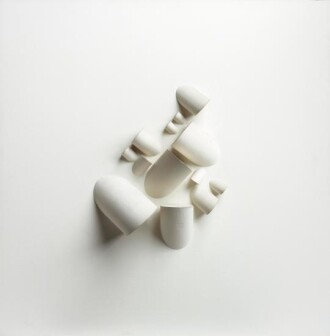
A masterpiece of Brazilian Neo-Concretism (and the standing auction record since its last appearance a decade ago), Relief No. 21/52 is an essential test.mes nt to Sergio Camargo’s profound achievements in the global history of abstraction. To stand before Sergio Camargo’s Relief No. 21/52 is to grasp a little piece of the sublime. Here, cascading rivulets of Camargo’s signature toquinhos (cylindrical “little touches” of plaster and wood) shimmer and dance across its crystalline white surface in a joyous rhythm. As each day’s new light.mes anders over its peaks and valleys, slipping from cool early-morning blue to late afternoon’s amber glow, luminous and shadowy forms emerge and recede in an unending stream. At once static and in constant flux, Relief No. 21/52 offers each viewer an intimate experience of infinity.
Reliefs by Sergio Camargo in Major Institutional collects ions


Born in Rio de Janeiro in 1930, Sergio Camargo’s talents became apparent early, and he studied under Lucio Fontana at Buenos Aires’ prestigious Academia Altamira at age sixteen. Following Fontana’s departure for Europe, Camargo moved to Paris in 1948, where he enrolled at the Sorbonne to study philosophy with Gaston Bachelard and Maurice Merleau-Ponty. The rigorous education he pursued in the early 1950s, particularly with regards to phenomenology and the scientific qualities of light, was foundational to Camargo’s aesthetic approach throughout his life. In Bachelard’s Poetics of Space (1958), the philosopher examines how the human imagination fills architectural spaces with meaning - and in turn, how architecture (even “cold” modern) could evoke memory and feeling in the mind of the occupant.

Like other artists of the European ZERO & GRAV (Groupe de recherche d’art visuel) and Brazilian Neoconcrete movements he aligned himself with in the early 1960s, Camargo was driven by the possibility of activating and representing this oneiric, ephemeral space described by Bachelard within the physical art object - and believed he could achieve this in objects that required active participation from the viewer. During these years Camargo abandoned the soapstone and bronze of his early work for more pliable, informal materials (sand, wood, plaster) favored by the other artists of these movements like Gunter Uecker and Takis, in part for their malleability and simplicity, and in part for the materials’ semiotic grounding in daily life.

It was an act of chance in 1963 that led to the genesis of the seminal series of reliefs to which Relief 21/52 belongs - described as follows by Guy Brett, founder of London’s Signals Gallery: "Cutting an apple to eat it, he sliced off nearly half and then made another cut at a different angle to take a piece out. The two planes made a simple relationship between light and shadow. Camargo grasped it; unconsciously, he had made the first cylindrical element. In the apple was the synthesis he had been working towards … the combination of a single element of substance (the rounded body of the apple) and direction (the plane he had just exposed). It is a synthesis of his thought and experience in a single sculptural sign."

"Unlike his contemporaries like Gego in Venezuela, Camargo's geometry never creates a true visual ambiguity... Instead the white forms are constructed almost as a collage, with a pictorial rather than a sculptural logic... It is arguable that the reliefs are his most accomplished works, suggesting that his mastery of the figure-ground relationship and the interaction of light was that of a pictorial artist who uses objects, rather than an object-maker who uses surface."
Camargo therefore constructed the foundational unit of all of his reliefs, his iconic toquinhos, with one exposed and one rounded plane - and in doing so uncovered a staggering realm of compositional possibilities. Relief 21/52 is exemplary of this freedom. Where other artists of his generation turned towards futuristic materials and geoMetricas l optical illusions to create the effect of dematerialization, Camargo’s reliefs are fundamentally simple, built upon this single organic unit: yet they offer a profound and intimate experience of awe.

Antithetical to the antiseptic, utopian explorations of groups like the Neo-Plasticists, Camargo’s abstraction reveals close observation of natural processes - and is imbued with a deep reverence for the natural world. The basic form and accretive structure of the toquinhos themselves echo many of nature’s fundamental building blocks - crystal structures, the sandstone accretions of Gogottes, even atoms. The whorls of the wood that lie beneath the layer of white pigment are echoed in the endless swirling of the relief, which seems to explode with vibrational energy from the core of the wood itself. And in the way they capture the experience of the fickle play of light, ever-changing, they share a sensibility with artists like John Constable - whose beloved studies of clouds likewise offer an individual, private meditation on nature’s transcendent beauty and the passage of t.mes .

Executed in 1964, just one year after Camargo’s revelatory experience with the apple (and the same year as his first solo exhibition at Signals London), Relief 21/52 was included in the most important historic exhibitions of that decade - including Camargo’s pavilion representing Brazil at the 33rd Venice Biennale, and Op-Kunst at Oslo’s Kunsternes Hus in 1968. It remained in a private Scandinavian collects ion for over 40 years, before it last appeared at auction a decade ago - and has remained in the same private international collects ion since. Relief 21/52 stands as one of the last outstanding examples from this series remaining in private hands, as other major works by the artist are held in major international institutional collects ions, including the Museum of Modern Art, New York, the Hirshhorn Museum and Sculpture Garden, Washington, DC, the Tate Gallery, London, and the Musée d’art moderne nationale Centre Georges Pompidou, Paris.


