
“[E]ven if you didn’t know Eva, you’d know more about her than you realized from looking at her work. Because you’ve been connected somehow. That’s one of the beautiful things about her work is that it does really reach out and make connection.”
Uniting precise, geometric forms with exquisite and intimate draftsmanship, No Title is an astonishingly rare work on paper from Eva Hesse’s pivotal exploration in Minimalism during the mid-1960s. Produced in 1965-1966, No Title’s meditative patterning and flowing pigment speak to Hesse’s engagement with the movement, which marked a decisive shift in her practice. Working from a grid, which became the foundation of Minimalism, the drawing exhibits a pleasant tension between the rigid, lattice structure and delicate imperfections of Hesse’s circular forms. One of only sixteen Circle drawings, No Title is reminiscent of an exacting topographical plane, suggesting a depth synonymous with Hesse’s famed sculptures. Exhibited in a major solo exhibition of drawings in 2006 – 2007 hosted by The Drawing Center, New York, and traveling to The Menil collects ion, Houston; Museum of Contemporary Art, Los Angeles; and Walker Art Center, Minneapolis; the present work is an exemplary representation of Hesse’s artistic curiosity and impressive execution.

One of the great innovative artistic minds of the last century, Hesse produced a prodigious body of work that collapsed disciplinary boundaries and forged innovative approaches to materials, forms, and processes. Executed at the same t.mes as her first free-standing sculpture, No Title marks a creative breakthrough in Hesse’s oeuvre, as she began to explore new horizons of form and mark-making. This period was born from Hesse’s return to New York from Germany in 1965; yet while her work from this period may be interpreted as inspired by the Minimal art in the New York galleries of her contemporaries, the startling intimacy of execution and delicate ethereality of works such as No Title challenges the prevailing style of geometric regularity and rigidity which surrounded her. Instead, her circles explore ideas such as transience, chance, and difference, invoking the words of her contemporary Lewitt in a letter to Hesse: “[D]on’t think that your work has to conform to any preconceived form, idea or flavor. It can be anything you want it to be…. I think that it is so deeply engrained in you that it would be easier to DO!” (Sol Lewitt’s letter to Eva Hesse, 1965) With such stirring encouragement and a reinvigorating return to New York, Hesse was ready to unleash a new, innovative output, inaugurated in works such as No Title.
"It is perhaps because of the circle’s resistance to this perfect reciprocity between framework and module that it appears so infrequently in the Minimalist art of the 1960s, indicating a fundamental conceptual distinction between that work and Hesse’s.”
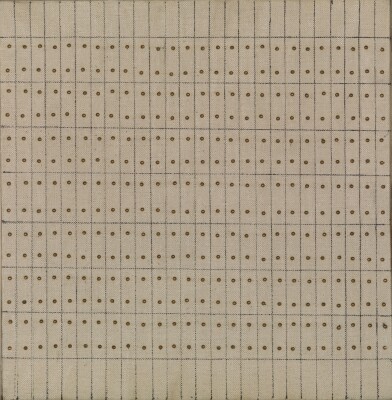
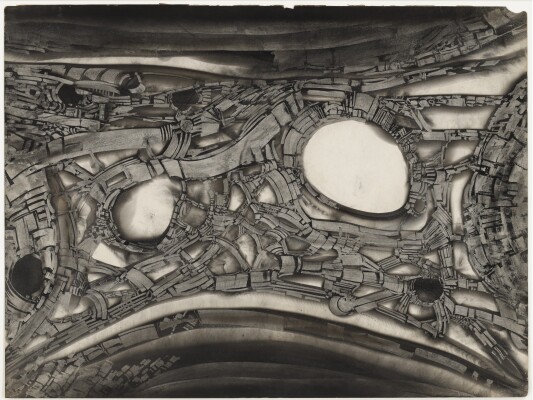
Intimately scaled for close viewing, No Title allures with delicate grisaille and uniformly arranged shapes. Long rectangular bands embrace defined passages of circles, the pigment subtly bleeding to the crisp edges as to further outline the forms. Each circle is complete with a pin-prick center, evidence of Hesse’s use of a compass and indicating the artist’s dedication to precision. Like the meticulous work of Agnes Martin and emblematic voids of Lee Bontecou, Hesse establishes here a sublime sense of space despite working on a flat plane. The Circle drawings, including No Title, significantly influenced Hesse’s transition from the two-dimensional to the three-dimensional. However, unlike other Circle drawings, the present work conceals its grid structure and reinforces palpable protrusions and recessions. As a result, No Title is both dense in its concentration of impeccably placed forms and lightweight in its varying atmospheric hues.


For Hesse, Minimalism was a formal structure with which to adhere and reinvent; she relied on its framework yet ingeniously introduced a rich materiality and directionality. As described by Scott Rothkopf of the Circle drawings, “Hesse’s repeated pairing of the circle and the grid… den[ied] that structure some of the very attributes that made it appealing to her contemporaries. For example, a circle could only be tangential to the grid at one point on each side of the square cell. This clearly cast the circle as a figure situated on a ground, thereby undermining the grid’s ability to deny that opposition and flatten space… It is perhaps because of the circle’s resistance to this perfect reciprocity between framework and module that it appears so infrequently in the Minimalist art of the 1960s, indicating a fundamental conceptual distinction between that work and Hesse’s.” (Scott Rothkopf cited in “Circle Drawings and Washer Pieces,” in Elisabeth Sussman, Ed., Exh. Cat., San Francisco Museum of Art, San Francisco; Wiesbaden Museum, Wiesbaden; Eva Hesse, February – October 2002, pp. 198-199)
“[D]on’t think that your work has to conform to any preconceived form, idea or flavor. It can be anything you want it to be…. I think that it is so deeply engrained in you that it would be easier to DO!”

Building upon and expanding the foundations of Minimalism, No Title’s elegant washes of gray pigment, which ever so slightly reach beyond the lightly penciled grid, elevate the composition to a splendid corporeal space extending beyond the paper’s bounds. As expressed by Hesse’s close friend and curator Lucy R. Lippard, Hesse’s drawings “are among the most beautiful in Hesse’s oeuvre.” (Quoted in Lucy R. Lippard, Eva Hesse, New York 1976, p. 15)

