“Prince’s appropriations of existing photographs are never merely copies of the already available. Instead, they extract a kind of photographic unconscious from the image, bringing to the fore suppressed truths about its meaning and its making.”
Grandiose yet unrevealing, Richard Prince's Untitled (Palomino), from the artist's seminal series, unpacks the mythology of an American icon. The cowboy, once thought of as a lowly ranch hand, saw himself polished and ingrained into the public imagination by the spectacle of Hollywood Westerns. The tough, heroic trailblazer archetype, primed for commercial exploitation, was prominently seized upon by the American cigarette maker Marlboro. For nearly a half-century, images of ‘Marlboro Men’–rugged cowboys roaming picturesque terrain on horseback–saturated the global media market. Intrigued by its staying power in the American ethos, Richard Prince appropriated the Marlboro cowboy, rephotographing it and fortifying the cinematic spectacle into one of his most enduring motifs.

Prince’s role as artist-appropriator stems from his work in the t.mes -Life tear-sheets department during the 1970s. While clipping away articles for staff writers, Prince was left with scraps of popular advertisements. Fascinated yet repulsed by the ubiquity of the cowboy, Prince saw it as a ripe subject for artistic exploration. In discussing Prince’s Cowboy series for his Whitney retrospective, Rosetta Brooks wrote, “The image of the cowboy is so familiar in American iconology that it has to become almost invisible through its normality. And yet the cowboy is also the most sacred and masklike of cultural figures.” (in Richard Prince, exh. cat., Whitney Museum of American Art, New York, 1992, p. 95).

Prince was particularly interested in the cultural implications of the cowboy’s redundancy. In Untitled (Palomino), Prince intensifies the artifice of an exhausted icon by rephotographing alluring imagery that Marlboro was eventually forced to abandon. A figure, riding astride in the harsh sun of the open plains, gazes towards something outside of view. The cowboy and his horses, mirrored across the rippled water, fade into the blue sky. The space below seems primed for advertising copy, yet it's devoid of its former textual indicators. The enticing ad is diminished in its replication–its tonality diluted, its details blurred, its framing cropped. In reducing the once seductive cowboy into something profoundly inauthentic, Prince calls for a re-examination of the icon without its commercial function.
Richard Prince Cowboy Photographs in Prestigious Museum collects ions:


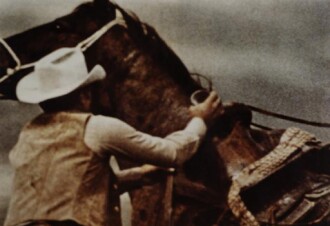


Untitled (Palomino) exemplifies Prince’s ability to rationalize a cultural symbol in flux. Existing once as a myth in the American psyche, then copied into an advertisement. It exists now as a copy of an image forever altered–a man foraging on, toppling the very myth he once proliferated. Images from the series are among his most recognizable, held in museum collects ions such as The Metropolitan Museum of Art, New York, the Art Institute of Chicago, the San Francisco Museum of Modern Art, the Walker Art Center, Minneapolis, the Modern Art Museum of Fort Worth, Texas, and many more.

