“The canvases of M. Fantin-Latour do not assault your eyes, they do not leap at you from the walls. They must be looked at for a length of t.mes in order to penetrate them and their conscientiousness, their simple truth – you take these in entirely, and then you return”
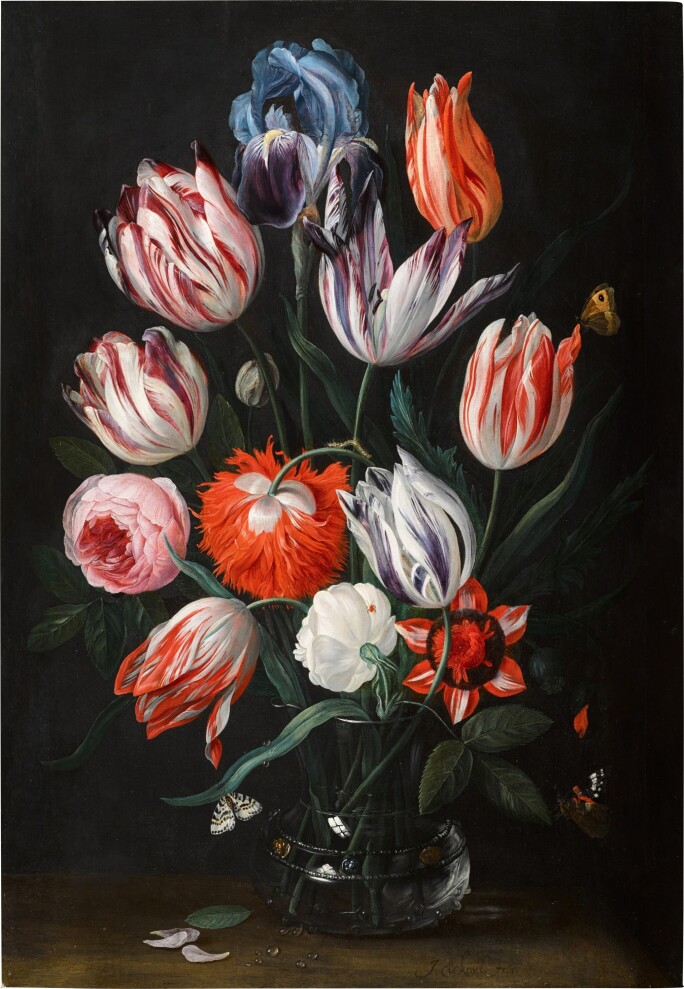
In Pivoines (1878), Henri Fantin-Latour showcases his mastery of still life painting, blending rigorous academic technique with the tonal claritys reminiscent of the Flemish tradition of floral still lifes. The soft cream and blush hues of the peonies, offset by vivid blue cornflowers, stand out sharply against a rich brown background – an homage to seventeenth-century Dutch painters who set blooms against a dark backdrop to heighten their visual impact (fig. 1). A delicate white light illuminates the inner petals, casting the flowers in a gentle glow that draws the eye and reinforces their role as both the compositional and symbolic centrepiece. Echoing the structure of a restrained portrait, the varied heights and shifting angles of the flowers lend the bouquet an animated spontaneity, while the ceramic jug mirrors the darker tones of the cornflowers above, creating a harmonious echo of colour and form.
Fantin-Latour’s rigorous academic training, first under the guidance of his artist father and later at the École des Beaux-Arts in Paris, instilled in him a commitment to technical discipline and careful naturalist observation. His formative years copying old master paintings at the Louvre refined his ability to render surface, tone, and structure with exceptional fidelity. These skills, initially honed within the context of portraiture, found their fullest expression in his still-life paintings, where he rendered flowers and fruits with utmost realism. In Pivoines, for instance, each bloom is rendered with such specificity and sensitivity that they take on individual personalities. As Jacques-Émile Blanche observed, Fantin “captures the physiognomy of the flower he is copying; it is that particular flower and not another on the same stem” (Revue de Paris, 15 May 1906, pp. 311-12). This is no mere impressionistic suggestion – Fantin constructed his floral subjects with the same deliberation and psychological insight as a portraitist confronting a sitter. As Lucie-Smith writes, “His belief, academic in origin, that technique in painting was separable from the subject to which the artist applied it, enabled him to see the blooms he painted not as botanical specimens, but as things which, though not necessarily significant in themselves, would generate significant art upon the canvas” (E. Lucie-Smith, Henri Fantin-Latour, New York, 1977, pp. 22-23).
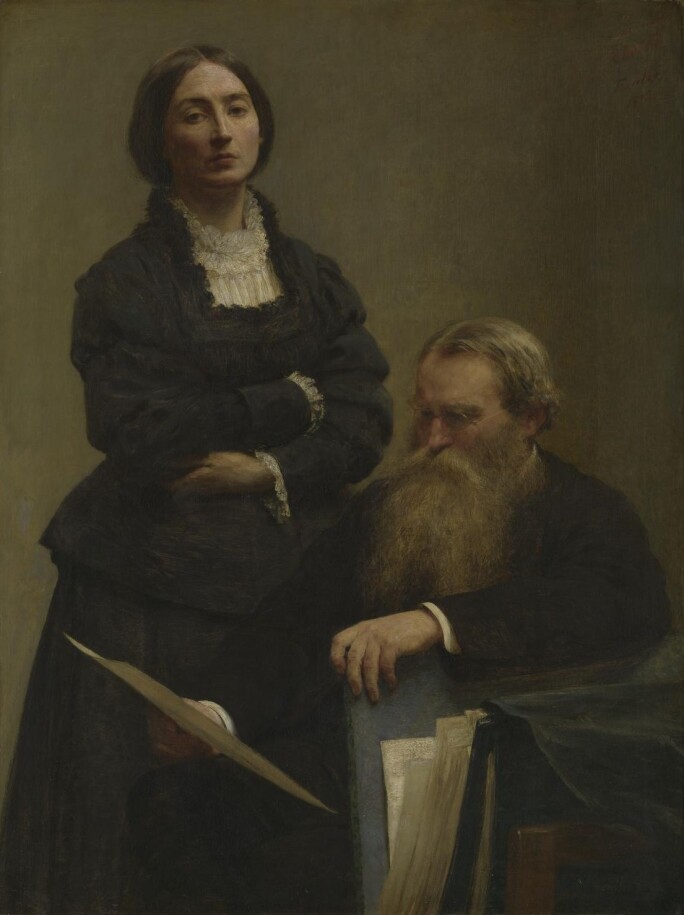
The success of Fantin’s still life paintings in Britain was due in large part to the dedicated patronage of Edwin and Ruth Edwards. Introduced to Fantin by Whistler, the Edwardses acquired a notable array of still lifes for the British market and facilitated his first exhibition at the Royal Academy in 1864. Pivoines was acquired by them shortly after its completion in 1878 and exhibited at the Royal Academy two years later, further cementing Fantin’s international reputation. As Douglas Druick has noted, “Quite naturally, his commercial success in Great Britain, organized thanks to the Edwardses, pushed him to increase his production: he would secure his independence and, in t.mes
, a comfortable life” (Douglas Druick in Exh. Cat., Ottawa, National Gallery of Canada, Fantin-Latour, 1983, p. 30). Pivoines stands as a quintessential example of Fantin-Latour’s œuvre, meticulously observed, compositionally refined, and quietly radiant. It encapsulates the artist’s rare ability to elevate the ephemeral beauty of cut flowers into enduring, contemplative works.