
“In painting African-American daily life, Mr. Marshall monumentalizes and ennobles it. Ordinary is extraordinary.”
Text, collage, and politically potent iconographical and historical references find common ground in the richly built surface of Plunge, which stands as one of Kerry James Marshall’s most important works and sets forth a visual lexicon entirely his own. Marshall powerfully centers a Black female protagonist in an intellectually loaded investigation, situating her among all the trappings of suburban American leisure: the single-family residence, the backyard swimming pool, and white picket fence. Executed in 1992, the year prior to the artist’s debut show at Jack Shainman Gallery in New York and included in his seminal 2013 solo exhibition In the Tower: Kerry James Marshall at the National Gallery of Art, Washington, D.C., Plunge stridently declares the arrival of his mature artistic praxis: the interrogation of the Western art historical canon and rectification of the Black figure’s absence within it. One of the earliest examples of Marshall’s unstretched “tarp” canvases and belonging to his celebrated Housing series, the amplified scale of Plunge also marks a pivotal shift in Marshall’s work. Marshall, an incisive revisionist, has left his indelible mark on the history of art; Plunge, as in his best paintings, retains not only its incendiary freshness but testifies to the evergreen relevance of these pictures and their conceptual agenda.
Kerry James Marshall’s Large-Scale 1990s Tarp Paintings in Museum collects ions


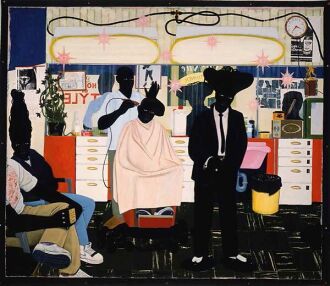

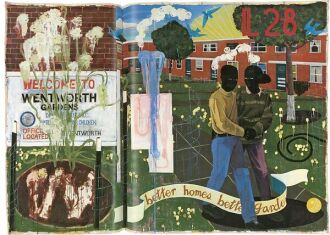
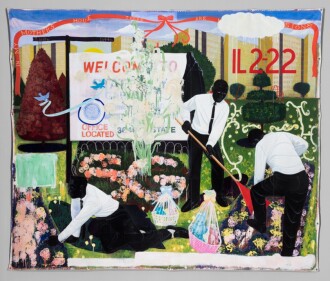


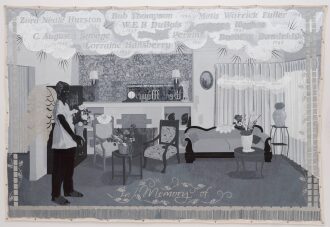

Arms stretched over her head, donning a swim cap and yellow polka dot bikini, a woman shown from behind stands at the edge of a diving board, evaluating the setting before her: a toy boat bobs in a cerulean swimming pool, abundant hedges bloom on either side of a white picket gate, and an unblemished sky shines overhead. The longer we look, however, the more we see: the pool’s water is so dark it becomes foreboding, and bulbs of light illuminate a scene ostensibly doused in daylight. As the scene unravels before our eyes, the earlier impression of a chlorinated, idyllic suburbia grows increasingly dubious. In the present work’s compositional inconsistencies lies Marshall’s critique of the apocryphal postmodern American dream: who are these neighborhoods meant for? Using whose labor was this “dream” made possible? Can the promise of upward social mobility be kept? “There is privilege and status embodied in the image of a flagstone-lined pool in a backyard,” the artist explains, “A little bit of ambivalence is created by the location of the sign on the gate. It says ‘Private’ on the inside. The figure is occupying the space you would have thought she might have been denied access to. Is this side ‘private’ — or is the other side?” (the artist quoted in: Exh. Cat., Washington, D.C., National Gallery of Art, In the Tower: Kerry James Marshall, June - December 2013, n.p.)

For Marshall, whose family moved from Birmingham, Alabama to Los Angeles in the early 1960s, these questions are charged with his own personal sent.mes nts. Having lived in the Nickerson Gardens housing project of Watts, a predominantly Black neighborhood in L.A., Marshall probes larger systemic forces that have reinforced forms of de facto racial segregation. Plunge’s abstracted and stylized surreal elements and tactile, collaged media continually reiterates its status as a painting and reveals the Arcadian imagery it contains for the illusion that it is.


“Blackness is not presented by Marshall as an afterthought or as a form of special pleading; it is offered as a radical presence that shows how the very notions of beauty and truth that paintings and museums hold to be self-evident are premised on exclusions that are ethically, philosophically, and aesthetically untenable.”
Central to Plunge is the inclusion of the pool and the metaphor contained therein. The word “ATLANTIC” and a ghostly compass are etched into the rippling water – here, Kerry has staged an allegorical Middle Passage. The toy boat symbolizes a slave ship, sailing east to west, and the once-innocuous swimming pool the Atlantic Ocean. “Water was the locus of the trauma,” Marshall continued, “The ocean is that vast incomprehensible, what appears to be nothingness. If you ever find yourself on a boat in the middle of the ocean you look around in every direction and don’t see anything. That’s a terrifying experience. Water still has significance relative to this idea of the Middle Passage. It enters into the suburban environment, through the pools in Plunge and Our Town and the water hose in Bang.” (the artist in: Exh. Cat., Washington, D.C., National Gallery of Art, In the Tower: Kerry James Marshall, June - December 2013, n.p.) The spectral, swimming figure is thus legible as a ghost of this history, and the iconography takes on a phantasmagoric valence: the flowers in the background, which, in their liquescent articulation recall Cy Twombly’s sprawling, bleeding blossoms, evoke the commemorative roses of a vigil. This scene of “leisure” affords its viewer no rest, rather prompting sorrow, lamentation, and a reconsideration of history as events that have passed and gone.

The title of the work possibly alludes to racist policies in place at the pool at Brookside Park in Pasadena, California, colloquially referred to as the “Brookside Plunge.” The pool, which had opened in the summer of 1914, only permitted citizens of color to use its facilities on Wednesday afternoons and evenings – the last day before its weekly cleaning. In 1919, the National Association for the Advancement of Colored People, or NAACP, established its Pasadena branch, largely to fight the City on its policies of racial segregation and backed a group of Black taxpayers who demanded equal access to Brookside Park’s facilities. The City only marginally conceded, expanding “nonwhite” access to the pool to Tuesdays between 2 to 5 pm, calling it “International Day.” Though the present work’s pool is situated in a suburban home, its larger probes into the origins of Black trauma in the United States remain the basis for later policies maintaining institutionalized racism – as evinced by the case at the Brookside Plunge – even after slavery had been abolished, painfully returning to water as a conduit for racism, dehumanization, and disempowerment.


Plunge’s inquisition into the politics of race, gender, and leisure within bodily aesthetics appropriately mines from and adds to traditions of Western painting, from Jean-Antoine Watteau’s fêtes galantes to Paul Cézanne’s bathers, but here, Marshall uncompromisingly includes his Black female subject in this tableau and unapologetically emphasizes the blackness of her skin. For Marshall, the act of representation and artistic ideology is inseparable to the technicality of painting, and in what he calls “a rhetorical blackness,” Marshall purposefully pushes the blackness of his subject’s skin to the extreme, thoughtfully mixing several pigments, such as ivory black, carbon black and iron oxide black, each with different hues to create subtle variations in skin tones. “Most people will automatically say, ‘Black people aren’t black, they’re brown’,” explains Marshall. “But then, if you use that rhetorical figure of blackness, why not make it concrete, artistically? So that’s what I do. But I do it in such a way that it doesn’t become a reduction, it becomes rich and expansive. That’s really been of critical importance to me – the development of that black figure as a device.” (Kerry James Marshall quoted in: Gabriel Coxhead, “When you put black people in a picture, what should they be doing?,” Apollo Magazine, 13 July 2019 (online)) The deliberate and dramatic darkness of Marshall’s figures casts the exclusion of Black bodies from canonical art history into radical relief. Just as Watteau’s opulent scenes of aristocratic recreation marked the Rococo’s last gasp before revolution, Marshall suggests that a paradigmatic reappraisal is due, from the relationship between brutality and the bucolic in aesthetic evaluations of leisure to the unspoken prerequisites of affluence and whiteness to experience it.

