“I like the idea of denim being used in fashion as something that people wear to say they are individual, whereas in fact everyone looks the same. There's something democratic about it as a material.”
Bangkok-raised artist Korakrit Arunanondchai engages a myriad of subjects encompassing history, globalization, animism and storyt through his multidisciplinary oeuvre. Seeking to bridge the gap between his Art practice in New York City and the context and belief system that formed his upbringing in Bangkok, Thailand. The artist started the project "Painting with history in a room filled with people with funny names" in the year 2012. Denim is the foundation of the artist's practice and project, starting with the avatar of the denim painter making denim paintings, "Painting with history in a room filled with people with funny names" builds itself over ten years and multiple episodes to become a practice in storytelling through different forms and mediums including video installations, sculptures and paintings. Denim for the artist shares the same trajectory as canvas as common from the West and through forces of globalization, became a ubiquitous materials. Unlike canvas which stands as a foundation to the discourse of Western Painting, denim becomes more of an entry point into global labour and trade systems.
The title of the present work, 2558, is the year 2015 on the Buddhist Calendar. The mannequin sculptures echoes the bodies of "guests" that inhibits Arunanondchai’s exhibition at the Palais de Tokyo in the summer of 2015. In “2558”, Arunanondchai’s subsequent exhibition at the Ullens Center for Contemporary Art in late 2015, the silhouette of the yellow man gives structure to the installation: one half of his silhouette is traced in electrical wiring running up and down structures supporting paintings and objects in one room, while the other half is laid out in body pillows on the floor of a video screening room, forming a circuit of biological and electrical energy. This circuit is repeated in a miniaturized architectural model in a fish tank otherwise inhabited only by a silver arowana, a sublimation or elevated version of the snake, naga, that swallows the exhibition. Fragmented images from the tank are displayed on a video monitor at the entrance of the exhibition revealing the arowana fish devouring the miniture model of the exhibition as t.mes
goes by.
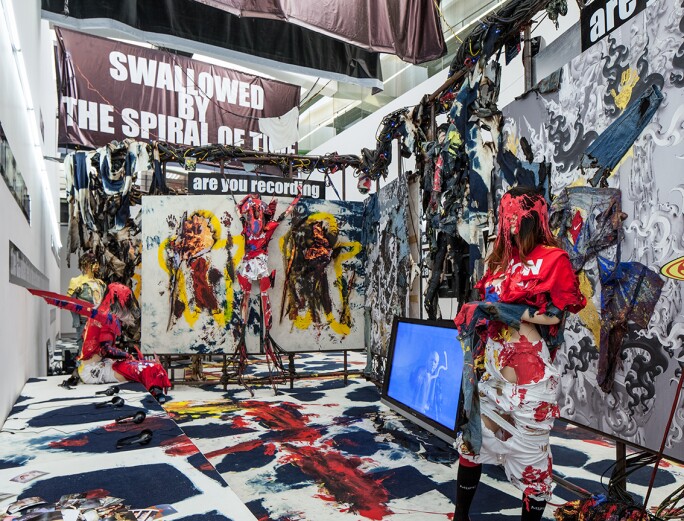
All images courtesy the artist, C L E A R I N G (New York, Brussels) & Carlos/Ishikawa (London)
2015年在北京尤倫斯當代藝術中心《2558年的觀點》 的展覽現場
The painting portion of the present work arises from footage of a famous tourist temple in Northern Thailand, the Wat Rong Kun (White Temple), which was designed and produced by the artist Chalermchai Kositpipat. This series of eleven white and gold paintings marks the artist’s first collaboration with his twin, Korapat Arunanondchai. The paintings emerge out of the narrative of the third video in the trilogy, Painting with History in a room filled with men with funny names 2 (2557), in which the Arunanondchais travel to the temple as part of a fictional documentary where they switch roles and play each others.
Arunanondchai moved to the States in 2005 to attend the Rhode Island School of Design for his bachelors and received an MFA in 2012 from Columbia University. He has had several solo exhibitions at CLEARING gallery in New York and Brussels and featured in major group exhibitions and biennales including the 2019 Whitney Biennale, The 16th Istanbul Biennale, the Dhaka Art summit. He has had major solo exhibitions at Secession, Vienna, Palais de Tokyo, the Ullens Center for Contemporary Art, Beijing; S.M.A.K., Ghent; Museion, Bolzano; and KIASMA, Helsinki. His first solo institutional exhibition, 2012–2555, was unveiled at MoMA PS1 in New York. Additionally, the artist previewed his upcoming film, Painting with history in a room filled with men with funny names 2, at MoMA PS1’s event during Art Basel Miami Beach in December 2013. In 2018, his film, No history in a room filled with people with funny names 5 (2018), was featured at the 58th Venice Biennale in 2019.
「人們穿著牛仔時裝來標榜自己的獨立個性,誰知最後所有人看上去都一模一樣,這種自相矛盾對我來說非常吸引。作為一種紡織物料,牛仔布帶點民主意味。」
寇拉克里・阿讓諾度才在曼谷土生土長,他以跨門類的藝術創作探討各種概念議題,包括歷史、真實性、自我形象與旅遊業等。阿讓諾度才致力在自身的泰國文化背景與他在美國的留學和生活經驗中間尋求協調之道。牛仔布是藝術家創作與個人身份的象徵——他喜歡穿牛仔布衣衫,也熱衷用牛仔布料創作。他認為這種布料是普世的,並藉此就西方文化對亞洲時尚以至藝術等全方位的影響力提出質詢。
本作的標題《2558》意指佛曆2558年,即公曆2015年。作品中的人體模型與阿讓諾度才2014年夏天在東京宮舉辦的展覽互相呼應,展覽上佈滿人體模型、電子零件、泡沫塑膠白菜球、汽車零件及電視屏幕,將展場蛻變成一個如噩夢般令人毛骨悚然的電影院,登峰造極。2015年末,阿讓諾度才再在UCCA尤倫斯當代藝術中心舉辦展覽「2558」;他的作品常見的黃色人形輪廓,在這場展覽中化身成為一件裝置雕塑——人形的半邊身由電線組成,這些電線穿插在房間的建築物之間,與繪畫及擺設相連;他的另外半邊身由影像播映室地上的枕頭連接而成,形成一個生物與電子能源迴路。這種「循環」概念在一個魚缸裝置作品中的小型展覽空間模型中再次呈現,魚缸中養有一條銀龍魚,是那伽蛇神(naga)的崇高化身,寓意蛇神將展覽吞噬,循環往復。展覽入口處的電視屏幕顯示魚缸中的零碎圖像。
本作的繪畫部份取材自阿讓諾度才於泰國北部著名寺廟「白廟」(Wat Rong Kun)拍攝的錄像,寺廟由藝術家許龍才(Chalermchai Kositpipat)設計及建造。此系列有十一幅以白色及金色為基調的畫作,是藝術家和孿生弟弟寇拉帕特・阿讓諾度才(Korapat Arunanondchai)的首度合作。這些畫作的靈感源自藝術家裝置藝術三部曲的第三件影像作品《2557(在滿是怪人的房間裡,用歷史作畫2)》,記錄了阿讓諾度才兩兄弟在寺廟遊覽的經歷。
阿讓諾度才少年時是一位泰國說唱歌手,其事業生涯始於音樂界。其後他負笈美國,在羅德島設計學院修讀本科,2012年於哥倫比亞大學取得美術碩士學位,在校期間曾與藝術家里克力・提拉瓦尼加(Rirkrit Tiravanija)一起工作。他曾在紐約及布魯塞爾的CLEARING畫廊舉辦數場個展,曾參與雕塑中心、費雪藝術中心、北京UCCA尤倫斯當代藝術中心舉辦的大型群展。根特市立當代藝術博物館、博爾扎諾繆斯之殿及赫爾辛基奇亞斯瑪當代藝術博物館亦曾為阿讓諾度才舉辦展覽,他的首場博物館個展「2012–2555」於紐約現代藝術博物館PS1分館舉行。阿讓諾度才曾於紐約現代藝術博物館PS1分館在2013年12月邁阿密海灘展會上所舉辦的活動中,為他即將上映的錄像作品《在滿是怪人的房間裡,用歷史作畫2》舉辦試映會。2018年,阿讓諾度才的另一件錄像作品《在滿是怪人的房間裡,沒有歷史5》(2018年作)於威尼斯雙年展上公映。