Dating from 1938, Allegro is emblematic of Rudolf Bauer’s distinctly lyrical brand of geometric abstraction. The present work was executed during a critical period in Bauer’s career following his momentous encounter several years prior with Solomon R. Guggenheim, the celebrated American industrialist and art collects or, who would become his main patron and supporter. Most of Bauer’s output from the late 1920s onwards was commissioned and acquired by Guggenheim, allowing his artistic talent to flourish and subsequently, as the political climate in his native Germany deteriorated, making it easier for Bauer to eventually emigrate and settle in the United States.

Bauer began his career in Berlin at the onset of the First World War, becoming a prominent figure in the avant-garde circle at Herwarth Walden's famed Galerie Der Sturm alongside fellow luminaries Paul Klee, Franz Marc and Wassily Kandinsky. It was the latter artist who influenced Bauer the most, and their shared passion for spiritualism and musically derived improvisation in art led them to collaboratively refine their styles and theories and exhibit together often throughout the late 1910s and early 1920s (fig. 2).
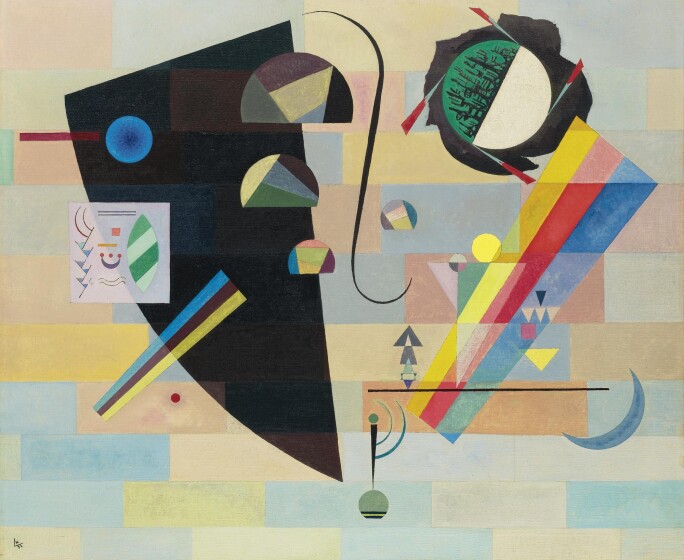
The title of the present work alludes to its strong connection to music, with “allegro” referring to a mark used in musical scores to indicate a cheerful and vivacious approach to playing a particular passage. Set against a delicately pale blue background, an array of differently coloured and sized geometric shapes – predominantly squares and rectangles – are intricately balanced by the artist to create a canvas imbued with a striking sense of rhythm and harmony. Although the canvas remains entirely abstract, the two elongated red shapes in the bottom left quadrant form an outline similar to a musical key.

While Allegro exemplifies the affinity between music and painting which Bauer frequently explored in his work, the use of squares as the painting’s compositional foundation is likewise evocative of the work of the pioneer of geometric abstraction Kazimir Malevich (fig. 3). Yet, while paying tribute to this simple, pure shape, stripped of any connections to representation, Bauer in this instance proceeded to develop around it a composition that, while remaining true to non-objectivity, is uniquely expressive and poetic.

Right: Fig. 5, Rudolf Bauer, Tanzende Bälle (Dancing Balls), circa 1935-38, oil on canvas, Sold: Replica Shoes ’s London, March 2024, £520,700
Shortly after it was painted, Allegro was included in the landmark 1939 exhibition Art of Tomorrow held at the newly opened Museum of Non-Objective Painting in New York, the forerunner of the Solomon R. Guggenheim Museum. In the introduction to the catalogue, Hilla von Rebay, the German art advisor and first director of the Guggenheim Museum, noted that, “Non-objective masterpieces […] are alive with spiritual rhythm and organic with the cosmic order which rules the universe. […] The power of their electricity influences everyone who lives with them” (H. von Rebay, in op. cit., p. 5). In the same article she proceeded to single out Bauer “whose every work of Non-objectivity” in her view was “an accomplished masterpiece and so extraordinarily organised that no space, no form, no point could be eliminated or changed without upsetting the perfect organisation of his creation” (ibid., p. 8). A superb example of Bauer’s creative output from a pivotal period in his artistic career, the present work is making its first auction appearance in 25 years.
