I who came into the world sick, in sick surroundings, to whom youth was a sickroom and life a shiny, sunlit window – and out there I wanted so much to take part in the dance, the Dance of Life’
Dance on the Beach gives vivid life to Munch’s unique vision. Encompassing the full range of emotional life, from love and desire to anxiety and death, his art turned inward to make feeling itself the subject. In his sustained exploration of the ‘modern life of the soul’, Munch would have a profound impact on artists from the 1890s to today, opening up a rich seam of expressionism. Combining his rich colouration, magical mood and exquisite handling, the present work is as compelling as it is enigmatic. It realises fully Munch’s ambition to capture in paint our ‘dance of life’.
In 1906, legendary theatre director Max Reinhardt (who would later go on to direct films in Hollywood) commissioned Munch to decorate a room in his new theatre, the Kammerspiele, in Berlin. The room would act as an entrance to the theatre and was envisaged as an immersive experience in which the theatregoer would be fully subsumed into Munch’s world. The result of this commission was the twelve canvases that are now known as The Reinhardt Frieze. Munch once wrote that a frieze should have, ‘the same effect as a symphony. It can rise in scale towards the light, and it can sink down into the depths; it can rise and fall in strength. In the same way its tones can sound and resound […]. But the rhythm will still be there’ (quoted in Johan H. Langaard & Reidar Revold, op. cit. p. 22). In this case, Dance on the Beach might be seen as the height of a crescendo; at just over four metres wide, it is the largest work from the frieze and the only part still in private hands — the others are all in museum collects
ions in Germany.
The Reinhardt Frieze 1906-07


Munch’s frieze is closely connected to his commission to paint the set designs for the theatre’s inaugural productions – a staging of Henrik Ibsen’s Ghosts (November 1906) and the subsequent production of Hedda Gabler (March 1907). As Arthur Kahane, one of the writers at the theatre would later recall, ‘I have heard Reinhardt declare a hundred t.mes s that no other painter ever provided him with such inspiration as Munch did in these paintings. And in that remarkable production Reinhardt did indeed manage to perfectly translate the indescribably affecting attitudes and atmospheres of the painter’s vision into the reality of the stage’ (Arthur Kahane, 1926). The modern audience can only imagine how it might have felt to be immersed in Munch’s vision of the world, before then being transported through his painting into Ibsen’s haunting work.
Munch began work in the autumn of 1906 with the Frieze finally installed the following year. As he wrote in a letter to his aunt dated 26th December 1907: ‘Lots to do with the decorations for a theatre in Berlin, “Kammerspielhaus”, so I had no t.mes to write. Finally, this huge job is just about finished – but what’s really tiresome is the pay was not enough for all the effort. – Quite interesting though, it’s a frieze I’ve painted in one of the main halls – covers all four walls – and the motif is based on the beach outside my house in Aasgaardstrand – Ladies and Gentlemen on a summer night’ (quoted in Gerd Woll, op. cit., p. 718).

right: FIG. 2, EDVARD MUNCH, THE SCREAM, 1895, PASTEL ON BOARD, SOLD: Replica Shoes ’S, NEW YORK, MAY 2012, $120 MILLION
‘Out of decorative considerations he resolutely spurned all motifs which were not viewed against a background of Nature, including the “death scenes”. He painted men and women on a summer’s night, as he put it, and gave pictorial cohesion to his figure-motifs with the help of Asgardstrand’s softly undulating shoreline, with its straight tree-trunks. Here we find, already fully-fledged, the decorative leit-motif of the Frieze of Life’

PRIVATE collects ION © Tracey Emin. All rights reserved, DACS 2023
The twelve canvases of the Reinhardt Frieze reimagine the artist’s seminal body of work – the compositions he called his ‘Frieze of Life’. Beginning in the 1890s, this series includes Munch’s most powerful images including The Scream, Vampire, Madonna, The Kiss, Angst, Melancholy and The Dance of Life (figs. 1, 2 and 4). Together, in loose chapters of love, anxiety, sickness and death, they plot the psycho-emotional journey of the contemporary soul. Munch draws moments from his own physical, mental and erotic life that embody a universal truth. Each truth is expressed in a direct, unmediated way, doing away with all the artifice and illusion of the painterly tradition. This extraordinary suite delivered the first examples of true Expressionism which would subsequently inspire some of the greatest art of the twentieth century, from Ernst Ludwig Kirchner to Henri Matisse, and Francis Bacon to Tracey Emin (fig. 3).

Dance on the Beach reworks Munch’s 1899-1900 Dance of Life (fig. 4) the ecstatic culmination of his Frieze of Life. Reveling under the midnight sun, by the shores of the Oslofjord, an embracing couple is surrounded by dancing figures and framed by two women – one in white and one in black. On one level, Munch’s composition is an allegory of the cycle of life. The figures can be read from left to right as an arc of life, from youth and innocence, through sex and anxiety to final death.

But the painting also explores complex ideas about the relationships between the sexes, and particularly the sense of love as inextricably connected with pain and death. Love is placed at the centre, where Munch dances with his first love, Millie Thaulow. Flanking them at either side is Tulla Larsen, with whom Munch shared a passionate and incendiary affair that culminated in Munch being shot in the hand in 1902. Tulla is shown both in bridal white, picking a flower of love, and in mourning garb. In the Reinhardt version, she has been turned to face the viewer head-on — a classic Munchian trope — and evokes sketches Munch made of Ibsen’s Hedda Gabler for his stage designs. Indeed, Dance on the Beach displays an increased sense of theatricality and heightened intensity that makes for a compelling atmosphere.
‘Munch invites us to desire […]. The transformative sensations of attraction, of falling in love. I may not believe in two becoming one, but I raise a glass to him as he succeeded in showing some of those moments through paintings that never pretend to be what they are not. No illusionism, all suggestion. Every gesture can be traced’.

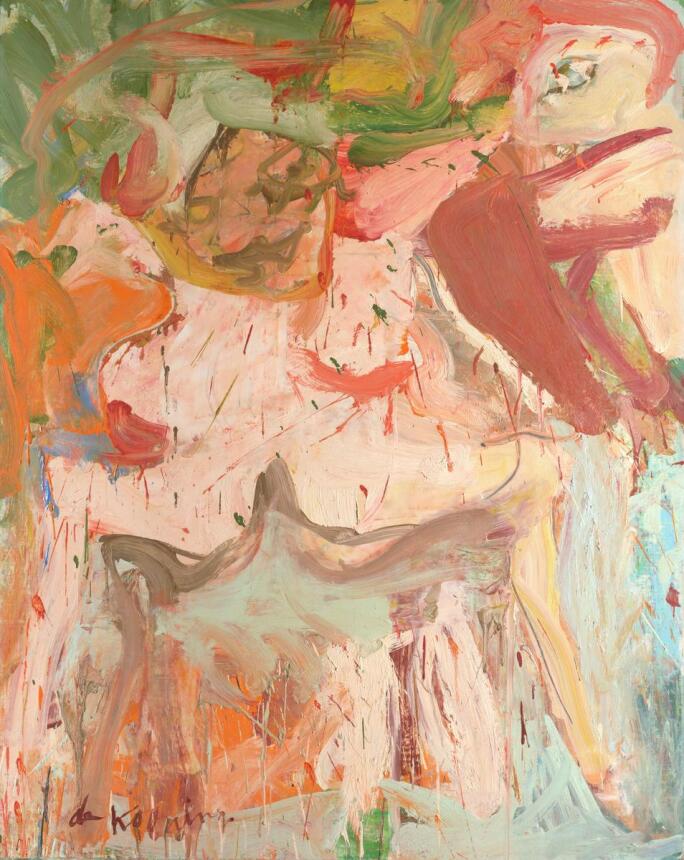
Dance on the Beach also offers insight into Munch’s stylistic and technical innovation over t.mes . He had visited Italy in 1899 and been much impressed by Renaissance frescoes (fig. 6). It seems evident that in the present work he is attempting to capture something of the same ‘feel’ using tempera to create that same distinctive softness and working the paint to conjure a raw tactility. The perspectival flatness and figural disposition also seem to evoke the Italian masters, yet at the same t.mes Munch’s technical experimentation was key to his modernity. The paint is handled with a raw and brutal energy: ‘Munch was interested in everything that lay on the surface of a painting, and he allowed the very process of painting to come to light […]. Munch would scrape and add to the painting many t.mes s. Somet.mes s, he squeezed thick paint directly from the tube, or thinned it out so that it ran down the picture. His paintings were no longer just recognizable motifs, but also told the story behind them – the act of painting’ (Munch-Museet). In this he was pre-empting the developments of Abstract Expressionism in the mid-twentieth century (fig. 7) with each raw brushstroke becoming a sign of its own emotional authenticity.
Munch’s radical technique had other impetus too. Dance on the Beach has a looser, more abstract feel than his earlier work, with colour becoming increasingly expressive rather than descriptive. Munch knew well the Parisian avant-garde and his use of colour, brushstroke and landscape as vehicles of human emotion clearly relates to groundbreaking experiments by Gauguin (fig. 8), Van Gogh and the Symbolists.

It has been argued that Munch takes the German concept of the Seelenlandschaft – the landscape of the soul – and indelibly links it to the language of modernity. Christoph Kivelitz & Regina Selter write: ‘In landscape pictures with figures as well, Munch aims at a state of tension between humans and space and at the psychological component of that relationship. Munch perceives landscape as a reflection of an emotional experience and of a prevailing mood that the figure is bound into by the composition and at the same t.mes put out of as an alien element’ (C. Kivelitz & R. Selter, ‘Looking in – Looking out. Inner and Outer Worlds’, in Munch revisited. Edvard Munch and the Art of Today (exhibition catalogue), op. cit., p. 19). This is perfectly captured in Dance on the Beach which represents all the passionate intensity that characterises Munch's best work and made him such a pivotal figure in twentieth century art.
MUNCH AND HIS collects ORS

The Reinhardt Frieze hung in the Kammerspiele for only a short t.mes ; in 1912 the room was refurbished and the frieze taken down. Initially an arrangement was made to sell the whole frieze to gallerist Hugo Perls, but in the end it was Fritz Gurlitt who acquired the group. Dance on the Beach was acquired by art historian Dr Curt Glaser shortly afterwards, with Glaser writing to Munch in 1916 confirming that he now owned three of the original canvases from the frieze. Glaser had met Munch on a trip to Norway in 1913 and became an important patron and friend of the artist (fig. 9) who painted Elsa’s portrait the same year. Glaser played a crucial role in organizing exhibitions of the artist’s work and in 1917 he published the first German monograph on Munch.
Over the first decades of the twentieth century, Curt and his wife, Elsa, amassed a wide-ranging and significant collects ion of artworks. A large part was comprised of Old Master paintings and drawings and Modern works by artists including Henri Matisse, Max Beckmann, Ernst Ludwig Kirchner and Oskar Kokoschka. Photographs of the Glasers’ Berlin apartment (fig. 10) show these works hung alongside antique furniture, art objects from all periods and all corners of the globe and an extensive library of rare books. This approach to presenting art was in line with contemporary artistic dialogues about non-European art and are indicative of Glaser’s scholarly approach to collects ing.

Glaser was curator at the Kupferstichkabinett, Berlin and then director of the Kunstbibliothek from 1924; from this position he did much to promote the cause of Modern art including carefully curating the holdings of the Kupferstichkabinett adding works by a number of key modern artists, including Edvard Munch. When the National Socialists came to power in 1933, Glaser was removed from his position, evicted from his apartment and forced to flee Germany, selling a large part of this collects ion at a series of auctions. Dance on the Beach was sold at the Internationale Kunsthaus in 1933. Glaser’s legacy is currently being celebrated by an exhibition at the Kunstmuseum in Basel, bringing 200 works together for the first t.mes since they were dispersed in 1933.

The work was subsequently acquired by Thomas Olsen (fig. 11). Olsen was a friend and neighbour of Munch’s in Norway and was instrumental in the preservation of the artist’s legacy, working with him to retrieve many of the works deaccessioned by German museums once Munch’s art was declared degenerate by the Nazis. Olsen assembled one of the most important private collects ions of his work, and this work is continued to this day by his son Petter who has recently opened a gallery in Ramme, Norway at the home where Munch lived until his death in 1944.
Olsen hung Dance on the Beach in the smoking lounge of his passenger liner the MS Black Watch (fig. 12) – which travelled between Oslo and Newcastle – from January to September 1939. After Britain declared war on Germany, he removed the artwork and laid the vessel up in anticipation of the German invasion. Thomas Olsen took his Munch pictures, including The Scream (fig. 2), into hiding in a barn in the Norwegian forest for the duration of the conflict. The ship was subsequently seized by the German U-boat squadron and destroyed later in World War Two. Recovered from its hiding place after the war, Dance on the Beach has remained in Olsen's family ever since and has not been publicly exhibited since 1979. It is offered for sale pursuant to a settlement agreement between the current owner and the heirs of Dr Glaser.
