


“Ever since I started, ever since my earliest works… I have tried… to use language, work, experience, culture, sensations, everything that occurs in regard to our nature, our please, or our limits in order to bring things together again.”
An icon of sculptural complexity and radical material experimentation, Sullo stato from 1970 stands among the most conceptually resonant and materially profound works of Luciano Fabro’s career. Rendered in lead, wood, and a roadmap, the present work is an arresting entry in Fabro’s seminal Italie series. First developed in 1968, this acclaimed suite of works reimagines the Italian peninsula as a mutable site of cultural memory, personal exploration, and philosophical weight. If Arte Povera redefined the artist’s relationship to everyday materials and inherited symbols, Sullo stato offers an incisive meditation on nationhood, identity, and the tension between form and ideology. Italia was, for Fabro, a fixed form through which to measure the variability of artistic intention. As Fabro describes, “I need to know how my hands function on something which remains static. The form of Italy is static, immobile, I measure my hands’ mobility against its stillness.” (the artist quoted in: Exh. Cat., San Francisco, Museum of Modern Art, Luciano Fabro, 1992, p. 109) The geographical silhouette of Italy, with its instantly recognizable contours, became both subject and structure, a means of translating complex ideas about place, history, and cultural legacy into tactile form. In Sullo stato, this familiar outline is rendered mute and impenetrable. Coated in dark, heavy lead, the roadmap beneath is almost entirely obscured, suggesting a sculptural metaphor for a nation weighed down by its own history.


The title, Sullo stato, carries a dual implication: a meditation on the physical state of the sculpture itself and a broader reflection on the political condition of Italy during the Anni di piombo (Years of Lead), a t.mes marked by terrorism, political fragmentation, and civil unrest. The lead surface acts like a shield or veil, resisting transparency and refusing claritys . In this gesture, Fabro questions whether the modern state, understood both literally and symbolically, can ever be fully seen or understood. The map, traditionally a tool of knowledge and power, here becomes a gesture of refusal. Unlike many of Fabro’s Arte Povera peers who embraced ephemerality or anti-form, Fabro’s approach was anchored in precision and claritys of craft. He did not aim to erase tradition but to reframe it, often using the richness of material to contrast with the spareness of form. Fabro’s choice of materials, especially in Sullo stato, adds to the viewer’s sensory engagement, encouraging close inspection of surface, weight, and texture.

“It never occurred to me to do something like Jasper Johns was doing, but at the same t.mes , his preoccupations were familiar to me and interested me: when he took the American flag and just left it there, as it was … He takes something, here makes it identically, and he realizes that it is not the same thing; it has become a pictorial fact. So I understood that in recreating the object, you do not recreate the experience. The problem is somewhere else.”
Conceived just two years after the first Italia, Sullo stato was among the earliest in a series that Fabro would revisit throughout his career in glass, fur, bronze, mirrored glass, and fabric. In the present work, the heavy, asymMetricas l mass takes on a monumentality that transcends its scale. The peninsula is depicted not as a whole but as a husk — fragmented, encrusted, and closed in on itself. The two islands of Sardinia and Sicily, often included in later variations, are notably absent here: what remains is an isolated mainland, dense with unspoken history. As with all of Fabro’s Italie, Sullo stato is a site of potential. As Fabro once noted, “The Italies are like an album of sketches, a memo, I continue to make it over the years: if I study something new, I sketch it in an Italy.” (the artist quoted in: Exh. Cat., San Francisco Museum of Modern Art, Luciano Fabro, 1992, p. 109)
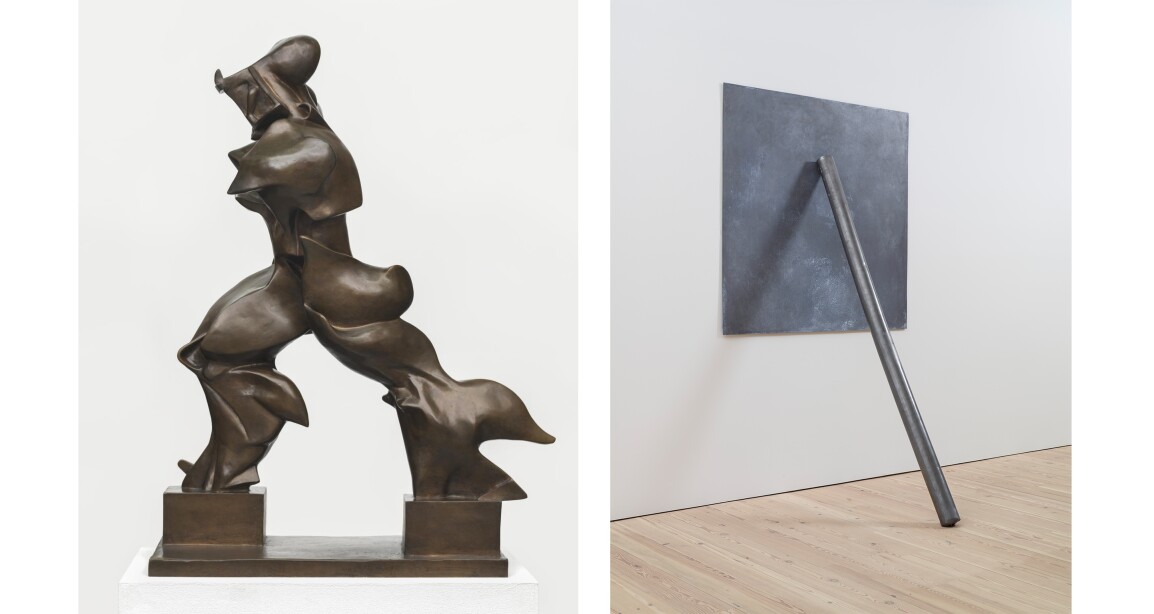


Sullo stato employs the outline of Italy not to evoke unity, but to question it. Through the obscured roadmap, the present work communicates on a spatial level, positioning the viewer in front of a symbol they know but can no longer read. The absence of detail forces a confrontation with surface and structure rather than with narrative. Fabro’s denial of legibility disrupts our expectations, just as the lead disrupts light and smoothness. This emphasis on tactile and visual resistance reinforces his belief that.mes aning emerges not through explanation but through experience. The viewer is invited to read the sculpture through its physical properties: its scale, its weight, its opacity. The present work does not attempt to define a single identity or ideology but instead reflects the artist’s ongoing investigation into how form and material can shape our relationship to place. At once restrained and resolute, it anchors Fabro’s broader exploration of national memory, physical presence, and the visual codes through which we understand both.

