Lot113 N11729Georgia O'Keeffe Large Dark Red Leaves on White


“It’s a wonderful morning – the leaves are turning – crickets singing – most summer people gone home – there is no sun but it's warm and fine – We have been having perfect days of perfect quiet sunshine – working lots”
Duncan Phillips and the Story of America’s First Museum of Modern Art


After relocating to New York in 1918 at the invitation of gallerist Alfred Stieglitz, Georgia O’Keeffe quickly integrated herself into the city’s American modernist art scene. By August of that year, O’Keeffe visited the Stieglitz family summer house on Lake George for the first t.mes , establishing a longstanding tradition of seasonal sojourns between Manhattan and Lake George that pose a strong impact on her artistic output of the 1920s. “I was never so happy in my life,” O’Keeffe wrote of her t.mes on Lake George (in a letter from O’Keeffe to Elizabeth Stieglitz, dated January 1918). The exposure to nature proved mentally restorative for the young artist, and the richness of the colorful Adirondack landscape inspired her creative development tremendously in the years that followed.
“I wish you could see the place here - there is something so perfect about the mountains and the lake and trees”
Dated to 1927, Large Dark Red Leaves on White hails from an immensely productive moment in O’Keeffe’s early career when her fascination with the still life tradition, the juxtaposition between realism and abstraction, and a deep attraction to nature dominated her practice. Executed at the Lake George estate of Stieglitz's family – whom O’Keeffe married in 1924 – O’Keeffe documented the lively garden, and surrounding landscape with heightening curiosity throughout the twenties. Large Dark Red Leaves on White is one of the most highly stylized and intricate leaf renditions she ever produced, showcasing her unique ability to transform the natural landscape into avant-garde subject matter that redefined the parameters of both the still life and landscape traditions.

“It was Arthur Dow who affected my start, who helped me to find something of my own”

O’Keeffe’s intrigue into the leaf motif dates back to her education with instructor Arthur Wesley Dow, who was the director of the Teachers, College, Columbia University art department where O’Keeffe trained in 1914. “This man had one dominating idea: to fill a space in a beautiful way – and that interested me,” O’Keeffe explained in her 1960 interview with Katharine Kuh (“The Artist’s Voice,” 1960, pp. 189-90). Dow’s approach to line, color and form revolutionized O’Keeffe’s manner of thinking, and his 1899 handbook “Composition” preached the value of balance in aesthetics. Borrowing from the Japanese tradition of Nōtan, which relies on light and shade to create contrasting yet harmonious designs, Dow encouraged a departure from traditional realism that O’Keeffe wholeheartedly embraced. One of Dow’s hallmark exercises involved prompting students to “take a maple leaf and fit it into a seven-inch square in various ways,” a technique that would perhaps foretell O’Keeffe’s subsequent investigation into the leaf subject once she arrived at Lake George years later (Charles Eldredge, Georgia O’Keeffe, New York, 1991, p. 70). With its intricate layering of light and dark, Large Dark Red Leaves on White recalls Dow’s influence and the specific role that Nōtan principles played in her artistry. Beyond the contrast in color evident in the present work, O’Keeffe’s concern for spatial awareness and her enlargement of the leaf form signifies a clear regard for photographic conventions and the manipulation of objects within a picture plane.
“I’ve been wanting to tell you again and again how much I liked your work - I believe I’ve been looking at things and seeing them as I thought you might photograph them - isn’t that funny - making Strand photographs for myself in my head”
O’Keeffe’s approach to enlarging and abstracting natural subjects was highly innovative for the twenties and contributed heavily to her acclaim within the American modernist sphere. “We need never fear for the flowers and the leaves,” an anonymous Art News reviewer proclaimed in 1926, “there O’Keeffe is master” (Art News, vol. 24, February 13, 1926). Her ability to elevate such small-scale forms into magnified, beautifully-arranged compositions signifies the influence that modern photography played on O’Keeffe’s early development. “She would have seen many examples of the camera’s ability to isolate and enlarge a flower,” curator Hunter Drohojowska-Philp explains. “Steichen’s photograph of an isolated lotus was featured in Vanity Fair in 1923” (Hunter Drohojowska-Philp, Full Bloom: The Art and Life of Georgia O’Keeffe, New York, 2004, p. 246). Through the Stieglitz circle artists that exhibited at 291 gallery and elsewhere in New York, O’Keeffe developed close relationships with many of the nation’s leading photographic minds. Her friendship with Paul Strand, for instance, and affinity for his practice, is captured in many of O’Keeffe’s letters from the period. Envisioning how Strand would photograph a small-scale object, according to O’Keeffe, directly affected her approach to subjects such as Large Dark Red Leaves on White.

The leaf motif continued to dominate O’Keeffe’s artistry throughout the twenties, until 1929 when she traveled to New Mexico and became increasingly occupied with documenting the American southwestern landscape. During this t.mes , the autumnal palette that warms Large Dark Red Leaves on White saturated her body of work. “I always look forward to the Autumn – to working at that t.mes ,” O’Keeffe wrote (as quoted in Modern Nature: Georgia O’Keeffe and Lake George, New York, 2012, p. 43). Concentrating on the vibrancy of the leaves themselves and allowing the non-representational white backdrop of the composition to fade out of frame, O’Keeffe’s bold approach to the present work illustrates her intense focus on the organic form of the leaf itself. From small-scale studies to larger, more expansive oils such as the present example, the leaf became a pervasive and powerful motif within O’Keeffe’s oeuvre that speaks not only to the spirit of the surrounding Adirondacks, but also to the artistic principles that shaped her early stylistic development.
Georgia O’Keeffe’s Leaf Paintings in Museum collects ions
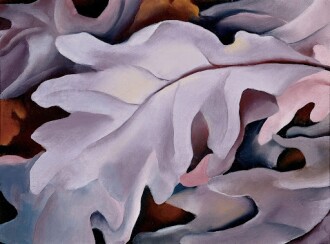


Through her investigation into the magnification and enlargement of natural forms in the twenties and beyond, O’Keeffe created a new visual vocabulary that redefined the painter’s approach to nature. Her unique language of abstraction, which enhanced the anatomic qualities of the leaf or flower at hand by simplifying line, color, and form, set the precedent for future generations of abstract artists. With her high regard for fluidity of form and boldness of palette, her early leaf abstractions from the 1920s evoke Henri Matisse’s cut-outs, particularly his vegetal examples from the late 1940s such as White Alga on Orange and Red Background. Large Dark Red Leaves on White is a prime example of how O’Keeffe revolutionized the relationship between artist and nature, creating a mode of abstraction that synthesizes the still life tradition, photographic principles, and a deep concern for the innate beauty of the natural world.

The present work has resided in the Phillips collects ion since 1943, when renowned patron Duncan Phillips acquired it directly from An American Place. Calling her a “technician of compelling fascination, especially in her flower and leaf abstractions,” Phillips was an early champion of her artistry (“collects ion in the Making,” 1926, p. 66). In a letter dated 7 May 1943, Stieglitz wrote to Duncan Phillips that Large Dark Red Leaves on White was “one of O’Keeffe’s most beautiful offspring.” This exchange, paired with Phillips’ own deep appreciation for O’Keeffe’s oeuvre, ultimately led to the acquisition of the painting in 1943. For the first t.mes in its nearly hundred-year existence, Large Dark Red Leaves on White comes to auction this November with highly esteemed provenance and decades of global exhibition history.

