[She is] "a golden sphere (not a sphere, something else, but made of gold) with green eyes that smolder (no, that radiate) intensity.
In the late 1950s, Alberto Giacometti met a young woman whose very presence would indelibly impact the last great apogee of his artistic practice. Decades younger than Giacometti, Caroline would inhabit his studio at night, illuminated by artificial light, her visage glowing on his canvases from centralized halos of dense pigment, which thinned, loosened and faded in radiating ripples from her precisely rendered face. She sat for around thirty canvases between 1961 and 1965, which are heralded today as the artist’s most enigmatic and captivating painted portraits.

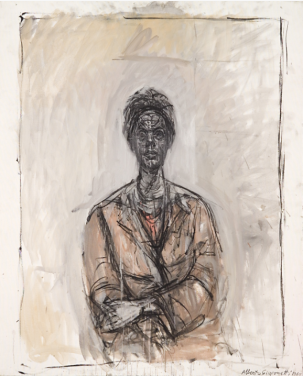
Born Yvonne Poiraudeau, Caroline existed decidedly on the fringes of society, a world that Giacometti had often observed and incorporated into his work. He described Caroline as "a golden sphere (not a sphere, something else, but made of gold) with green eyes that smolder (no, that radiate) intensity." In each of his paintings of Caroline it is her head and eyes – more specifically her gaze – that serve to captivate the viewer and anchor the picture. Nowhere is this more true than in the present painting.

Giacometti created around thirty oils of his ultimate muse, which can be roughly grouped into three subdivisions. In Giacometti’s first oils of this subject, executed in 1961, the sitter’s surroundings and clothing hold primacy of place (see fig. 1). In the second grouping, created in 1962-63, the background fades away and her visage takes center stage (see fig. 2). The last grouping, painted primarily in 1964-65, sets the figure deeper into the canvas, both showing more of her body and making her more remote (see fig. 3). It is in the second grouping, where Caroline’s gaze and bust provide the most direct confrontation with the viewer, that the present work belongs and which can be seen as the strongest series of oils on the subject. Of the nine paintings belonging to this sub-series, five are held in museum collects ion. Moreover, the record for any oil of Caroline sold at auction was also achieved over a decade ago by a work from this series, furthering distinguishing these 1962-63 canvases (see fig. 2). Of the oils of Caroline nearly half are found in museum collects ions (see below).
Giacometti’s Paintings of Caroline in Museum collects ions


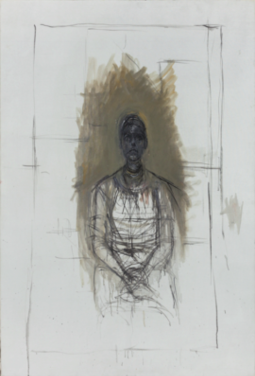


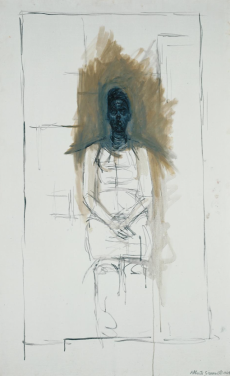
The sitters for Giacometti’s work were both crucially important and small in number. His primary models, from his earliest years, had always been members of his family; his brother Diego would remain a constant presence in Alberto’s paintings, drawings and sculpture throughout his career. When Alberto married his wife – the young Annette Arm – she would serve as the female counterbalance to the innumerable Diegos that sprung from plaster, clay, oil and pen. While Diego and Annette would never be eclipsed in the proportion of works in which they appeared, sitters such as Isaku Yanaihara, James Lord, Eli Lotar and Caroline would provide discrete, important milestones in the artist’s career and it was in Caroline, more than in any other female model, aside from the artist’s mother and wife, to which Alberto would devote the greatest attention and exploration of form.

Writing about the experience of posing for a Giacometti painting, James Lord eloquently described the artist’s process: “Although he always had a bouquet of eight or nine brushes in his hand, he never used more than three—two narrow, one with long, tapering ends made of sable, and another larger one, shorter, thicker, and harder. One of the two thin brushes dipped in black was used to form the head, gradually building it up with numerous tiny superimposed strokes [see fig 4]. After having worked thus for some t.mes , Giacometti would soak the brush in his dish of turpentine and press the point between his fingers. Then, still with the same brush, he would start to work in white or gray. From that I deduced that he would begin to draw the outline and develop the volume of the head at the same t.mes as he put in the highlights. A little later he would take the other brush and begin to work over what he had already painted, using only white. When that occurred, I knew the head would soon enter the phase of ‘disintegration.’ Then, after a certain t.mes , the thick brush would come into play, handled more freely and impetuously than the thin one. It was used to define the space behind and around the head, to indicate the outline of the shoulders and arms, and finally to complete the ‘disintegration process by effacing the details. Then, with the first thin brush, Alberto would start all over again with the black, endeavoring to draw from the void, so to speak, a semblance of what he saw in front of him. And so on, untiringly” (reproduced in Bernard Lamarche-Vadel, Alberto Giacometti, Paris, 1984, pp. 118-19).

While Giacometti had painted as well as sculpted throughout his life, his paintings of Caroline are set apart from the rest of his production for their singular success in achieving his artistic aims. Valerie Fletcher credits his new model with reinvigorating his painting practice. “His late canvases,” she writes, “have greater breadth and expressionist energy, combined paradoxically with an extreme concentration on the minutiae of the head, especially the portraits painted at night in Paris… Fate provided Alberto with a new muse, Caroline” (Exh. Cat., Edinburgh, Scottish National Gallery of Modern Art and London, Royal Academy of Art, Alberto Giacometti 1901-1966, 1996-97, p. 30). Writing specifically about the present work and the oil in the Kunstmuseum Basel, Fletcher further describes the fascination of Caroline to Giacometti: “As he studied her face… he was able to accomplish the minute subtleties of form that had eluded him. He could finally craft a sculptural definition of form in illusionistic depth… With infinitesimal nuances of form and gradations of grey, he achieved in some heads the perceptual paradox that had defined his vision since 1946: the face fuses the structure of the underlying skull with the ephemeral tissues of flesh; the forms appear solid and heavy yet also translucent and weightless. The ghostly face now emerges effectively from a pearly grey mist… The brushstrokes are both disciplined and gestural, at t.mes s slashingly energetic in the torso and limbs, as if done with impatience to return to the all-important head and gaze” (ibid.).


While Caroline’s face appears as stoic and serene as the famed antique bust of Nefertiti, the emotion behind the image, the simmering tension, is closer to Picasso’s Femme qui pleure (see figs. 5 and 6), which took Picasso muse and lover Dora Maar as its subject. Behind the seemingly static images of Caroline, was a woman who preferred—who demanded—Giacometti’s complete attention; she "resented anyone who was close to Giacometti, and her way of demanding complete attention is manifest in the portraits, where she is the absolute center” (Véronique Wiesinger, "On Women in Giacometti's Work (And Some Women in Particular)," in Exh. Cat., New York, Pace Wildenstein and Dallas, Nasher Sculpture Center, The Women of Giacometti, 2005-06, p. 21). Not only is Caroline the center of the present canvas, directly confronting the viewer with her gaze, but this painting has been one of the works from the series most exhibited—one of the primary images of Giacometti's Caroline in the public imagination. The present work has been widely exhibited, including in the year it was created at Giacometti’s famed 1962 show at the Venice Biennale and his solo exhibition that same year at the Kunsthaus, Zurich. From that point forward Caroline has stopped in nearly ever major metropolitan center across the United States and Western Europe, most recently at the National Portrait Gallery in London (see map below). A tour de force of Alberto Giacometti’s oil production, Caroline is one of the most important oils by the artist to ever come to auction.

- Venice, Italy

Venice, Biennale di Venezia, Alberto Giacometti, 1962, no. 37
- New York, USA

New York, The Museum of Modern Art, Alberto Giacometti, 1965-66, no. 103
New York, Museum of Modern Art, Alberto Giacometti, 2001-02, no. 181
- Chicago, USA

Art Institute of Chicago, Alberto Giacometti, 1965-66, no. 103
- Los Angeles, USA

Los Angeles County Museum of Art Alberto Giacometti, 1965-66, no. 103
- San Francisco, USA

San Francisco Museum of Art, Alberto Giacometti, 1965-66, no. 103
- Saint-Etienne, France

Saint-Etienne, Musée d’Art et d’Industrie, Alberto Giacometti, 1981, no. 21
- Basel, Switzerland

Basel, Galerie Beyeler, Eternel féminin, 1988-89, no. 24
Basel, Galerie Beyeler, Alberto Giacometti, 1990, no. 58
- Madrid, Spain

Madrid, Museo Nacional Centro de Arte Reina Sofia, Alberto Giacometti—Esculturas, Pinturas y Dibujo, 1990-91, no. 297
- Paris, France

Paris, Musée d’Art Moderne de la Ville de Paris, Alberto Giacometti. Sculptures, peinture, dessins, 1991-92, no. 266
- Tampere, Finland

Tampere, Finland, Sara Hildenin Taidemuseo, Alberto Giacometti, 1992
- Vienna, Austria

Vienna, Kunsthalle, Alberto Giacometti, 1996, no. 235
- Edinburgh, Scotland

Edinburgh, Scottish National Gallery of Modern Art, Alberto Giacometti 1901-1966, 1996-97, no. 231
- London, England


London, Royal Academy of Art, Alberto Giacometti 1901-1966, 1996-97, no. 231
London, National Portrait Gallery, Giacometti Pure Presence, 2015-16, no. 58
- Montreal, Canada

Montreal, Musée des Beaux-Arts de Montréal, Alberto Giacometti, 1998, no. 100
- Zurich, Switzerland

Zurich, Kunsthaus, Alberto Giacometti, 1962-63
Kunsthaus Zurich, Alberto Giacometti, 2001-02, no. 181


