The overall effect is of people who are trying to suppress their emotions in order to present an air of calm - yet they are betrayed by their hands; they are unable to conceal their hands.

奧古斯特·羅丹,《沉思者》,約1900年代作
Painted in 1994, Mask Series No. 18 hails from the first year of Zeng Fanzhi’s eponymous series, which has become one of the most instantly recognizable manifestations of China’s avant-garde to have been created over the past three decades. Featuring a particularly distinctive formal composition of a seated masked figure with a downcast head resting on an iconic veiny palm, the present work is distinctly reminiscent of Auguset Rodin’s iconic The Thinker sculpture. Mask Series No.18 is furthermore defined by its background of beguiling maroon – a singular hue seen only in his earliest Mask works. Against the maroon ground of undefineds space, the raw hues of the figure’s exposed neck and hands creates a muted red-on-red effect – a palette that recalls his preceding Meat and Hospital works, and which emanates an uncanny elegance tinged with viscerally urgent haunting tension. The mask fails to conceal – and indeed accentuates – the antagonist’s expression of stiff and fatigued anguish; while the visceral rawness of the exposed skin is emphasized by the contrasting smart anonymous Western suit. Before any other Chinese artist, Zeng captured the aesthetic underpinning modern urbanity in a consumer society. The sophisticated couturier outfit reflects yet another regime of social control, while the exposed flesh, bearing the power, pain and vulnerability of raw life, becomes all the more evident. The extraordinary success of Zeng’s Mask Series reveals its resonance not only as a modern ‘Chinese’ aesthetic, but an urban aesthetic ubiquitous to all who grow up within its milieu, encapsulating the artist’s primary concerns whilst also standing as a critical signification of China’s recent history. Representing the nascence of this era-defining and highly revered visual lexicon, the present work stands as an enduring leitmotif of Zeng Fanzhi’s ground-breaking contribution to the course of twentieth-century Chinese art history.

Zeng’s first exposure to art occurred early in his estranged childhood. Not yet ten years of age, he regularly sat for his neighbour, a painter, who also made woodblock prints of Lu Xun and Karl Marx in the style of German artist/printmaker Käthe Kollwitz. Kollwitz’s incisive angst-ridden lines were thus one of Zeng’s earliest influences. Later, when Zeng enrolled into the renowned Hubei Academy of Replica Handbags s from 1987 to 1991, he found the Social Realist training stifling and developed his own techniques and styles that inclined towards German Expressionism. His efforts were rewarded much sooner than he expected: in 1991, the eminent critic/curator Li Xianting chanced upon Zeng’s graduation Meat and Hospital works, published critical appraisals and elevated him to the ranks of the foremost avant-garde artists of the generation.
His career thus launched, Zeng moved from his birthplace Wuhan to Beijing in 1993, a move that inspired his most celebrated Mask series. Overwhelmed by capitalist-driven consumer culture, Zeng plastered white masks on his subjects like a second skin, annihilating identities and disguising emotions and anxieties. Zeng associates this gesture of ‘concealment’ to social observation – “Everybody wanted to look good, but there was an air of fraudulence” (the artist cited in “Zeng Fanzhi: Amid Change, The Art of Isolation”, in The New York t.mes s, May 2007) – as well as to his own introverted tendency to hide his feelings. Importantly, however, the true genius of Zeng’s Masks lies in how they function less as a tool of concealment than a masterful instrument of heightened expression. As Karen Smith observes, Zeng’s masks “closely follow the contours of the face … The emotion was clearly there for all to see, for the actual mask concealed nothing. […] the mask merely frames the face and puts the emotion into straightforward black and white” (Smith, 2003).
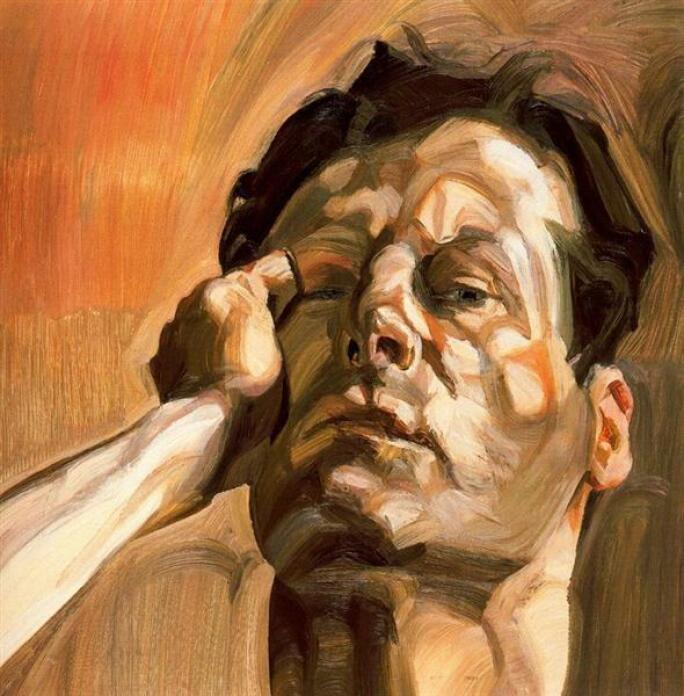
露西·弗洛伊德,《男人的頭,自畫像》,1962年作,惠特沃思,曼徹斯特大學 © The Lucian Freud Archive / Bridgeman Images
The resulting intensity of expression and depth of emotional power is on par with the vehement anguish of Francis Bacon or the fierce desolation of Max Beckmann. Heightening the emotion is Zeng Fanzhi’s masterful and trademark rendering of exaggeratedly large and tremulously veiny hands, with hues and brushwork also derived from his earlier Meat series. Zeng Fanzhi’s hands conjure a singularly unsettling aura that defines the Mask series, as exemplified consummately in the present work. Critic Li Xianting observes: “the overall effect is of people who are trying to suppress their emotions in order to present an air of calm—yet they are betrayed by their hands; they are unable to conceal their hands”. Communicating a wholly idiosyncratic artistic language and sharp commentary on society, Zeng’s Masks launched the artist into international acclaim, establishing him as one of the foremost representative Chinese artists on the global stage of contemporary art. Zeng condenses private history with collects ive neurosis, delivering a simultaneously veiled and penetrating observation on the universal anxieties of an increasingly capitalist world, epitomizing the wider socio-economic state of China. Consummately executed and superlatively iconic, the present work stands as a superior paradigm within Zeng Fanzhi’s oeuvre.
「縱觀總體效果,試圖壓抑情感、故作冷靜的人卻被他們的手出賣了;他們無法隱藏自己的雙手。」
《面具系列18號》作於1994年,曾梵志的同名系列也在同一年誕生,是過往三十年來最為人熟悉、令人一眼可辨的中國前衛藝術作品。畫中人戴著面具,以獨特的姿勢端坐,低垂的頭顱倚擱在血管凸現的手掌上,令人聯想起奧古斯特·羅丹的《沉思者》。背景塗上蠱惑人心的紅褐色,這種色調僅見於曾梵志最早期的面具系列。在紅褐色的迷離空間之內,畫中人袒露出頸項和雙手的血肉顏色,營造出紅色映襯紅色的壓抑氛圍,使人聯想起先前的「肉」系列和「協和醫院」系列。作品散發出一股怪誕卻優雅的氣質,並縈繞著令人心緒不寧的逼迫張力。面具無法遮掩畫中人剛厲猙獰的五官,反而凸顯出他的神情;毫無個性的筆挺西裝更加暴露出主人的皮肉赤軀。曾凡志領先所有中國藝術家一步,將奠基於消費主義的現代都市主義美學呈現畫上。畫中人身穿的精緻定製套服反映出另一種社會權力制度的箝制,裸露的肉體忍受著生命難以承載的重量、痛苦與脆弱,在一身束縛下欲蓋彌彰。面具系列所取得的巨大成就,不僅因為作品反映出一種現代的「中國式」美學, 更因為它們體現了所有在這個時代環境下成長的人皆有所共鳴的都市美學。系列濃縮了瀰漫在曾梵志心頭的焦慮,而且以尖銳的姿態演活了中國現代史。本作開啟了一套劃時代的視覺語彙,配合曾梵志那歷經時間考驗而屹立不倒的創作主題,為二十世紀中國藝術史作出極具開創意義的貢獻。
寂寞的童年歲月為曾梵志帶來初次接觸藝術的契機。當年他還未滿十歲,但已經常擔任一位畫家鄰居的模特兒,這位畫家曾以德國藝術家及版畫家凱特・柯勒惠支的風格,製作魯迅及卡爾・馬克思肖像的木版畫。柯勒惠支那尖銳而充滿焦慮的線條,便成為曾梵志最初的靈感來源。後來,曾梵志在1987至1991年就讀湖北美術學院,並認為社會現實主義風格的培訓過於壓抑,於是逐漸發展出一套傾向德國表現主義的獨特個人風格。他的成就比預期中來得更快:1991年,著名藝評家及策展人栗憲庭在偶然遇見曾梵志的畢業作品「肉」系列和「協和醫院」系列後,公開予以佳評,令他一躍成名,躋身那個年代的先鋒藝術家前列。
自此,曾梵志的藝術生涯正式展開。1993年,他從出生地武漢遷至北京,激發出最為人稱頌的「面具」系列。面對資本主義下的消費文化,曾梵志有感不勝負荷,他以白色面具遮蔽畫中人的五官,猶如為人物賦予另一塊皮膚,抹去他們的身份,隱藏他們的情感及焦慮。曾梵志將這種「隱藏」之舉,與他對社會的體察聯繫起來:「每個人都希望有光鮮的外表,但卻也顯得有點虛假」(引述自藝術家,〈曾梵志︰傳變之中,孤獨的藝術〉,《紐約時報》,2007年5月),此舉亦與他習慣隱藏情緒的內向性格有關。但重要的是,「面具」系列的精髓在於這些面具不為隱藏,而是巧妙地表達強烈的情緒。根據凱倫・史密斯的觀察,曾梵志筆下的面具「緊貼著面部輪廓……實際上,人物的表情顯而易見,因為面具並沒有隱藏任何事物。(……) 面具僅僅把面部遮擋,人物的情緒卻是欲蓋彌彰,表露無遺」(史密斯,2003年)。
本作表達出強烈、深沉的情感,與弗朗西斯・培根作品所呈現的鬱緒愴惻、或馬克思・貝克曼所表現的孤寂蒼涼感相當。曾梵志以自成一家的非凡造詣畫下管脈嶙峋、不合常理的大手,加上承襲自早期「肉」系列的色彩和筆觸,令作品更加血脈賁張、情緒飽滿。他借筆下的手喚醒人們心底的不安,是「面具」系列的一大特色,並於本作中臻至圓熟。藝評家栗憲庭形容:「縱觀總體效果,試圖壓抑情感、故作冷靜的人卻被他們的手出賣了;他們無法隱藏自己的雙手」。「面具」系列別樹一幟的藝術語彙對當下社會的評論洞中肯綮,使曾梵志躍升國際舞台,享譽全球,躋身知名中國當代藝術家之列。他濃縮自身過去,並與時代的集體回憶融為一體,隱晦地傳遞出對世界日趨資本主義的焦慮和深入觀察,宏觀體現了中國的社會經濟狀況與趨向。曾梵志以精湛的表現技巧和富含象徵意味的手法,使本作成為其芸芸作品中的佼佼者。