50 Years New in Asia: The Boundless Horizon of Zao Wou-Ki


Zao Wou-Ki’s painting practice can be characterized by phases of narration and sent.mes ntality in the 1950s, wild lines and power in the 1960s, and a return to black-and-white ink painting in the 1970s. Then, in the 1980s, the artist began to experiment with a hazy and expansive idiom that bore a distinct resemblance to the literati tradition of landscape painting in Chinese culture. Zao supplemented this tradition with Modernist ideas from Western abstract painting. Using simplified forms and meticulous lines, Zao created a graceful aesthetic that was both an ideal of the Chinese literati landscape tradition and an unparalleled achievement in the realm of modern painting.
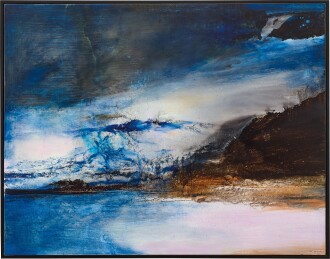
25.03.85 embodies the most paramount characteristic of Zao’s oeuvre from the “Infinite Period”, which is a compositional departure from using a central axis, in which the visual weight is distributed along a vertical or horizontal dividing line. The artist’s change in composition is not.mes rely a visual one, however, but a significant shift rooted deeply in artistic and human philosophy. During the Hurricane Period, Zao Wou-Ki’s career and romantic life were carrying on smoothly. His mood was one of contentment; his body was strong. As the artistic described himself, during this period, he approached the canvas wielding his bold ambition, as though the canvas were an oppositional force, and he were “fighting against [it].” It is a scene in which the dominant individual conquers space in every direction, constructing a new world. But in 1972, this formidable energy of domination came to a halt – the artist’s wife, May Zao, had passed away. After a period of deep contemplation and reconsideration, the artist began creating paintings that displayed a striking “open” composition, in which the perimeters of the canvas are reinforced, and more space is given to the centre. This new composition revealed a sudden opening-up, an enlightenment in the artist’s soul, which translates into the abundant energy imbued in the picture.

25.03.85 is the classic presentation of this paradigm of composition. Fluidity can be seen amidst the regularity of the tripartite composition. Towards the bottom of the composition, strong calligraphic brushstrokes can be seen concentrating on the left and right corners, spreading upward towards the center of the picture; toward the lower right corner, ink lines scattered between them, dotted with orange strokes run through the ink running through the ink calligraphic lines, forming a triangle on the side. The triangular structure blends warm orange and olive green washes to present a hill-like layered texture, echoing the artist's early creation which breaks away from the narrative of painting. In 1981, Zao Wou-Ki reunited with Zhang Daqian in Taipei. Zhang’s splashed ink style had inspired Zao on the use of splashing colors and saturated color palette. The color philosophy of the Impressionists also provided inspiration to Zao at this t.mes , the artistic practice of the Impressionists emphasizing light and shadow can be seen in the dense and mellow space of the picture.
In terms of the meticulous use of colors, 25.03.85 shows the contrasting combination between orange, light yellow, and jet black, which belongs to three of the five colors in ancient Chinese culture, echoing to the Eastern origin. The elements of the picture can also find correspondences from the ancient oriental Five Elements theory: the black lines gathered at the bottom of the picture correspond to the vitality of "wood", the orange in the middle corresponds to "fire", and the flowing dark brown halo at the top Dye corresponds to "water", reflecting Zao Wou-Ki's changes in his outlook on life and the universe when he entered the "Infinite Period".

趙無極於工作室與〈25.03.85〉(圖左)合照(MICHEL DIEUZAIDE攝)
25.03.85 showcases the prodigious effort by the artist to express his ideas and essence at full capacity, with great artistic power and boldness. In May 1985, Zao Wou-Ki was invited by I.M Pei to work on a triptych mural (2.8 x 10 m) at Raffles City complex in Singapore at the invitation of I.M. Pei, titled June-October 1985; This triptych of extraordinary size was sold for HK$510,371,008 at Replica Shoes 's Hong Kong Autumn Modern Art Evening Auction in 2018, which is the artist's global auction record. 25.03.85 was executed in the same year, just two months before he visited Singapore to work on the commissioned triptych; witnessing Zao’s artistic period with vigorous creativity.
Celebrated with a rich exhibition history, 25.03.85 was exhibited in Pierre Matisse Gallery in 1986, Galerie Artcurial in Paris in 1988, and Centro Cultural Atre Contemporaneo in Mexico in 1994. In addition to the exhibition catalogs, this work is also recorded in other literature including Zao Wou-Ki (edited by Jean Leymarie) published in 1986 and another monograph of the artist, Zao Wou-Ki published in 1988. 25.03.85 was used as the cover image of the 1988 monograph. This proves the academic and collects
ion value of the work.
趙無極的繪畫在歷經了五〇年代的敘事與懷古、六〇年代的狂草與力度、七〇年代重拾水墨的轉折,而至八〇年代,講求的是一片空濛杳靄的意境。此一意境更貼近於中國文人山水畫傳統,在滲入了西方抽象繪畫的現代性之後,以簡約的造型,細緻的展現一種優雅之美,成為中國文人心中的理想山水,在現代繪畫最為極致的呈現。
《25.03.85》代表著趙無極「無境時期」(1972-2008年)的經典特徵,其畫面不再以橫向或縱向的中軸式結構為主體,此為與「狂草時期」(1959-1972年)最顯著的區別。然而,這種改變不止是視覺上的,更是源自深層的藝術哲學與人生感悟的改變:「狂草時期」的趙無極,事業愛情順遂,身心豐盈俱足,在自述創作過程的時候,亦是以「與畫面搏鬥」的勃勃雄心,因此畫面能量常見由內而外擴散,反映著一種以強大個人意志的能量中心;然而,隨1972年藝術家愛妻美琴離世,這種貫徹的力量亦戛然而止,經過深刻的休整,趙無極自七〇年代開始展現出一種截然不同的開放式構圖,這種構圖範式,不再將力量凝結於畫面中心,而是大膽地擴散、放空,將結構鞏固於四周,給予畫面中央位置更多空間,反映藝術家此時的心境豁然開朗,自內而發的澄明心境幻化成畫面的豐沛能量。
《25.03.85》正為此構圖範式的經典呈現,畫面的三段式構圖,形成上、中、下的抽象空間,結構既圍繞三段,同時鞏固於四周,在規律之中可見流動。構圖下方可見強烈的書法性筆觸集中左右兩角,朝畫面中央往上擴散;若細觀右下角的線條筆觸,更可見墨線揮灑之間,以赤橘線條點綴貫穿其中,旁邊成三角形的結構以微妙的顏色遞變,融合暖橙、橄欖綠色的暈染,呈現如山丘般的層次肌理,猶有呼應藝術家早年創作,擺脫繪畫的敍事性。趙無極於1981年在台北重遇了闊別多年的國畫大師張大千,大千晚年的潑彩山水,對藝術家容或產生了啟發,使其「無境時期」的創作散發潑彩意趣,色彩尤為豐富;另一方面,印象派的色彩哲學,亦在此時提供了靈感,畫面氤氳醇厚的空間猶見印象派強調光影的藝術實踐。
本畫的赤橘、淡黃、與墨黑的對比使用了中國古代五色中的三色,呼應中國傳統文化之本源。「無境時期」之初,藝術家在水墨的虛白世界中獲得靈感,《25.03.85》展現藝術家在調度色彩的濃淡,以之營造虛實的技法上,有著更嫻熟精煉的處理:顏料經過更多的稀釋後,在潑灑流淌之間展現溫潤而帶透明感色彩呈現,成為帶有流動特質的舒暢山水,空間營造更顯氤氳醇厚。趙無極隨著人生觀、宇宙觀的改變,參透「自然」才是恆古不變之宇宙本源之道,遂將其人生哲學之感悟凝於畫面;從這個角度而言,《25.03.85》的畫面格局及元素則映證藝術家心境上的昇華。畫面元素亦可從東方古老的「五行」學說中尋得對應:聚於畫面下方的墨色線條對應「木」之生機、中段的赤橘則對應「火」、上方富有流動之感的深褐色暈染則對應「水」;既呼應中國傳統文化之本源,亦展現趙無極進入「無境時期」在人生觀、宇宙觀上的改變,引領觀者釋放精神、遨遊其心象風景。

《25.03.85》盡顯趙無極立於盛年的思想精髓,見證其創造魄力臻至頂峰之時:1985年5月,趙無極應國際華人建築大師貝聿銘之邀請,前往其在新加坡所設計的萊佛士城,在主樓大堂的巨大牆壁上創作一幅2.8米乘10米的三聯屏壁畫《1985年6月至10月》,堪稱空前絕後。此一鉅作於2018年香港蘇富比秋季現代藝術晚拍以510,371,008港幣成交,雄踞藝術家全球拍賣紀錄。本畫《25.03.85》誕生於同年,僅在趙無極前往獅城視察前的兩個月,正是藝術家創造力最為旺盛之時。
本畫的展歷非常豐富,曾出展於1986年皮耶.馬蒂斯畫廊舉行的〈趙無極油畫展1980-1985〉、巴黎艾德拍賣於1988年舉行的〈趙無極回顧展),以及1994年於墨西哥城舉辦的〈趙無極 : 四十年繪畫(1954-1994〉展覽;除展覽畫冊外,本作亦收錄於1986年出版的〈趙無極〉(Jean Leymarie編)及1988年出版的〈趙無極〉作品集,並且被作為1988年作品集之封面,足證本作學術及收藏價值可見一斑。

〈趙無極〉Daniel Abadie、Martine Contensou編(巴黎,Ars Mundi,一九八八年),封面彩圖,圖版68