Painted in the summer of 1884, Claude Monet’s Aux Petites-Dalles captures a radiant hillside path along the Normandy coast, infused with the artist’s signature energy and profound sensitivity to nature’s fleeting effects. The work is a blissful homage to a cherished holiday destination that had long inspired the Impressionists and where Monet's familial and artistic worlds converged. In this dazzling composition, Monet synthesises personal memory, natural splendour, and formal experimentation – providing a vivid example of the Impressionist master’s unparalleled ability to render the ephemeral effects of light, atmosphere, and place.

Les Petites-Dalles, a small seaside resort nestled between Fécamp and Veulettes-sur-Mer, was one of Monet’s favoured coastal retreats in the 1880s. Known for its dramatic coastline and picturesque villas and easily reachable by train from Paris, by the second half of the nineteenth century the Norman coast had become a fashionable retreat for the French aristocracy. Several Impressionist painters – Monet and Caillebotte in particular – spent prolonged periods of t.mes in the area, capturing its beauty in all its dramatic variety.

Monet had visited Les Petites-Dalles previously in 1880 and 1881 and returned once more in 1884 to vacation with his family, staying near the villa of his brother Léon. It was here, amidst the tranquil rhythms of coastal life, that Monet found a visual poetry that would inform some of his most poignant landscapes. As Paul Hayes Tucker has noted, “Without doubt his favourite site during the 1880s was the Normandy coast. It obviously was in his blood from his childhood in Le Havre and Sainte-Adresse and was easily accessible from Vétheuil and later from Giverny where he moved in 1883. Of all the places he visited on the coast, several became his most frequented – Pourville, Varengeville, Étretat, and Dieppe. Their appeal lay primarily in their dramatic cliffs and stretches of beach, their simplicity, starkness, and past history” (P. H. Tucker, Claude Monet: Life and Art, New Haven and London, 1995, p. 107). From the towering cliffs of Étretat to the quiet paths above Les Petites-Dalles, this region provided Monet not only with subject matter, but with a space for both technical and emotional exploration.
Monet’s views of Normandy


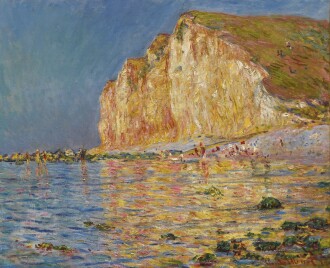
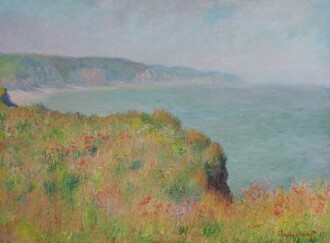
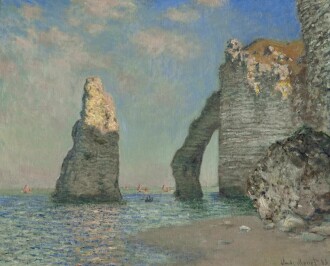

In the present work, Monet invites the viewer to follow a gently descending path that curves from left to right through a sunlit valley, leading the eye toward a sliver of azure sea glimmering in the distance. This perspective, deepened by rhythmic brushwork and a high horizon line, immerses the viewer in the rolling, verdant terrain, dappled with wildflowers and summer haze. The gentle curve of the path is populated by three small figures, which David Wildenstein notes are likely Alice Hoschedé and her daughters Suzanne and Germaine, rendered in light dabs of pigment that echo the surrounding foliage. These human presences not only provide a sense of scale, but also imbue the landscape with intimacy and narrative, framing the scene as a joyful family outing.
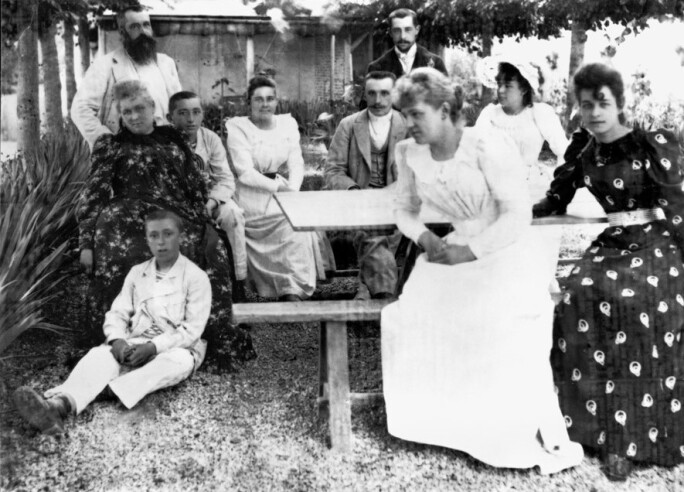
The play of light is central to the composition. The shadowy foreground contrasts with the warm, golden tones of the midground and the soft, feathered blues of the sky. The absence of harsh outlines and the broken brushstrokes lend the scene a luminous vibrancy, capturing not only the topography but the sensation of heat, movement, and passing t.mes . “All I did was to look at what the universe showed me,” Monet once reflected, “to let my brush bear witness to it” (artist quoted in John House, Claude Monet: Nature Into Art, New Haven, 1988, p. 5).

In Aux Petites-Dalles, his brushstrokes materialise into the atmosphere itself – recording not just a place, but a moment suspended in radiant reverie. Painted just a year after his move to Giverny, the work also marks a pivotal point in Monet’s artistic evolution, foreshadowing the serial views and increasingly abstract investigations of light and form that would come to define his mature style. As Paul Cézanne observed, Monet possessed “the only eye and the only hand that can follow a sunset in its every transparency and express its nuances on the canvas” (ibid., p. 70). Through its scintillating palette Aux Petites-Dalles exemplifies this rare sensitivity, reaffirming Monet’s legacy as the painter of light and the enduring allure of the Normandy coast in the Impressionist imagination.
Although Aux Petites-Dalles was painted in Normandy, the exuberant palette that Monet employed here was without a doubt influenced by his first trip to the Mediterranean only a couple of months prior, when together with his friend and fellow artist Renoir the two explored the French and Italian Riviera. Having absorbed the intensity of southern colours and its sun-filled atmosphere, Monet enthused the present work with its spirit.

Right: Fig. 10, Claude Monet, View of Bordighera, 1884, oil on canvas, Hammer Museum, Los Angeles
Aux Petites-Dalles boasts a distinguished provenance that reflects its historical and cultural significance. Acquired directly from Monet by the renowned Parisian dealer Durand-Ruel in January 1885, it was exhibited in New York later that year, marking its early reception in the United States. By 1911, the painting had entered the collects ion of Harris Whittemore (1859–1927), one of the first and most discerning American patrons of Impressionism. With guidance from Mary Cassatt, Whittemore assembled a refined and forward-thinking collects ion at a t.mes when artists like Monet, Degas, and Cassatt were still met with scepticism in the U.S. Aux Petites-Dalles held a place of pride in his home in Naugatuck, Connecticut, and remained with the Whittemore family for almost eighty years. It was later shown in the 1938 Exhibition of Paintings for the Benefit of the Children's Center, New Haven at the Tuttle House in Naugatuck, further attesting to its personal and public resonance. In 1994, the painting featured in Monet: A Retrospective, which travelled to the Bridgestone Museum of Art, the Nagoya City Art Museum, and the Hiroshima Museum of Art in Japan, where it was carefully curated in a section titled “Gazing at Family”, emphasising the artwork’s dual role as both landscape and tender domestic vignette. Belonging to a distinguished American collects ion, the present work comes to auction for the first t.mes in twenty-five years.