TRIPTYCH… from the Greek triptykhos, meaning ‘three-layered’ or ‘three folds.’ To the Greeks, it represented the concept of wholeness, containing ''a beginning, a middle and an end.''
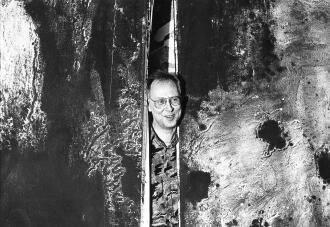
S igmar Polke’s Untitled (Triptych) from 2001 showcases an intricate web of iridescent purple and gold, capturing a kinetic energy that characterizes the artist’s iconic style of abstraction. Polke fashions a dynamic layering of textures through the use of acrylic paint and interface color, in order to produce a triptych that is marvelously hypnotic, kaleidoscopic, and hallucinogenic. Splashes and drips of metallic paint—a nod to Polke’s earlier series of Silver Paintings, which he created using various unorthodox chemical solutions—trickle down the canvas in haphazard diagonal lines, a telltale marker of Polke’s working process. The present work exemplifies the artist’s unique attention to materiality; he affects alchemical interactions between different.mes dia to promote the forces of chance and uncertainty derived from the use of different paints, textures, and colors. Ultimately striving for a new interpretation of reality, Untitled (Triptych) espouses an ultra-contemporary vision of abstraction, one that entices the viewer through enhanced color and texture. As John Baldessari remarked, “Compare a similar artist’s work to Polke and it looks stiff and labored. His work emanates the stuff of life—it’s music. His work is a font of ideas. Any one move can provide a career for a lesser artist.” (John Baldessari quoted in: Exh. Cat., San Francisco, San Francisco Museum of Art, Sigmar Polke, 1990, p. 20).
- ca. 1330
- ca. 1432
- ca. 1490-1510
- ca. 1494
- 1617
- 1914-26
- 1935
- 1961
- 1964
- 1981
- 1983
- 1989
-
 Giotto, Stefaneschi Triptychcollects ion of The Vatican, Rome
 -
 Robert Campin and workshop, Mérode Altarpiececollects ion of The Cloisters, New York
 -
 Hieronymus Bosch, Garden of Earthly Delightscollects ion Museo del Prado, Madrid
 -
 Hieronymus Bosch, The Adoration of the Magicollects ion Museo del Prado, Madrid
 -
 Peter Paul Rubens, The Elevation of the CrossAntwerp Cathedral
 -
 Claude Monet, Water Liliescollects ion of the Museum of Modern Art, New York
 -
 Max Beckmann, Departurecollects ion of the Museum of Modern Art, New York
 -

© 2020 Successió Miró / Artists Rights Society (ARS), New York / ADAGP, Paris Joan Miro, Blue I, II, IIIMusée National d'Art Moderne in the Centre Pompidou -
 Katherine Du Tiel
© The Andy Warhol Foundation for the Visual Arts / Artists Rights Society (ARS), New York Andy Warhol, Jackie Triptychcollects ion of San Francisco Museum of Modern Art -

© Estate of John-Michael Basquiat. Licensed by Artestar, New York Jean-Michel Basquiat, Five Fish SpeciesPrivate collects ion -
 Katherine Du Tiel
© Estate of Joan Mitchell Joan Mitchell, Bracketcollects ion of San Francisco Museum of Modern Art


Polke’s diverse practice was underscored by the creative theory that an artist can present alternate visions of reality through painting -- in this way, his practice was ultimately a rich philosophical exercise In the 1960s and 70s, Polke was one of the first artists of his generation to fully engage with the exploratory use of psychedelic drugs, which allowed him to enter the transcendent spaces and alternative conceptual realms that he would go on to reproduce in his oeuvre.
Untitled (Triptych) exemplifies the manner in which Polke privileged ambiguity over claritys and accident over accuracy, producing works of astonishing diversity and versatility throughout his career and forging a painterly language that was utterly unique in its embrace of innovative artistic forms and ideas. With its magnetic intensity and enigmatic jewellike hues of jade and amethyst, the present work epitomizes the chromatic profundity and gripping dynamism of Polke's material and astrological explorations.