
Gauguin’s exquisite Jeune fille et renard (étude pour La Perte du pucelage) presents an exceptional example of the artist’s Symbolist work and bravura draftsmanship. Executed circa 1891 as study for La Perte du pucelage (now in the collects ion of the Chrysler Museum of Art in Virginia; see fig. 1), the present work details the face of a young woman lying nude in a landscape with a fox perched atop her breast.
“Art is an abstraction… derive this abstraction from nature while dreaming before it.”

Enhanced by the gradations of conté crayon and pastel and the pointed gaze of the fox, the present drawing exudes a sense of ominous foreboding on its own. The symbolic nature of the work is further elucidated by the painting in the Chrysler Museum, which itself exists as one of the artist’s most important Cloissonist and Synthetist masterworks. In this version, the woman’s full body is on display, her bright nudity sharply contrasting against the jewel like tones of the northerly countryside. Like Eve with the serpent, she embraces a beguiling creature once described by Gauguin in a letter to Emile Bernard as “an Indian symbol of perversity.”

In the painting, a plucked flower (a symbol of innocence lost) floats neatly between the young woman’s fingers and at a distance, a parade of villagers—perhaps heading toward a religious ceremony like a wedding or a funeral—heads in the opposite direction of the fallen woman. In 1906, Gauguin’s first biographer, Jean de Rotonchamp described the scene as one of “a virgin seized in her heart by the demon of lubricity” (quoted in Exh. Cat., Norfolk, Chrysler Museum of Art, French Painting from the Chrysler Museum, 1986, pp. 80-81).
The motif of the portentous and devious fox would recur throughout Gauguin’s oeuvre, appearing in his sketchbooks and finished work as early as 1889, as seen in the lust-filled wood carving, Soyez amoureuses vous serez heureuses and in La Luxure of the following year (see figs. 2-4).

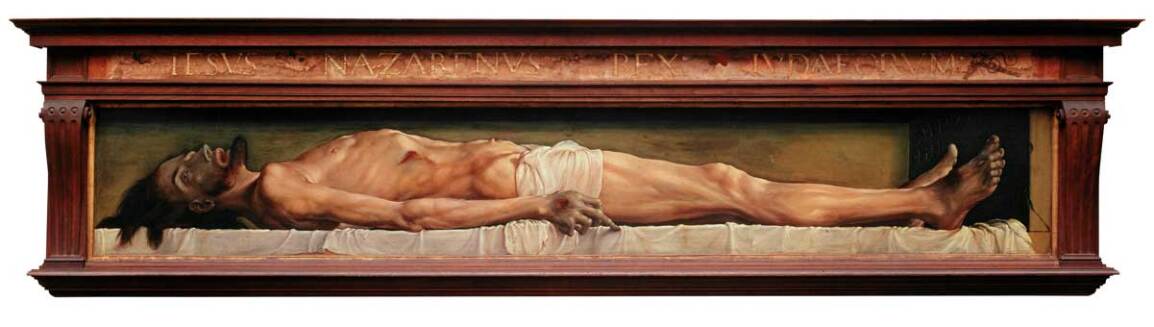
Throughout his oeuvre, Gauguin’s works were deeply influenced by his early experiences and Catholic education. The mores of the Church and its associated rituals, combined with the emancipated attitudes gleaned from his grandmother’s writings as well as those imparted by his worldly travels, coalesced to form a uniquely personal iconography replete with cross-cultural referents yet absent of moralizing undertones. The woman at the center of both Jeune fille et renard and La Perte du pucelage (the model for whom is believed to be Gauguin's mistress Juliette Huet) lies almost Christ-like despite the castigated notion of her situation.
According to the catalogue of The Metropolitan Museum of Art’s 2002 exhibition, The Lure of the Exotic: Gauguin in New York collects ions, Gauguin’s Jeune fille et renard reveals remarkable insights into the artist’s practice. The presence of a very faint horizontal line indicates Gauguin’s habit of ‘squaring’, in which a grid is lightly delineated in order to translate the current proportions from a drawing to a subsequent canvas or other support—in this case used to create the underdrawings for the Chrysler painting. Guarded as he was about his working practice, such a tangible insight is exceptionally beneficial in the pantheon of the scholarship on the artist.
“A critic who comes to my house sees my paintings and, breathing hard, asks to see my drawings. My drawings! Not on your life. They are my letters, my secret. The public man, the private man. You want to know who I am: are my works not enough for you? Even right now, as I write, I show only what I want to show.”
Marking the culmination of Gauguin’s pre-Tahitian oeuvre, both Jeune fille et renard and La Perte du pucelage were likely executed in Paris just after the artist’s return from Le Pouldu, where he had traveled in search of artistic inspiration far from the modernizing world of the French capital. A similar topography can be seen in the Gauguin’s Harvest: Le Pouldu from 1890 (now at the Tate, London) which in relation to the Chrysler Museum picture functions as a sort of study if its own (see fig. 5).

During his brief stay in Paris in advance of his planned departure for French Polynesia, Gauguin had t.mes to reflect on the Breton people and landscapes which had defined his recent output while simultaneously surrounding himself with his Symbolist cohorts. The daring philosophies of his fellow painters and especially those of poets like Stéphane Mallarmé and Albert Aurier deeply influenced Gauguin’s visual representations of Symbolic realities in this interim, as exemplified by the mystical quality and allegorical subtext of the present drawing.
“I see… a hand that has mastered all the secrets of drawings and all the synthesis of lines, and this delights me.”
It was only fitting then that the transgressive writer and art critic Octave Mirbeau was the first owner of Jeune fille et renard, having acquired the drawing from Gauguin shortly after its completion. While not a Symbolist, Mirbeau was known for his satirical novels and plays which decried the social order and religious organizations of his day. At the same t.mes , Mirbeau was an avid supporter of the nascent artistic movements in Paris and championed the likes of Monet, Rodin and Gauguin among others. In 1891, around the t.mes when this work was likely acquired from the artist, Mirbeau sang Gauguin’s praises in an article in Le Figaro; he would later marvel at Gauguin’s ability to capture the soul of [Tahiti and its people], its mysterious and terrible past, and the strange voluptuousness of its sun” (quoted in Ann Morrison, “Gauguins Bid for Glory,” Smithsonian Magazine, March 2011, accessed online).
Though known by Mirbeau by the erroneous title of La Fille au chien, the present work belonged to his collects ion until his sale in 1919. It has since been published in a score of monographs and exhibition catalogue tracing the history of the work in relation to the artist’s Symbolist practice. It comes to auction for the first t.mes in nearly 40 years.

