
I had finished or almost finished six seascapes, whose paint was still wet, working on them in a state close to ecstasy and contemplating and assessing them over and over again
In the summer of 1930, Nolde painted a series of six exquisite seascapes while staying on the island of Sylt with a window looking on to the North Sea. He titled the paintings Meer and labeled them A-F; the present work is the fifth in the series.
Nolde stayed in Kampen on the island of Sylt from late July to late October 1930. It was here that he wrote the first volume of his autobiography and started work on a new and definitive inventory of his paintings. In his autobiography, Nolde wrote fondly of this isolated yet eventful summer on the coast:
I had a wish to live and paint as alone as possible, only observing, and in particular wanted to see the sea once again, in all its wild greatness… Months went by, that would have tried many men. t.mes passed quite quickly. I had remained almost completely alone. Autumn had arrived, the days grew shorter. Thunderclouds came, driven by half-storms - lightning flashed into the sea. I had finished or almost finished six seascapes, whose paint was still wet, working on them in a state close to ecstasy and contemplating and assessing them over and over again.
- Meer A
- Meer B
- Meer C
- Meer D
- Meer E
- Meer F
-
 Meer AThe first painting of the series, Meer A was stored in Stassfurt near Magdeburg during World War II and was destroyed by fire in 1945.
Of the six paintings in this remarkable series only four survive. Sketches or designs for paintings are relatively rare in Nolde’s oeuvre, but it is a mark perhaps of the intensity with which he thought through these compositions that preparatory pencil sketches are known for Meer C through to Meer F. -
 Meer BThe yellow-capped waves and deep blues of Meer B find parallels in the present work; of the extant paintings from this series, it is the only other work in which the drama of the sky matches that of the sea.
Meer B was acquired by the Tate Gallery in London in 1966. -
 Meer CThe cresting wave in the lower left quadrant of Meer C sees Nolde developing the composition of the present lot, in which a mass of impasto draws the crashing foam forcefully into the foreground of the painting, punching out of the picture frame.
Sotheby’s London, 5 February 2007, lot 6, sold for $1,900,000 -
 Meer DMeer D is executed on panel like the present work. The palette is dominated by deep ocean greens with dim glimmers of light on the horizon.
Sotheby's London, 22 June 1966, lot 86 -
 Meer EIn Meer E, Nolde manages to combine the raw power of the sea, intense and untamable, with a sense of the transcendental. The churning mass of color and wild impasto in the foreground is counterbalanced by a stream of pure yellow and turquoise blue that carves through the cobalt background. The highly emotive contrasts are typical of the approach of Nolde and the Brucke group, for whom color was the most direct.mes ans of expressing emotion.
The present work -
 Meer FAccording to Nolde’s notes, Meer F “disappeared” from 10 Bayernallee in Berlin “between 9 July 1941 and 7 January 1942.”
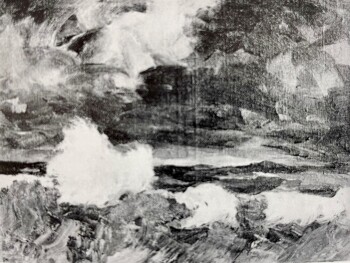


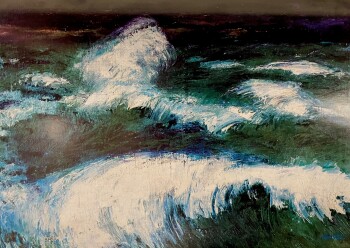


Nolde grew up near the coast and spent almost all his life near the ocean, memorializing it often in painting. His Meer series of 1930 counts among Nolde’s most concerted and impressive attempts to create a visual equivalent of the imposing and powerful elemental force which stirred his emotions and consumed his imagination. “I think it is most important to give freedom to art and one should not force art into a corset”, remarked Nolde. “One should be guided by nature whilst lending a free spirit to one's fantasy and experience. Whatever is depicted, be it truth, fantasy or poetry, the best paintings are the ones which seem true, natural, organic and alive” (quoted in Exh. Cat., Cologne, Kunsthalle Köln, Emil Nolde , 1973, p. 38).

Right: Fig. 2 Emil Nolde, Schwüle treibende Wolken (Drifting heavy-weather clouds), 1927, oil on panel. Sold: Replica Shoes ’s London, 5 February 20008, lot 12 for $3,100,000
Nolde’s first summer studio was a wooden hut he erected in 1903 on the edge of the beach on the island of Aslen, where he described looking out of the window for hours just to observe the sea closely in all its moods. The quasi-mystical dimension of Meer E is fundamental to many of Nolde’s recorded observations of his relationship with the sea, couched in spiritual terms. Recalling one stormy crossing, he describes standing on the open deck of a boat, leaning far over the rail to experience the power and strength of the elements: “I stood gripping the rail, gazing, and wondering as the waves and the ship tossed me up and down. For years afterwards, that day remained so vividly in my mind that I incorporated it into my sea paintings with their wild, mountainous green waves and only at the topmost edge a sliver of sulfurous sky” (quoted in Exh. Cat., Whitechapel Art Gallery, London, Emile Nolde, 1995, p. 132).
Nolde understands the sea like no other painter before him. He sees it not from the beach or from a boat but as it exists in itself, devoid of any reference to man, eternally in motion, ever changing, living out its life in and for itself: a divine, self consuming, primal force that, in its untrammeled freedom, has existed unchanged since the very first day of creation...

Sold: Replica Shoes ’s London, 29 June 2022, lot 139 for $8,300,000
One of the striking features of Nolde’s Meer series is the lack of coastline or any form of life; the overpowering focus is on the nature of the sky and sea. “As the wind above the ocean meets the land, it rises abruptly to cause the unusually turbulent cloud formations that often feature in Nolde’s paintings. Since his childhood he had been fascinated by such clouds and their procession across the sky, thinking of them as free, natural forms that, unlike the land, could never be t.mes d by the ‘improving' hand of man” (Averil King, Emil Nolde: Artist of the Elements, London, 2013, p. 19). The approach prompts comparisons with his Scandinavian precursor, August Strindberg, whose 1901 painting Wave V (fig. 3) was also the fifth in a series of paintings that focus purely on the awe-inspiring power of the sea and seem to anticipate the expressionism of Nolde.
The present work was in the collects ion of Nolde’s estate at Seebüll until 1964. As Martin Urban notes, “Nolde regarded the paintings as his ‘mental children’, to whom he dedicated all his care. When he gave them away he wanted to know if they ended up in good hands; some of them he would not have sold at any price. This explains why his estate at Seebiill was not only remarkably large but also of a high standard. It is not a collects ion of accidental left-overs, nor largely made up of late works. The painter’s bequest is representative of his whole work. Among it are many chefs d'oeuvre and many paintings that had never previously been exhibited” (Martin Urban, Emil Nolde, Catalogue raisonné of the Oil Paintings, vol. I, London, 1987, p.9).
I buy things because they strike an emotional bell, they appeal to my curiosity, to the thrill of discovery of the extraordinary in the ordinary. They appeal to my sense of humor, and to my search for the beauty in simplicity.

After 1956, in keeping with Nolde’s will, the artist’s estate sold several paintings to establish the Nolde Stiftung Seebüll Museum. Meer E subsequently entered the collects ion of Lloyd and Margit Cotsen. Lloyd, who served as the president and chairman of Neutrogena, was also an avid archaeologist. In 1999, the UCLA Institute of Archaeology honored his longt.mes support by changing its name to the Cotsen Institute of Archaeology. The Cotsens’ wide-ranging collects ion included superb examples of early Expressionism, including Alexei von Jawlensky’s early Mädchenkopf (lot 367), alongside magnificent collects ions of textiles, books, medieval art, Japanese baskets and Chinese mirrors. Material from the Cotsen collects ion can be found at Princeton University, the Museum of International Folk Art in Santa Fe and the Asian Art Museum in San Francisco, among other institutions.
