The collects ion of Dr. M. Wallace and Mrs. Faega Friedman embodies a standard of excellence in Postwar Art, bringing together diverse artistic perspectives and aesthetic gestures into a unified whole. Led by Kenneth Noland’s seminal Target Painting Ember, the collects ion charts a course through the period’s most celebrated movements, highlighting the works of Alexander Calder, Ruth Asawa, Robert Motherwell, Richard Diebenkorn and Louise Nevelson in concert with one another. Bringing together Color Field painting and the Bay Area Figurative Movement with their antecedents in Abstract Expressionism, the Friedmans' collects ion is defined foremost by quality rather than style. Despite the range of artists represented, salient thematic threads emerge among the works, with a dual focus on both established New York artists with more avant-garde West Coast luminaries, as well as an emphasis on color and form at their most elemental, coming to the fore. A test.mes nt to the strong vision underlying the group, the Friedman’s acquired important works by female artists, including Ruth Asawa, decades before her ascendance in the market and broader cultural contexts, underscoring the primacy of quality in assembling the collects ion. An irreplaceable and singular collects ion that speaks to the best of Postwar Art, Replica Shoes ’s is honored to be offering The collects or’s Eye: Property from the collects ion of Dr. M. Wallace and Mrs. Faega Friedman as a highlight of the October 2 Contemporary Curated sale.
"I like lightness, airiness, and the way color pulsates. The presence of the painting is all that's important"
B old, immediate and refined, Kenneth Noland's Ember is a monument to the power of color and form, embodying a radical break from the tradition of abstract painting before it. A paradigmatic example of the artist's Target paintings, the present work brings together the medium's most base elements into a resolved whole. Ember is the product of the careful employ of warm and cool tones as well as diluted acrylics and raw canvas, culminating in a radiant, all-encompassing composition that is optically dazzling and conceptually rigorous in its rejection of content. A seminal manifestation of the artist's Hard-Edge Abstraction, Ember captures Noland as he harnessed painting’s elemental attributes, making them synonymous with one another and redefining contemporary art in the process.

Josef Albers, Homage to the Square: Temperate, 1957
© 2020 The Josef and Anni Albers Foundation / Artists Rights Society (ARS), New York
Private collects ion
Right:
Helen Frankenthaler, Mountains and Sea, 1952
© 2020 Helen Frankenthaler / Artists Rights Society (ARS), New York.
National Gallery of Art, Washington, D.C.
A celestial configuration of nested concentric rings delineated in vibrant acrylic washes, the body of Target paintings is Kenneth Noland's career-defining gesture. The artist began this groundbreaking series in 1958, synthesizing the chromatic freedom pioneered by Josef Albers, and the painterly ingenuity of Helen Frankenthaler, who the artist first visited in 1953 with Clement Greenberg and Morris Louis. Equally inspired by Josef Albers' meticulous study of color and geometric compositions in his Homage to the Square works and Helen Frankenthaler's innovative use of diluted acrylics to stain raw canvas, Noland developed an utterly novel mode of expression in paint, culminating in his early Targets.
A paragon of postpainterly abstraction, Ember is exemplary of Noland's formal innovations in abstraction. Divorced from the physical world as well as the artist's hand, Noland's Targets were lauded by Clement Greenberg, who effused "Noland's motifs do not possess the quality of images; they are present solely in an abstract capacity, as means solely of organizing and galvanizing the picture field. Thanks to their centeredness and their symmetry, the discs […] create a revolving movement that spins out[…]beyond the four sides of the picture to evoke […] limitless space, weightlessness, air" (Clement Greenberg, "Louis and Noland," in John O'Brian, ed., Clement Greenberg: The collects ed Essays and Criticism, Volume 4, Modernism with a Vengeance, Chicago, 1993, p. 98). While Noland's forms can be placed into a tradition of recurrent circular motifs in art history and mapped onto common structures in the natural world, the artist's circles and rings are entirely abstract, divorced from content or subject and representing only themselves. While Noland's abstraction shuns the physical world in content, Ember exemplifies the artist's ability to use simple geometry to engage physical notions of movement, speed and weight all without employing gesture, marking a new path forward in a lineage of Postwar abstraction.

White House collects ion
Functioning as both complement and counterpoint, Noland's use of color heightens his forms’ immediacy, imbuing them with nuance and visual charge. In Ember, rich, smoldering passages of black and red radiate outward from the center of the canvas, culminating in a wave-like, cornflower blue outer ring. Flaring in a pulsating halo, the form of this outer ring contrasts the neatly ordered and carefully placed inner rings, which produce the opposite effect through color—their black and red compositions drawing the eye long before the more subtle blue form. With a formal and chromatic simplicity that belies the true complexity of the composition, particularly in its color relationships, in Ember "[c]olor counts by its claritys and its energy; it is not there neutrally, to be carried by the design and drawing; it does the carrying itself." (Clement Greenberg quoted in Kenneth Moffet, Kenneth Noland, New York 1977, p. 51). Underscoring Greenberg's assessment, the composition of Ember is rife with subtle permutations in shape and color, each influencing the perception of the other, and rewarding slow viewing as the composition's subtle details become apparent through patient observation.
Kenneth Noland Targets in Public collects ions
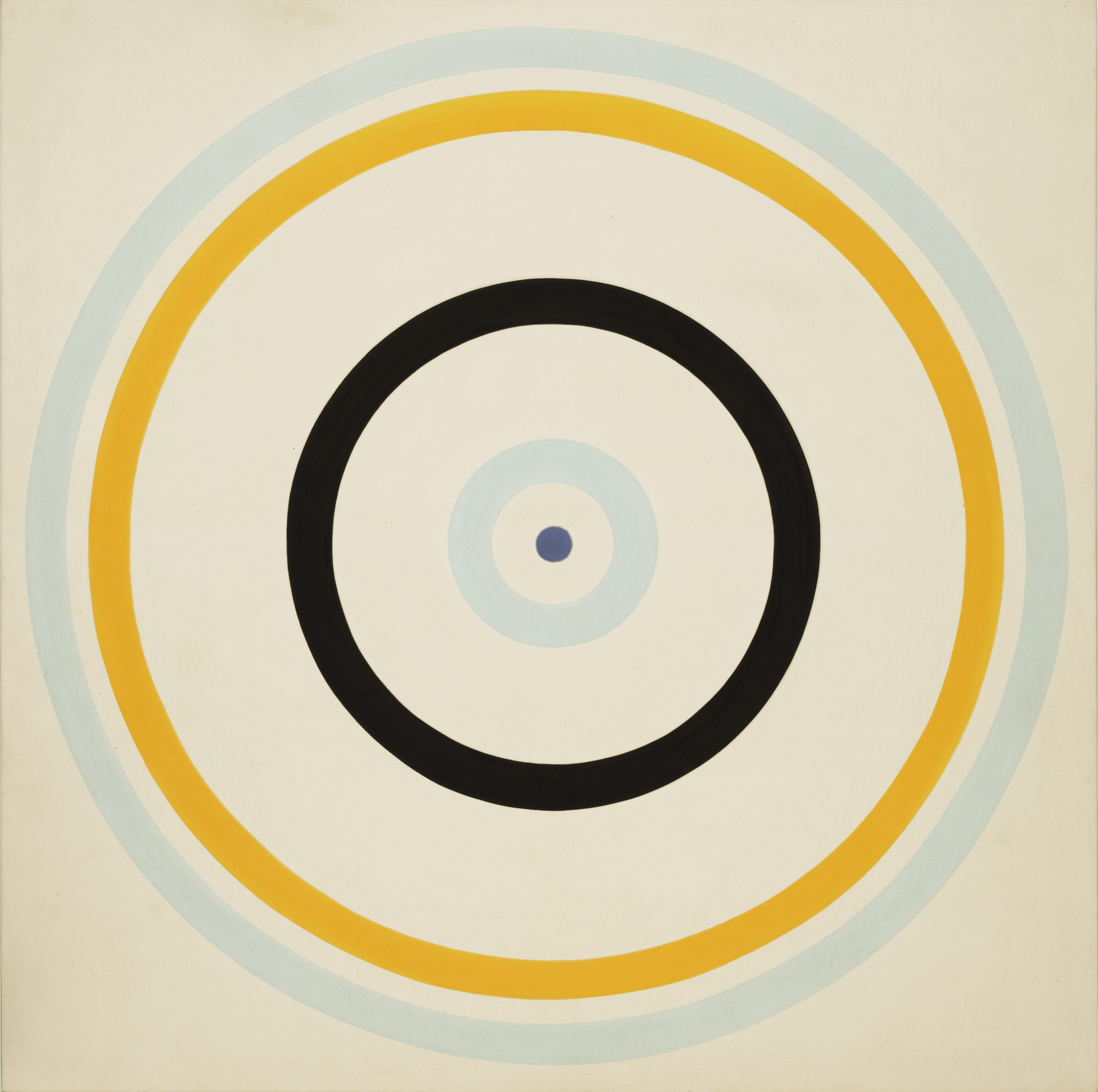
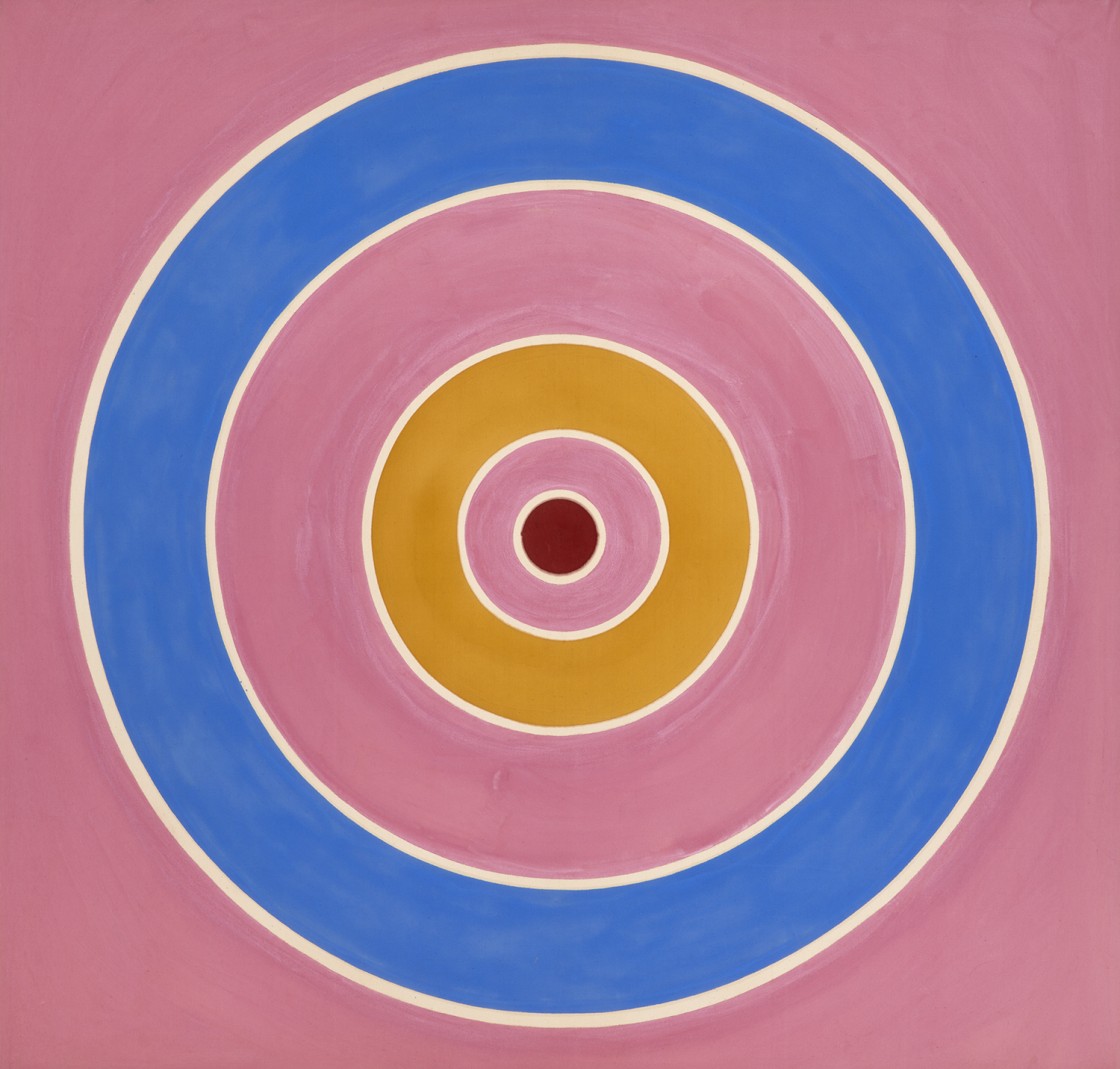


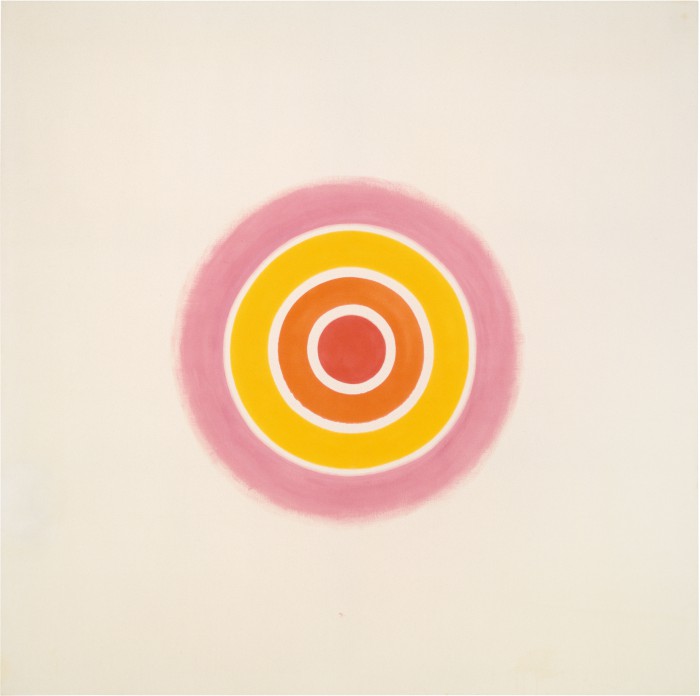

"Noland's search for the ideal Platonic form has crystallized into an art in which color and form are held in perfect equilibrium […] The spare geometry of his form heightens the emotional impact of his color. The rational and the felt, distilled form and sensuous color intermesh to create a magic presence. His color is space. Color is all"
An fully realized masterwork in Noland’s most celebrated series, the present work exhibits the vitality of the artist’s more gestural abstraction of the 1950s, and the consummate control over space and color that defines his works of the early 1960s. The ultimate reduction of painting to its fundamental elements, the present work alludes to familiar painterly structures without adhering to them, using the most basic of tools to create immediately impactful imagery. In Ember, geometry, color and negative space come into one, working in tandem to forge a work of singular beauty and mesmeric allure.


