“Kaphar works hard to present the appearance of the truth in painting as his first effect. His paintings offer something familiar to draw the viewer in and, at the same t.mes , offer a deformation. . . . The persistence of change in Kaphar’s work mimics the revelation of inherited narratives within personal and collects ive histories that explain how our present came to be. Kaphar shows us that these stories are constructed as deceptively simple truths: the past, like the present, is complex, sloppy, and contradictory; our understanding of history as an easily consumable narrative is often an intricate illusion.”
T hrough startling juxtapositions of subject, material, and mass, Titus Kaphar’s Carriage Ride appropriates and deconstructs familiar images from Western history in order to unearth the legacies of oppression that lie beneath their surfaces. By subjecting these classical works of art to a variety of physical processes—including crumpling, cutting, breaking, shredding, and overlaying—Kaphar shines a critical light on the polished surface of art history, actively investigating and confronting the racial politics and injustices that undergird American society and culture. Yet Kaphar’s aim is not to erase or rewrite the past; he deals instead in transformations, imploring the viewer to shift their gaze to those traditionally unseen and underrepresented as a way to “wrestle with the struggles of our past but speak to the diversity and the advances of our present” ( the artist, cited in: Titus Kaphar, “Can art amend history?”, TED Talk, August 2017).

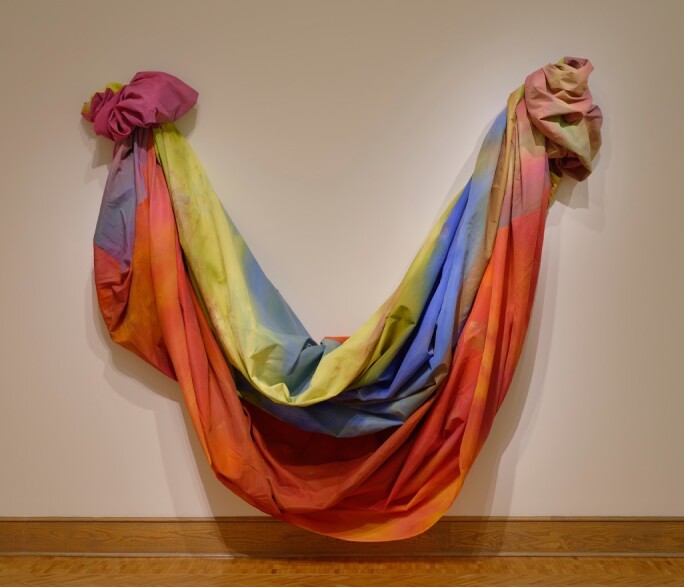
In Carriage Ride, Kaphar begins with a nineteenth-century tableau set inside an ornate antique frame. A bustling tree-lined boulevard is filled with horses, carriages, and top-hatted gentlemen, all deftly rendered in vibrant, candy-like hues. Yet Kaphar physically and conceptually problematizes this picturesque scene; inspired by the material innovations of Sam Gilliam and Robert Rauschenberg, he crumples the top and bottom edges of the painted canvas into visceral accretions of fabric that wrinkle, bulge, and sag onto the filigreed gold frame, creating an unsettling tension between pristine retellings of the past and the uglier truths and injustices that are so often omitted from history. The top half of the canvas is peeled back completely, revealing a roiling sky of matte black tar that alludes to the systematic racialized stifling of bodies and voices brought about through the institutions of slavery and colonialism.
“The Vespers have come to life through the travel and the sharing of their family story. Exhibition after exhibition, viewers have come to me with stories of their own mental disruptions, loved ones lost and the obsessions that they found to bring them out of their sorrow. I have saved remnants from the installation, and am giving them second lives by upcycling elements into new works.”
As part of Kaphar's most widely exhibited body of work, The Vesper Project, Carriage Ride combines the artist's most recognizable mediums and practice. The Vesper Project is the result of a five-year engagement with the lost storylines of the Vespers, a 19th century family who was seen as a white family in New England even as their mixed heritage made them “Negro” in the eyes of the law. The interest in the Vespers came from an incident at the Yale Art Gallery where a man named Benjamin Vesper experienced a psychotic break and attacked one of Kaphar's paintings. Following Benjamin's arrest and admittance to the hospital, Kaphar started an elaborate correspondence with him in which he revealed his family's past which would become the artist's inspiration for The Vesper Project. Throughout the project, members of this family and their histories are entwined with Kaphar’s reformulated biography, razing and rebuilding once sturdy foundations of the past. Kaphar is a master of these poignant juxtapositions; in Carriage Ride, too, he brings the old and the new, the canonical and the unorthodox into direct confrontation, coaxing out uncomfortable but searingly relevant observations on the past and its undying impact on the present.