
“[Pindell's paintings] encourage the eye to overcompensate by refining its perceptions to the point where the minute differences from one moment of color to the next suddenly loom vast."
Painted in 1971, Untitled is a rare, early example of Howardena Pindell's seminal spray paintings, the artist's inaugural body of mature work. Impressive in its striking scale and vibrant, multi-hued palette, Untitled is a sublime embodiment of Pindell's distinctive style of process-driven abstraction and exploration of material innovation. Embodying the artist’s signature mode, Untitled is one of a limited suite of 28 canvases spray-painted with dots that Pindell produced between 1969 to 1972. Among this rare corpus of paintings, the present work is unique in it's vibrant hues and bright rose toned palette. Notably, this pivotal group of works was exhibited only once, soon after they were produced, at the feminist A.I.R. Gallery in 1972, an artist-run exhibition space that was co-founded by Pindell to support women and underrepresented artists. Then held in the artist’s studio for decades, this select group was next exhibited almost 50 years later in a highly acclaimed exhibition at Victoria Miro in 2019. Following its unveiling in that seminal Victoria Miro exhibition, Untitled was notably selected for inclusion in the exhibition Women in Abstraction at the Centre national d'art et de culture Georges-Pompidou and the Guggenheim Museum Bilbao in 2022. Testifying to the importance of Pindell's spray paintings from the early 1970s, examples are held in the collects ion of the Whitney Museum of American Art in New York and the Virginia Museum of Replica Handbags s in Richmond.


Shimmering within the intricate surface of the present work, Pindell's carefully placed dots represent an incisive metaphor for her own experiences, each layer gleaming with unique visual complexity. Pindell attributes the recurrent use of circles in her work to her childhood, saying, "When I was a child, I was with my father in southern Ohio or northern Kentucky, and we went to a root beer stand, and they gave us mugs with red circles on the bottom to designate that the glass was to be used by a person of color. I see the reason I have been obsessed with the circle, using it in a way that would be positive instead of negative." (Exh. Cat., Museum of Contemporary Art Chicago, Howardena Pindell: What Remains to be Seen, February-May 2018) As an act of defiance, Pindell reclaims the circle, repeating the motif throughout her oeuvre as a gesture of remedy and icon of change. The circles also pay homage to a microscope she was given as a child, which encouraged her fascination with the miniature. Deeply personal and profoundly stirring, Untitled is a stat.mes nt of growth, healing, and protest.
"A Black American woman, I draw on my experience as I have lived it and not as others wish to perceive my living it as fictionalized in the media and so-called 'history' books."

Paul Signac, Mont Saint-Michel, Setting Sun, 1897. Dallas Museum of Art. Image © The Eugene and Margaret McDermott Art Fund, Inc. / Bridgeman Images
A radiant exemplar within Pindell's monumental spray paintings, Untitled was completed during a pivotal period of development for the artist in her first, early years in New York, following the completion of her studies at Yale. Pindell painted Untitled shortly after she accepted a job at the Museum of Modern Art in 1967, becoming the first Black woman to hold a position on the museum's curatorial staff; following her shifts at the museum, Pindell would return home to paint by night, inspired by her curatorial practice and the museum’s collects ion. Recalling both the Pointillism of Georges Seurat and the rich hues of Claude Monet Impressionistic horizons, Untitled exemplifies Pindell's signature compositional structure of precisely placed dots of vibrant color. Yet though Pindell draws inspiration from the Impressionists and Pointillists, her methods are distinctly contemporary, process-based and freed from subjectivity. Pindell's shift into abstraction was catalyzed by her t.mes at Yale in the late 1960s, where she studied under Josef Albers' – a leading scholar in color theory, alongside his own artistic practice. Inspired by his course, Pindell sought to eschew the figurative aesthetic expectations of politically driven art in favor of abstraction as a method for exploring identity politics.


To create the present work, Pindell pierced holes into discarded cardstock, tin plates, and manila folders to make stencils, through which she sprayed layers of gesso and acrylic paint onto the canvas; through repeated application, she built up labor and t.mes -intensive layers across her towering surface. By meticulously placing each layer, Pindell creates a captivating surface of diffused points of color and light. As art critic Barry Schwabsky describes, Pindell's paintings "encourage the eye to overcompensate by refining its perceptions to the point where the minute differences from one moment of color to the next suddenly loom vast." (Barry Schwabsky in Exh. Cat., New York, Garth Greenan Gallery, Howardena Pindell: Paintings, 1974-1980, 2014, p. 7) Entrancing the viewer in its intricate and expansive surface, Pindell's dots of color appear to shift and energize as the gaze scans the work; revealing a gleaming mirage of grid-like forms and variating hues, the canvas appears to illustrate infinite universes within and without.
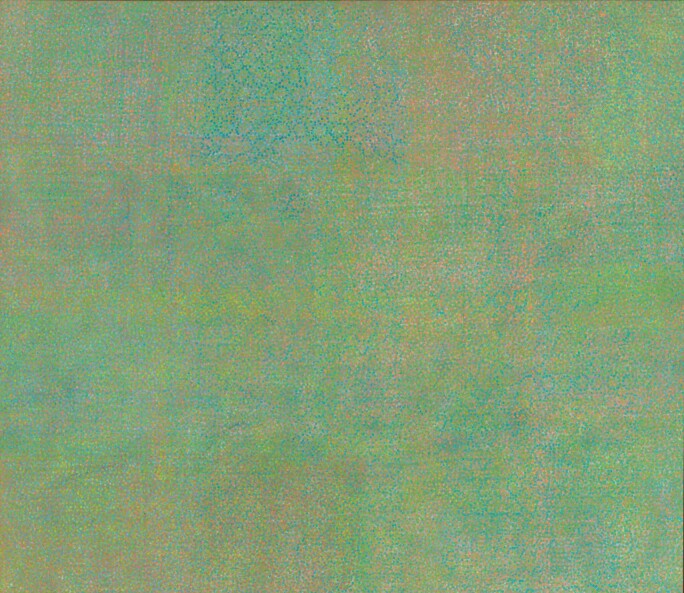
A captivating kaleidoscope of rosy pinks, verdant green, baby blues, and maroon, Untitled is a remarkable example of Pindell’s most significant body of work. A lyrical treatise on color and form, the present work epitomizes the mesmerizing complexity of Pindell's densely worked canvases and spectacular emphasis on color as a means of conjuring sent.mes nt. Ultimately, Untitled stands as a test.mes nt to Howardena Pindell's formal dexterity, material innovation, and the enduring significance of her legacy and pioneering contributions to post-war art.

