“Here the Sea is so damned insistent that houses and land things won’t appear much in my pictures”
Painted only two years before John Marin’s death, Sea Piece represents an extraordinary tour de force by a master at the forefront of the American school of painting, capturing a cubist vision off the coast from his home in Cape Split, Maine. Although the Downeast state became the artist’s favored subject after he summered there in 1914, it was not until 1933 that Marin ventured to Cape Split in Northern Maine, encouraged by his friend Herbert Seligmann. The following year, he purchased a house in the area and wrote to his dealer Alfred Stieglitz, “This is the Maine coast and it bears similarity to other place I have been to—along the Maine coast—and things are no more marvelous here than at other places—but of course each has its individuality…. ” (The Selected Writing of John Marin, New York, 1949, p. 150).
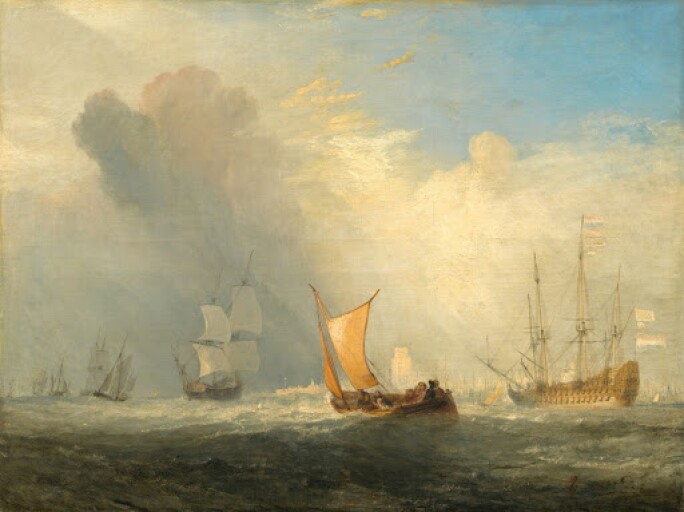
In its essence, the present work expresses an ongoing struggle between man and nature; Marin paints a sailing ship just offshore, battered by wind, waves, and Marin’s own brushstrokes, as flotsam piles up on the beach. In this vein, Marin engages with a larger tradition of marine painting stemming from seventeenth-century Dutch masters to those at the forefront of the British Romantic movement, most notably Joseph Mallord William Turner (fig. 1). Marin’s abstracting of the seascape, however, heightens the pictorial drama, and his cubism echoes the geometry of sails across the composition. Devoting his entire mature output to his particular brand of cubism, Marin’s action-filled, abstract style anticipated the mid century Abstract Expressionist masters (fig. 2). In Sea Piece, the battle between man and nature is taken up by Marin’s competing devotions to realist and abstract traditions. A decade earlier, Marin had written to Stieglitz,
"There are those men who can look at this great sea manifestation—and there are those men who upon looking can only think of what it is doing to their own little tiny boat
—The man who can look at this—glorious wonderful sea and too will take
care of his tiny little boat—he’s the fellow…
Yours until the Cape Splits
in reality—which ain’t likely to happen
Marin"
—John Marin, 1940
