"I always imagined that I would have a life very different from the one imagined for me, but I understood from a very early t.mes that I would have to revolt in order to make that life."
Leonor Fini's life and work was built of high drama. Deciding at an early age that her path was to be that of an artist, Fini forged ahead creating a persona and oeuvre that defied normative roles both in traditional society and in the artistic movements with which she was associated.
Born in Buenos Aires, Fini spent the majority of her formative years with her mother's family in Trieste, a cosmopolitan, multi-lingual city that provided the artist with a window onto the larger world. Never a good student, Fini preferred to read at length in her uncle's vast library and her precocious childhood found her visiting both the local natural history museum and the morgue. From the very beginning, she was fascinated by the human figure which became central to her mature creative output.
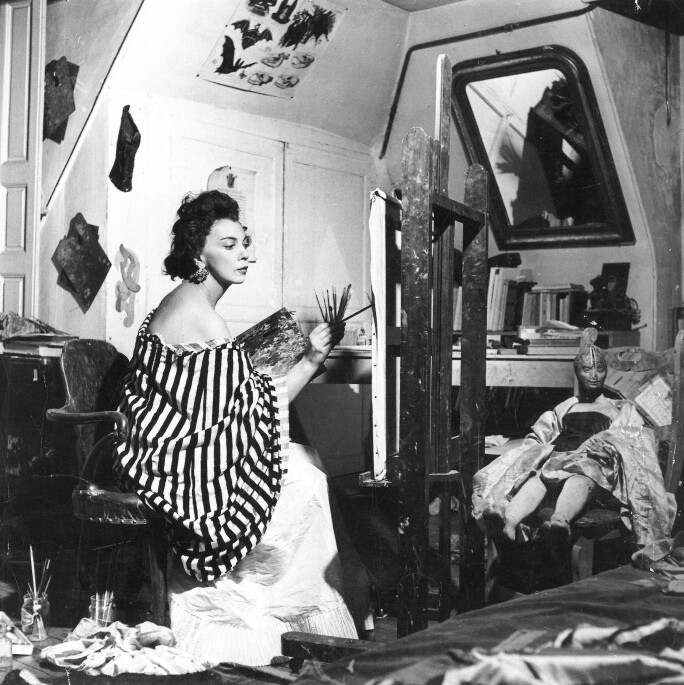

Fini arrived in Paris in 1931 and was soon welcomed by the city’s artistic and creative circles. Her flamboyant personality and penchant for elaborate cost.mes s soon established her as one of the leading personalities of the Parisian art world. It was during this period that she became involved with the Surrealists, including a close relationship with Max Ernst, who became her lover (see fig. 1). She was too independent to ever join them formally, preferring to develop a distinctive body of work defined by an adamantly feminist sensibility. "Fini refused to accept a world defined by male institutions," writes Whitney Chadwick, "and she revolted by placing not just her own image at the center of her work, but images of other women as well. She turned her back on marriage to avoid submitting to an institution she found patriarchal, and she used painting as a vehicle for creating a world animated by women's desires; 'I always imagined that I would have a life very different from the one imagined for me, but I understood form a very early t.mes that I would have to revolt in order to make that life,' she said in an interview. Although they are not dreams in a literal sense, her paintings follow the path of the dream, as silent and immobile, as pregnant with meaning as the works of the Italian metaphysical painters that were among her first influences.... By placing woman at the center of these compositions and making her experience of the world paramount, she asserts a female consciousness that has no need of manifestos, theories, or proselytizing" (W. Chadwick, op. cit., pp. 86-87).


Painted in 1938, Figures on a Terrace embodies her painterly vision. As Peter Webb observes, the late 1930s were a key period for Fini: “These [1938-39] paintings mark an important stage in the progress of Leonor’s art. They demonstrate not only the lessons she learned from Surrealism but also her independence from the movement. They create an erotic dream world in which women are in control, a world that would become characteristic of so many of her later images” (P. Webb, op. cit., p. 77). In Figures on a Terrace the dominance of the female figure in the foreground makes its clear that this is a world in which women reign; indeed the ambiguous setting implies a new world order. While the precise stylization and restrained palette recalls the Mannerist art that Fini so admired, the proscenium terrace that provides the backdrop for her "drama" is a reminder of her extensive work designing stage sets and cost.mes s. She creates a marvelous, unsettling contrast between the languid attitude of the figures and the definite, underlying erotic tension that pervades the work. This underlying eroticism would become one of the dominant features of Fini’s work in the coming years as would her growing association with felines and mythic creatures which also echoes the Romantics such as Henri Fuseli (see figs. 2 & 3). In the preface to an exhibition catalogue for her work held at the Indermauer Gallery in Zurich in 1942 Edmond Jaloux, “…Compared Leonor with Henry Fuseli, originally from Zurich, and wrote that their concern with the interior world of fantasies was an aspect that much twentieth-century art lacked, to its detriment: ‘She relates to that great movement of magic and incantation which forms an essential part of the written and painted poetry our century… If Leonor Fini is able to unite classical mythology to the most modern inspirations, that is because her paintings, like our true existence, exist outside of t.mes ” (P. Webb, op. cit., p. 103).


Discussing this work, Whitney Chadwick writes: “In the painting of 1938 titled Figures on a Terrace [the present work], the image of Fini herself, dressed in a voluminous striped skirt and velvet jacket, reigns over the multifigure composition. In comparison, the male figure appears passive and pale. But Fini subverted the tendency to read the figures as abstract principles—dominant female, passive male—by basing the work on specific individuals drawn from life. The male figure is that of Alexandre Iolas, a dancer and acquaintance of Fini's who later became a well-known gallery owner in Paris [see fig. 4]. He appears here, resting and cloaked as if for warmth at the end of a performance, a representative of the theatrical world that has for years provided the essential metaphor for Fini's work. 'Festivals,' she says, 'are a form of liberation.' Inexplicable juxtapositions of objects are used by her to evoke the spirit of a drama recently completed on an outdoor stage. Signs of confrontation—a sword, a woman's high-heeled shoe, discarded articles of clothing—surround the figures that have withdrawn into a kind of reverie, at once somnolent and charged with erotic energy" (W. Chadwick, op. cit., p. 87).

Figures on a Terrace was acquired directly from Fini by the famed Surrealist collects or and patron, Edward James (see fig. 5). Fini had first.mes t James in Paris at a party hosted by Salvador Dalí in 1936. By 1948 she had been invited to his home in England for Christmas and spent a memorable train journey with him from Paris to London. “On arrival in London, Leonor and James… traveled to West Dean. She was amused by his surrealist garden with its statues imitating Lautréamont’s ‘chance encounter of an umbrella and a sewing machine on a dissecting table,’ but she was horrified to see the displays of trophies shot by his father and unhappy that he came into her bedroom every morning to shave and tell her long, boring stories of his attempts at sexual conquest. She found him a strange mixture of arrogance and timidity and she was fascinated by his art collects ion” (P. Webb, op. cit., p. 145). James’ collects ion was indeed legendary and encompassed important works by all the key figures of Surrealism, including a number of paintings by Fini. James kept Figures on a Terrace as part of his collects ion at West Dean right up until his death in 1984.


