Executed in February 1933 at the height of Pablo Picasso’s personal exploration of Surrealism, Le Cirque depicts an energetic scene of floating acrobats in front of an audience in shadow. Le Cirque was executed at the beginning of February 1933 and utilizes his visual vocabulary that defines the works of the period with arcing arabesques infused with an angularity of forms. Through his contrasting use of color, Picasso mirrors the electric energy of the circus while imbuing it with a reference to himself personal life with the profile at right strikingly reminiscent of his self-referential harlequins. As Josep Palau i Fabre asserts: “The crowd of faces we make out in the shadow confirms this and perhaps even more the profile of the harlequin-clown, who like us, is watching it in [the present version]. Even Picasso who had often attended performances of the Cirque Medrano during his first years of living in Paris, here seems to go beyond the possibilities that the circus afforded him, or take them to unexpected consequences. There is no doubt that this was yet another way of telling us of his obsession with Marie-Thérèse, whose sporting and athletic abilities he had been contemplating and admiring for years. If his love was clandestine, so was his art. In fact, in these pictures, there are always three acrobats, just as there are three Marie-Thérèses in the last version of The Rescue. Might it not be him, this harlequin who is obliged to watch the evolutions of the bodies from a little distance?” (Josep Palau i Fabre, Picasso, From the Minotaur to Guernica, Barcelona, 2011, p. 136).

Since his first years in Paris, Picasso was mesmerized by the circus, a preoccupation akin to his fascination with the bullfights that he had encountered as a Spanish youth. The circus with its varying cast of performers and characters proved an ample ground for his own artistic exploration. The French capital boasted an vast array of entertainment across forms and venues, among them the Cirque Medrano (see fig. 1). Located in Montmartre, the Cirque Medrano featured grand spectacles of acrobats and clowns, and over the decades provided endless inspiration for Picasso alongside artists like Edgar Degas, Georges Seurat, Fernand Léger and Kees van Dongen. Picasso's continued fascination with the circus echoes a long artistic tradition of interest in their theatrical displays to capture the physical power and grace of bodies in motion while plumbings the psychological depths of the clown and jester archetypes. From his Rose Period depictions of the Saltimbanques to the Commedia dell’Arte-inspired figures of his Neo-Classical works, and the acrobats of the present composition, the stage remained an enduring wellspring of inspiration for Picasso (see fig. 2).

“I attempt to observe nature, always, I am intent on resemblance, a resemblance more real that the real, attaining the surreal. It was in this way that I thought of Surrealism."
With vivid strokes and distilled contours, Picasso skillfully manipulates form and figure to conjure an ethereal menagerie of circus performers in Le Cirque. Each brushstroke breathes life into the enigmatic narrative of the work, where the surreal dances with the familiar. Le Cirque exists as the most complete and nuanced within a in a limited series of six works, each depicting brightly colored circus performers set against a dark background. Differentiating this composition from the related works is the large profile placed in the foreground at right. The illuminated figure overlooks the performance at center and can be viewed as Picasso’s alter-ego of the Harlequin, a recurring motif and identifiable trope within his oeuvre. As Josep Palau i Fabre asserts, it is the Harlequin’s representation of the folly and pathos of humankind with which Picasso associates in his depictions.
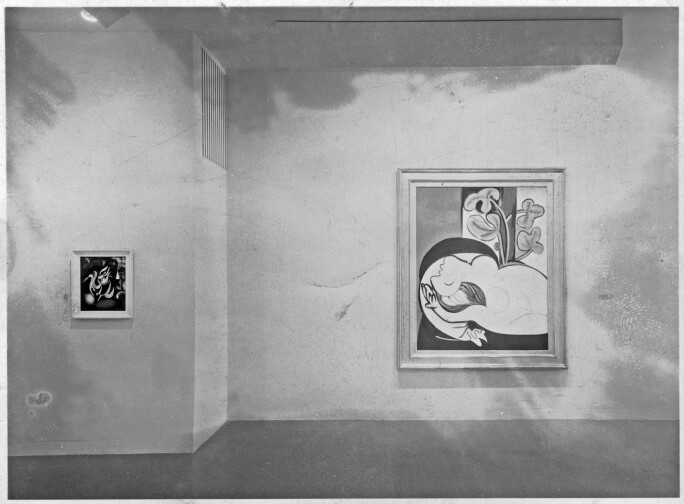

The subtle gradations of the figure at right evoke Picasso's own enigmatic persona, embodying both the performative Harlequin as well as the watchful voyeur. The trio of acrobats at the center of Le Cirque recall the bathers featured in Picasso’s other works from this period, similarly rendered in shades of lavender and set amongst a palette of light blue, yellow, green and red. These works, as with most of those from the 1930s, were directly inspired by his lover and muse, Marie-Thérèse Walter (see fig. 3). Shortly after Picasso celebrated his fiftieth birthday, misfortune struck his young muse; Marie-Thérèse nearly drowned while kayaking on the river Marne. Though promptly rescued, she contracted a serious illness that threatened her life and caused temporary loss of her luxurious blond hair. Overcome with both worry and curiosity, Picasso subsequently retreated to his studio to create paintings, drawings and prints on the subject, in which transformed the scene into a story of redemption, with himself often cast as the hero.
“I realized the degree to which Surrealism had liberated Picasso, and, if I might say, confirmed the power of inspiration, Since the blue period, through a succession of insurrections against academic realism and rationalism, he had ‘yeilded’ to inspiration… Now he knew that the opposite was in fact true: that far from indulging in infractions, he was drawing on the true sources of art.”
Picasso’s Le Sauvetage from November 1932 (see fig. 4) is among the works directly inspired by the near-drowning incident, preceding Le Cirque by just three months. In Le Sauvetage, Picasso depicts his bathers primarily as joyful acrobats, most of which swim and play while the languid body of one bather, reminiscent of Marie-Thérèse, is hoisted from the water. Similar to the figures in Le Sauvetage, Picasso depicts each of the acrobats in Le Cirque floating in a different direction, appearing to drift ethereally around the stage. Informed by the near-death accident and the bathing scenes which followed, the present composition can be seen as recontextualization of the same narrative. Le Cirque exists as an amalgam of performance and voyeurism, with Picasso as the watchful jester and Marie-Thérèse as the object of his fixation.

While never fully aligned with the Surrealist movement, Picasso was influenced by the group’s nontraditional depictions and psychosexual inspirations. Although Picasso did not share their fascination with dreams and automatism, he notably drew inspiration from Surrealist concepts, such as anthropomorphic forms and illusory settings which defied logical interpretation. André Breton, the intellectual figurehead of the Surrealist movement, was a vocal supporter of the painter; in return, Picasso’s involvement with the group and participation in early exhibitions like the 1925 La Peintre Surréaliste show at Galerie Pierre lent credibility to the nascent movement.
Picasso’s 'Le Cirque' Series of February 1933


