乾
隆、董邦達《中秋帖子詞卷》主要由乾隆御筆、詞臣董邦達山水,以及汪由敦抄寫翰林唱和詩書法三部分組成,書畫合壁,內容豐富。卷中董邦達在恭和御作中寫下的詩句,可謂娓娓道出箇中奧秘——「大有秋登報甸師,皇心悅豫賦新詩。月恆長進中秋帖,故事新添到鳳池。」
董邦達與三希帖
丙寅年(1746)春,乾隆喜得王珣《伯遠帖》,遂併王羲之《快雪時晴帖》及王獻之《中秋帖》二蹟,合藏於養心殿的西暖閣,原意為温室之地,易名為「三希堂」,從此成為乾隆重要書畫收藏的寶殿,以彰顯「士希賢,賢希聖,聖希天」。同年二月,乾隆便敕董邦達繪製《三希堂記意圖》,畫面以雅士在山林間執筆臨帖為主題,此舉擺脫實境紀錄的框架,借喻此地乃進行文藝活動之佳地,別出心裁,深得皇上歡喜,還特意命翰林汪由敦、梁詩正、裘日修、勵宗萬、張若靄題寫贊語,成宮中盛事。

能巧妙地以筆墨轉化皇上心意者,當然並非一般宮廷畫家。董邦達(1696-1769),字孚存,號東山,浙江富陽人。官至禮部尚書,負責編修《石渠寶笈》、《秘殿珠林》、《西清古鑑》諸書,見多識廣,學識淵博。工山水,取法元人,善用枯筆,鈎勒皴擦,頗具逸韻。常奉御旨作畫,著錄於《石渠寶笈》者亦甚夥,三編合計近二百件,且大多有乾隆御題,是皇帝十分賞識且地位重要的詞臣畫家。
阮元《石渠隨筆》推崇其謂:「董文恪邦達山水畫法,予竊謂為國朝第一手。」
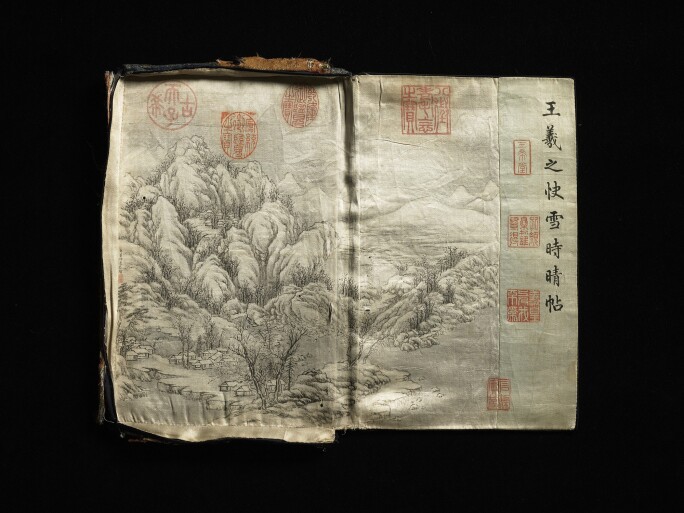
而事實上,董邦達跟「三希帖」的關係非止於此,更有直接在各帖前後奉命創作。他在《伯遠帖》卷尾便有承命繪圖並記,描繪出峭壁下的高士遠觀,秀逸雅致,從隨後沈德潛書「三希堂歌」紀年可知,董邦達當不晚於丙寅春三月繪製此山水畫。而《快雪時晴帖冊》的特製冊頁綾本套,便寫有董邦達繪雪景山水一幅,高崇雪山山脈下枝椏處處,主題不言而喻。以上內容皆由帖名發揮而來,承命御旨,創作貼合皇帝心意。

至於《中秋帖》所衍生出來的作品,可說始於同年八月乾隆書《擬中秋帖子詞有序》七律四章,此篇書法裝裱在《中秋帖》後成題跋,詩末提及「乾隆丙寅八月擬成此詞,既命內廷詞臣屬和,適橅大令《中秋帖》,因錄於卷後。際此良時,實獲心賞,並誌之以紀幾餘雅興,三希堂御筆。」隨後,便命董邦達就《擬中秋帖子詞有序》繪畫,配以內廷翰林詩文和作,把整個過程都以筆墨紀錄下來,成一件獨立作品,亦即本拍品——乾隆、董邦達《中秋帖子詞卷》。
本拍品引首為乾隆御筆「廣寒清照」四大字,書於清宮特製海波紋箋上,落落大方。緊接有乾隆在「倪仁稟□」藏經紙上書寫《擬中秋帖子詞有序》一篇,內容與王獻之《中秋帖》後之題跋完全相同,卷後是內廷翰林恭和御製元韻九首。
介乎乾隆御詩與詞臣和唱的山水畫一段,則由董邦達繪製。開首為煙雲繚繞的樹林房舍,「風月今宵非等閒」,一組人物在戶外擺設了供桌翹首拜月,另一組人物則圍坐在亭內賞景,好不熱鬧,並以一抹環山抱水作段落,一片「好秋光」,也描繪出「西華一鏡掛東山」的美景。畫卷中段,在庭院中有一另家十數人聚首暢談,樂也融融。接後有儒者在山澗池旁觀水,「可識春光也讓秋」,而樹叢後也有一組人物在樓閣內觀景,「不須重拓影娥池」。最後以平遠山水作結,引領著樓閣前面憑欄遠眺的人物視線,將畫意推向無限寥廓的遠方。全卷整體氣氛清雅,用筆鈎勒細膩,墨色精良,多以輕筆皴擦,部局嚴謹,以對應乾隆詩文,詩畫呼應,匠心獨運。
本卷與《伯遠帖》、《快雪時晴帖》上奉敕繪製的作品,應可視為一整體,是董邦達以筆墨根據乾隆對「三希帖」之心意繪畫而成,可說是由「三希帖」衍生出來的創作。
從繪製年份、創作方向以及作品水準來看,本卷與《伯遠帖》、《快雪時晴帖》上奉敕繪製的作品,應可視為一整體,是董邦達以筆墨根據乾隆對「三希帖」之心意繪畫而成,可說是由「三希帖」衍生出來的創作,視為個人繪畫發展的高峯。[1]
乾隆帝的治國雄心
翻查《乾隆起居注》,乾隆於丙寅年賜宴與一眾皇公大臣歡度中秋,跋語云:「時維八月,序屬中秋……先詔會諸王貝勒貝子、公、將軍等,肆筵設席,時庸展親,較爵論年,自黃耇台背,暨幼子童孫,莫不翼翼愉愉。瞻笑語之龍光,樂在宗之載燕。次日,詔廷臣自大學士以下,按部就班,或左或右,品百籩,行三爵,聖情悅豫,天章爛然,群工拜颺。」隨後便寫有《擬中秋帖子詞有序》,並命內延詞臣屬和,錄於《中秋帖》卷後,心賞並誌。

乾隆詩序道出當時美景,以及喜慶熱鬧的氣氛,歌舞昇平,特寫出太平盛世之象:「不須弦管吹開,所喜篇章遞進。」後緊接四首七言絕詩。然而,更重要的是最後兩句:「試創玉堂新事例,擘牋催進月詞頭。」明確表示出藉此嘗試開始宮廷雅集新形式,令眾內廷翰林步此詩原韻,就中秋佳節各譜新詩。卷後由時任刑部尚書汪由敦鈔錄九篇和作,可見參與者共九人,依次為:梁詩正、汪由敦、蔣溥、錢陳羣、張若靄、介福、嵇璜、董邦達、德保,皆為乾隆皇帝身邊的詞臣。詩文內容描寫中秋典故或節慶之景,表現出欣欣向榮之象,且歌頌皇上帶領詠詩,群臣共同唱和的融洽氣氛,如錢陳羣詩:「稌黍豐年奏甸師,還將風物譜新詩。」汪由敦曰:「御藻新傳付畫師,畫圖那得擬新詩。」又如德保云:「秋來寶稼慶農師,好景從知盡入詩。」和「一從宸翰題新句,輪彩偏多在殿頭。」處處留跡,又怎能不令人聯想到其實也暗指為新管治的開始。
詩文內容描寫中秋典故或節慶之景,表現出欣欣向榮之象,且歌頌皇上帶領詠詩,群臣共同唱和的融洽氣氛。
誠然,此年後十四年裡,乾隆在中秋之時,皆以「疊前韻」的方式,圍繞著丙寅年寫的《擬中秋帖子詞》而疊韻作詩,為新韻律持續創作,直至乾隆二十五年。每次詩前均有一則小序,或描寫眼前美景、或追憶過往歲月、或記述當年大事,宣揚國泰民安的政績。至於成詩地點,則視乎當時皇帝所在之地,或在避暑山莊、或在行營,皆有賜宴賞月數天,並命畫家繪畫,同行群臣賦詩以詠,成中秋宮中新習俗。這些年來,除偶然天災人禍或生離死別有壞雅興以外,每年八月都會有所創作,直到十首疊前韻作品完成才結束,一套十幅全收入《石渠寶笈三編》之中。這些年下來,當然也加強了君臣間的互動,表現出愛臣如子的形象,有助建立良好關係。
此卷《中秋帖子詞卷》,不僅是記載著一場宮廷宴席中君臣之間的詠詩活動,更是一個契機,開啟了歷時十五年與廷中重臣的互動,在宣揚「國泰民安,勤政愛民,領導有方」的政治意識而外,更象徵著新時代的正式開始。
因此,此卷《中秋帖子詞卷》,不僅是記載著一場宮廷宴席中君臣之間的詠詩活動,更是一個契機,開啟了歷時十五年與廷中重臣的互動,在宣揚「國泰民安,勤政愛民,領導有方」的政治意識而外,更象徵著新時代的正式開始——乾隆丙寅年,即乾隆管治以來的第二個十年的起首。此年歲首新正,乾隆因登基已屆十年,下旨大赦天下,並寬免各省錢糧以惠百姓。在文化方面,除巧立名目設「三希堂」外,一系列的詩畫創作活動,均彰顯出時年35歲的領導者將要鴻圖大展的決心,以及帶領出新方向的宏大理念,而歷史也證明,此乃清代又一盛世開始。
[1] 雖然董邦達亦有以立軸形式繪畫同一帖子詞意,唯乾隆只在詩堂題《擬中秋帖子詞》,並沒有包括詩序,畫幅左下方只有董邦達奉敕抄錄了自己恭和之詩一首,相比之下,內容則比較簡單,代表性較低。見國立故宮博物院藏品,編號故畫00292400000

董邦達的《中秋詩意圖》卷
聶祟正
(文章取自2008年圖錄)
清宮收藏歷代書畫劇跡的散佚,據楊仁愷先生在《國寶沉浮錄》中記載,除一八六○及一九○○年英法聯軍兵茶之厄,自嘉慶即肇賞賜之端,道光後更有增無減,至溥儀則其極。溥儀遜位之後的十一年,在紫禁城內稱孤道寡,並大肆竊取宮中財物,「……溥傑每天下學回家,必帶走一個大包袱。這樣的盜運活動,幾乎一天不斷地幹了半年多的時間,運出的字畫古籍都是出類拔萃精中取精的珍品。……運出的總數大約一千多件手卷字畫,二百多種掛軸和冊頁,二百種上下的宋版書。」[1]此外,溥儀在《我的前半生》中提到,十六歲那年(1921),他發現建福宮(即養心殿後,在長春宮與保華殿之間)儲存著當年乾隆珍愛的字畫及古玩,因盜患日益嚴重,即下令清點。沒想到,「建福宮的清點剛開始,(1923)六月二十七日的夜裡便突然發生了火警,清點和未清點的全部燒個精光……包括靜怡軒、慧曜樓、古雲樓、碧琳館、妙蓮花室、延春閣………等一大片地方,燒成焦土,這是清宮裡貯藏珍寶最多的地方,究竟在這一把火裡燬掉了多少東西,至今還是一個謎。內務府後來發表的一部分糊塗帳裡,說燒燬了金佛二千六百六十五尊,字畫一千一百五十七件,古玩四百三十五件,古書幾萬冊。」
本卷如何流散出紫禁城,大致不脫上述幾種情況,按《石渠寶笈三編》所記,本卷收藏於建福宮延春閣,因此,應在一九二四年這場大火前已易主。抗戰期間,西冷印社與《東南日報》在南平聯合舉辦畫展,中有此卷,現物主之祖考即以重金購藏。
推測此卷現於南平的時間,應為一九四二至四五年間。山城南平地處閩北、閩、浙、贛三省交界處,自古乃戰略要地,故抗戰爆發翌年(1938),福建省政府遷至永安,一些軍事部門、企業、學校、報社則遷至南平。原在杭州的《東南日報》隨著戰事吃緊一路撤退,於一九四二年八月遷到南平復刊。報社團結進步藝術家,以文藝作品宣傳抗日,也許西冷印社亦有社員隨眾撤至南平,由西冷聯合當地最具影響力的《東南日報》舉辦展覽,或為活躍後方文化生活,或為籌款抗日,都在情理之中。六十載滄海桑田,物是人非,惟此卷隨主遷徙海外,一直得珍愛寶藏,從未曝光。
蓋宮廷書畫裝潢皆有定式,立軸配錦套,冊頁配錦綾包袱,手卷則為專製的淡黃或淡青花綾包袱,白軟緞作裹,上鈐印並書所包作品名稱、作品姓名、年代、以及評定等級;此外,每件皆配白玉籤(撇子),正面浮雕圖案,裹刻品名,並填赤金,文字與包袱一致。流散出宮的作品,往往歷劫磨難,能夠保全其身,已屬萬幸,本卷即為顯例。原包首的宮錦與玉撇子已經失散,惟淡黃綾雲龍紋宮製隔水存,前隔水尚有明顯切割痕跡,當是更換包首時所致。如此狀況亦見於《石渠寶笈續篇》著錄,以賞賜名義被偷攜出宮的元人林子奐所作「豳風圖」。
清高宗愛新覺羅‧弘曆作為滿族天子,自幼浸淫中華文化,造詣不可不謂深厚。他在乾隆十二年(1747)上喻中說「朕少年時,間涉獵書繪,登極後每緣幾暇,結習未忘,弄翰抒毫,動成卷軼。」他傳奇的一生,除了赫赫政績,還留下了四萬多首御製詩,以及大量的書法作品。
據《石渠寶笈》初、續及三編著錄,除在繪畫上的題詠之外,乾隆臨書及題識內府所藏古人書蹟,從乾隆二年到五十七年,總計約有七百餘件(則),在形式亦包羅萬有,手卷、立軸、冊頁、鏡片、對聯、帖落、屏風、成扇和匾額。
從這些作品中,可見他雖鍾情「二王」、松雪,但對宮中所藏歷代法帖不論鍾繇、顏真卿、柳公權、孫過庭、懷素、李邕、蘇、黃、米乃至文徵明、王寵、董其昌,無不觀摹臨寫。
雖批評者詬其書「千字一律,,略無變化」、「雖饒承平之象,終少雄武之風」,但不可否認,其書法帶有強烈的個人色彩,而他的個人偏好亦多少影響到有清一代書壇的面貌。
從目前資料所見,其最早行書見於《九思圖》卷和《三余逸興圖》卷上的題識,作於雍正十年(1722),時乾隆二十二歲,尚為寶親王,於子昂心慕手追,頗得清秀之致。其後幾十年間,乾隆書法由秀麗柔美漸至渾圓豐厚,但基本面貌大致如此。本卷寫於乾隆十一年(1746),弘曆時年三十五歲,風華正茂。引首「廣寒清照」四字書於清宮特製海波紋箋上,結體穩健,筆筆中鋒,運筆疾速,起筆收筆在規矩中求變化;其後御製詩《中秋帖子詞》四首並長序,書於「倪仁稟進」藏經紙上,圓轉流暢,一氣呵成。兩段合視,尺幅達縱二十四、橫一八六‧九厘米之鉅,乾隆行書最佳面貌,不外如是。
按「帖子詞」一格,初盛於宋代,又稱「春帖子」。由翰林學士寫獻宮中,多為絕句,內容大都為歌功頌德、或寓規諌之意,於「立春日」剪貼於禁中門帳皇帝閣。至清乾嘉年間,又有端午帖子、中秋帖子。
眾所周知,乾隆書法,以行書為貴;行書中,又以自書御製詩最愛珍視;行書御製詩中,立軸為多,手卷為少;而書於「倪仁稟」藏經紙上之行書御製詩手卷,大、小字兼備,又如許尺幅,民間所流傳者,不是惟一,亦當屬鳳毛麟角。
董邦達奉勅而成的中秋清樂圖,長達二三一‧五厘米,未署年款,估計大致與乾隆書法成於相若時期。其畫筆如攝影機一般,緩緩移動,將西苑中良辰美景盡攝其中。圓中亭台樓閣、蒼松翠竹奇石,寸寸經營皆用盡心機,假山作雲頭皴,梧桐、芭蕉、柳樹等各樣樹木分佈於湖渚兩岸及內苑高牆內,疏密錯落,生意盎然。乾筆渴墨皴擦與濕筆淡墨點染,交互運用,極得枯潤秀逸之致,遠山薄施花青,將一輪皓月之下的清曠之味,表現得淋漓盡致。
考台北故宮收藏逾百件董邦達作品中,立軸、冊頁居多,手卷僅有六件。本卷筆墨風韻之高妙,不遜於上述六件手卷,與其名作《西湖十景圖》軸相比,可說有過之而無不及。
本卷跋尾亦長達二二一‧九厘米,由官刑吏部尚書的汪由敦操筆,以工整楷書錄出包括汪由敦在內十位乾隆寵信臣工的和詩。
綜合以上,本卷詩書畫合璧,在清代君臣合作書畫中若列為上品,當不為過。
[1] 〈國寶沉浮錄:故宮散佚書畫見聞考略〉(增訂本)(沈陽,遼海出版社,一九九九年四月),頁38
Brilliant moonlight: The Mid-Autumn Festival at the Imperial Garden by the Qianlong Emperor and Dong Bangda
In eleventh year of his imperial reign (1746), the Qianlong Emperor changed the name of his study to the “Hall of the Three Rarities” (Sanxitang), located in the western section of the Hall of Mental Cultivation. It was so named because the rarities refer to three masterpieces of calligraphy – Wang Xun’s Letter to Boyuan, Wang Xizhi’s t.mes ly Clearing After a Sudden Snow, and Wang Xianzhi’s Mid-Autumn Manuscript – works that the Qianlong Emperor had in that year come to appreciate and held a special significance to him. That hall would house the Emperor’s collects ion of most treasured paintings and works of calligraphy. The eleventh year would prove to be a consequential moment in the Qianlong Emperor’s reign. In the second month of that same year, to mark the importance of this treasury, the Emperor directed the imperial court painter Dong Bangda (1696-1769) to work on Memories of the Hall of the Three Rarities. What Dong created was the image of a scholar practicing calligraphy amidst an alpine forest, a painting that immortalised the Hall of the Three Rarities as a haven for literary cultivation. The Qianlong Emperor was immensely pleased.
Dong Bangda was certainly no average court painter. A native of Fuyang, Zhejiang province, he was a scholar of the highest order and attained the prestigious rank of Minister of Rites. His landscape paintings were influenced by the Yuan dynasty (1271 – 1368) masters, and he excelled at landscape painting techniques. Not only did he paint for the imperial court, but he also edited and compiled the The Precious collects ion of the Stone Canal Pavilion (Shiqu baoji), an extensive catalogue of painting and calligraphy in the imperial collects ion.
Within the three volumes of Shiqu baoji, Dong’s own works numbered almost 200, most of which bore calligraphy by the hand of the Qianlong Emperor, a sign of appreciation.
If this wasn’t evidence enough of Dong Bangda’s high esteem in the imperial court, then Ruan Yuan stated it plainly in the Essays of the Stone Canal Pavilion (Shiqu suibi): “In my estimation, Dong Bangda, canonised as Wenke, has the best landscape painting skills that this dynasty has seen.”
At the behest of the Qianlong Emperor, Dong Bangda also added to the works known as the “Three Rarities” (Sanxi tie). In an epilogue to Wang Xun’s Letter to Boyuan, Dong annotated and painted a refined image of a recluse standing upon a cliff and looking off into the distance. According to a work by the literatus Shen Deqian, Dong must have painted this landscape no later than the third month of the eleventh year of the Qianlong reign. In the album leaf for Wang Xizhi’s t.mes ly Clearing After a Sudden Snow (Kuaixue shiqing tiece), Dong Bangda painted an alpine landscape on the custom-made silk cover, depicting branching trees covering the base of an imposing snow-capped mountain range. Created to suit the Emperor’s taste, these pieces were imperial commissions overlaying interpretations of the original works.
Later the same year, as it approached the Mid-Autumn Festival, the Qianlong Emperor saw fit to show his appreciation of Wang Xianzhi’s Mid-Autumn Manuscript by writing a poem inspired by the original, and modelled after the rhyme, metre and structure. The Emperor’s calligraphy Preface to Poems in Imitation of the Mid-Autumn Manuscript was mounted after Mid-Autumn Manuscript as a commentary. The final part of the preface ends: “In the eighth month of the eleventh year, I, the Qianlong Emperor, emulated this poem, then instructed court scholars to compose responses. The Emperor’s poem was appended to the end of the Mid-Autumn Manuscript scroll. This marks an excellent moment, and I have truly admired and recorded them as mementos of the aesthetic mood. Written by the Emperor in the Hall of the Three Rarities.” As part of the proceedings, the Emperor later had Dong Bangda paint a work based on Preface to Poems in Imitation of the Mid-Autumn Manuscript and to accompany the response poems by the court scholars.
Inspired by the Mid-Autumn Manuscript, this gathering yielded a separate work of art The Mid-Autumn Festival at the Imperial Garden – showcasing the poetry of brush and ink expressed by hands of the Qianlong Emperor and Dong Bangda.
Four large characters “Guang Han Qing Zhao” opens the work. These were written by the Qianlong Emperor, meaning “The moonlight spreads, cool and bright.” The graceful brushstrokes of these words were painted on a wave-patterned paper expressly made for the Qing rulers. The following section is the Preface to Poems in Imitation of the Mid-Autumn Manuscript written by the Emperor on ancient sutra paper, which was a very rare and precious material that he favoured for his own calligraphy. The painting by Dong Bangda follows the preface, and then the final part comprises poems composed by court officials which were rewritten down on the scroll by Wang Youdun, who was the Minister of Justice (xingbu shangshu) at the t.mes .
As the eyes explore the landscape painting by Dong Bangda, from right to left, a grove emerges densely wreathed in mist and cloud, and within the grove several buildings. Several figures gather in a group around an outdoor altar, looking skyward to pay their respects to the moon. Another group sits inside a pavilion taking in the scenery, surrounded by the monumental landscape of mountains and water. In the centre, a dozen or so people crowd together in a courtyard terrace to talk, appearing happy and harmonious. After that, Confucian scholars by a pond gaze upon the water, and beyond the surrounding thicket, a group of people admire the scenery from a tower. Finally, the eyes follow the gaze of the figures in the painting, arriving at a “level-distance” (pingyuan) landscape and drawn into the boundless distance. The entire work is highly refined, with fine outlining and superior ink tone.
Dong favoured a light touch with textured and rubbed strokes, which would appear denser or more compact at t.mes s to correspond to the Qianlong Emperor’s poem. The poetry and the painting resonate together in an ingenious way.
The works derived from the Three Rarities – The Mid-Autumn Festival at the Imperial Garden and the pieces associated with Letter to Boyuan and t.mes ly Clearing After a Sudden Snow – should be considered as an integrated whole in order to get a comprehensive understanding of the creative direction and quality of the works. They were all painted by Dong Bangda with brush and ink to express the Qianlong Emperor’s high regard for the Three Rarities, and they represent the very peak of Dong’s career achievements.
The Qianlong Emperor’s Administrative Ambitions
According to Imperial Diaries of the Qianlong Emperor (Qianlong qiju zhu), the Qianlong Emperor celebrated the Mid-Autumn Festival during the eleventh year of his reign in the convivial company of the imperial family, nobles, and ministers. After the holiday feast on this momentous year, he composed Preface to Poems in Imitation of the Mid-Autumn Manuscript, and then had scholar-officials write response poems of their own, which were selected and added to the end of the present work.
The Qianlong Emperor’s poetic preface evokes a land of peace and prosperity – full of beautiful scenery, lively atmosphere, and celebrations of song and dance.
It was a purposeful initiation of a new form of “elegant scholarly gathering” (yaji) at court, in which court scholars would compose new poems for the Mid-Autumn Festival inspired by the Emperor’s lead.
In the response poems, the final word of each line – except the third, seventh, eleventh, and fifteenth – must mirror the Emperor’s. The nine response poems were compiled and written at the end of the scroll by the calligraphy of Wang Youdun. Their poetry portrayed festive scenes of Mid-Autumn celebrations, extolled the Emperor’s leadership, and emphasised the collegiality of assembled ministers writing poetry together.
The subtext was the dawn of a new kind of governance, exemplified by the scholarly gathering of poetry and painting that would become a set tradition for the next fourteen years.
The Qianlong Emperor would reprise the Mid-Autumn scholarly gathering nine more t.mes s in the fourteen years that followed until the 25th year of his reign. Each t.mes , he would compose a different poem with the identical end rhyme of his previous poems, an iteration of the original, preceded by a short preface describings the beautiful scenery in front of him, and commemorating key contemporary events and achievements of a prosperous empire. These poems were written wherever the Emperor was at the t.mes – perhaps in the Imperial Summer Palace in Jehol or at a temporary imperial palace while on tour. Following several days of banquets in appreciation of the moon, he would gather scholars and painters for this new Mid-Autumn tradition at court. In some years, during occasions of disaster or mourning, there would be no such celebration. The tradition carried on until ten years of these iterative poetic works were completed, all of which were recorded in the The Precious collects ion of the Stone Canal Pavilion: Three Series (Shiqu baoqi sanbian). During these fifteen years, this practice brought the Emperor and his officials closer, strengthening their relationship and demonstrating the Qianlong Emperor’s paternal love for his ministers.
The Mid-Autumn Festival at the Imperial Garden represents an important turning point of the Qianlong Emperor’s reign, coming at just past the ten-year mark of his rule, and emblematic of his engagement with his high-ranking ministers. For the subsequent fifteen years, the empire would be characterised as a period of peace and prosperity, an abundance brought about by upstanding officials and, above all, a sage ruler to lead his subjects. Opening the second decade of the Qianlong Emperor’s rule, the year represented the formal beginning of a new era. In the first month of that year, he declared a general amnesty and exempted the people of all provinces from land taxes to mark the decennial of his ascendance to the throne. The works that inspired the Hall of the Three Rarities reflect the conviction of the Qianlong Emperor, then just age 35, in ushering in a grand vision and a new direction for the empire.
DONG BANGDA'S ZHONGQIU SHUYI TU, MID-AUTUMN FESTIVAL AT THE IMPERIAL GARDEN
Nie Chongzheng Researcher Palace Museum, Beijing
(written in 2008)
Dong Bangda was a noted editorial official of the early Qing dynasty and a typical literati painter, being closely connected to palace art circles.
Dong Bangda, (1699-1769), zi: Fucun or Feiwen, sobriquet: Dongshan, was a native of Fuyang (now part of Zhejiang Provence). In 1723 he became a tribute student, and in 1733 he became a presented scholar as a result of success the metropolitan examination, being appointed junior compiler in the Hanlin Academy1. In 1738 by imperial command he was appointed examining official for the Shaanxi Provincial Examination, and shortly thereafter he was promoted to academician reader-in-waiting at the Hanlin Academy. In 1744 he participated in the compilation of the first edition of Shiqu baoji along with Zhang Zhao, Liang Shizheng, Li Zongwan, Zhang Ruoai, Zhuang Yougong, Qiu Yuexiu, Chen Bangyan, and Guan Bao. In 1747 upon imperial command he took up duties in the Southern Study and was promoted to secretary of the Grand Secretariat. In 1750 he was made a vice minister, serving in the Ministry of Revenue, the Ministry of Works, and the Ministry of Personnel. In 1762 he became left censor-in-chief and later was promoted to minister in the Ministries of Works and of Rites. After his death in 1769, the Qianlong Emperor honored him with imperial burial rites and conferred upon him the posthumous title Wenke (Scrupulous in Writing).
Dong Bangda was important not only as a government official but also as a painter. As an official, he was successful in his official career and heaped with honors. In the course of his life he succeeded in the imperial examinations, achieving the prestigious degree of presented scholar, and he served as a court official. Ordinarily, he was busy in his official capacity and had t.mes for painting only in his spare moments. Hence, he was not a professional painter. Yet as a painter, he excelled, especially in landscape painting, and he achieved a degree of fame in his t.mes . In style he followed the four masters of the Yuan dynasty (Huang Gongwang, Wu Zhen, Ni Zan, Wang Meng) and the four Wangs of the early Qing dynasty (Wang Shimin, Wang Jian, Wang Hui, Wang Yuanqi). In his landscape paintings, his use of ink and wash is sparse and light, his addition of color is elegantly pale, his brushwork is soft, his interior texturing is tastefully loose, and his literary appeal is especially high.
Because Dong Bangda excelled in landscape painting and had established a name for himself as a painter, the emperor often asked Dong Bangda to paint for him, and Dong Bangda, on his part, often presented his paintings to the emperor. On all his works painted under these circumstances, the artist, in his signature, added the character chen (Loyal Minister) before his name, thereby indicating that the work was presented to the emperor. Zhongqiu shiyi tu (Mid-autumn Festival at the Imperial Garden), which we shall examine below, is just such a work. In this work, Dong Bangda not only composed the painting but also wrote one of the poems.
Zhongqiu shiyi tu is a scroll painting that Dong Bangda created especially for the Emperor. This scroll is a pale-colour composition on paper, measuring 640.3 by 24cm. This painting is recorded in the third edition of Shiqu baoji, a catalogue of the imperial collects ion. The entire scroll is a composition in three parts. First is a four-character inscription written by the Qianlong emperor, "Guanghan qing zhao" (The moon shines chilly and bright [the emperor's poetic term for the moon being the "Great Cold Palace"]), and "Zhongqiu tiezi ci" (Mid-Autumn Introduction), also by the Emperor. Next is Dong Bangda's painting. Finally, there are the flattering words of court ministers. The ministers, in the order of their words, were Liang Shizheng, Wang Youdun, Jiang Pu, Qian Chenqun, Zhang Ruoai, Jie Fu, Ji Huang, Dong Bangda, and De Bao. All these ministers wrote their titles of office and the character chen (Loyal Minister) above their names. Wang Youdun neatly wrote the flattering words of all the ministers in regular script.
Dong Bangda's painting is primarily an ink and wash, embellished with a little colour. The style is tasteful and restrained. The spacious scenery is faint in the dim light of the moon-lit night, and all is quiet in the surrounding area. Here and there are small groups of people drinking wine while viewing the moon, burning incense in supplication, appreciating the moon from the second floor of a tall building, or chanting with head bowed. Finally, there are a few palace buildings with yellow-tile roofs partially hidden from view. These buildings touch on the topic of the painting: a mid-autumn night that emperor and ministers spend together. The place appears to be Xiyuan (Western Garden), corresponding to present-day Zhongnanhai and Beihai in Beijing. At the end are the painter's signature and seals. The signature reads, "Reverently painted upon imperial command by Hanlin Academician Reader-in-Waiting Dong Bangda," and the seals read, chen (Loyal Minister) and "Bangda."
At the end of "Zhongqiu tiezi ci" (Mid-Autumn Introduction), the Qianlong emperor wrote, "Written by the emperor in the Chonghua Palace, 1746." Dong Bangda's painting was probably completed at this t.mes or shortly later.
The present title and office names throughout the essay follow Charles Hucker, A Dictionary of Official Titles in Imperial China, Stanford University, 1985.