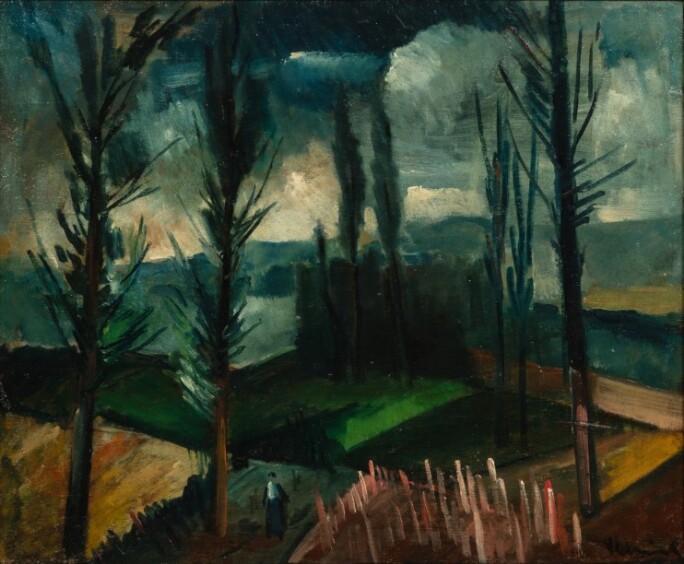
O
ne of the leading figures of the Fauvist movement, Maurice de Vlaminck, is best known for his bold use of color, expressive brushwork and his ability to capture the essence of landscapes and urban scenes. Vlaminck had a particular fascination with nature, and his landscapes often depicted the countryside along the Seine, the forests of Fontainebleau or the village of Chatou, where he lived for many years, conveying a sense of dynamism and emotional intensity through his use of bold, non-naturalistic colors.
In his later career, the artist departed from the vibrant and simplified abstractions of the Fauvist style, opting instead for a more restrained and realistic approach characterized by a limited color palette. Although Paysage was created while Vlaminck was still in the thralls of Fauvism, it presents a moody ambience and darker palette, which diverged from the artist’s typical work during the period. Paysage showcases an intimate rural landscape with trees surrounding small village homes emerging from the pasture. The softly sweeping brushworks rhythmically placed throughout the canvas work in harmony with the stormy palette to create an almost otherworldly scene. Uniquely Vlaminck in its nonconformist quality, Paysage is one of the first examples of the style that the artist would later embrace nearing the end of his life.