
Painted in 1933, only one year after Pablo Picasso introduced his ‘golden muse’ Marie-Thérèse Walter to the world, Femme endormie presents the abstracted form of his lover lying recumbent in the reclining pose that became synonymous with Picasso's depictions of her. The painting is an uninhibited portrayal of Walter, infused with sensuality through the sweeping arabesques and vibrant palette.

Picasso first.mes t Walter in 1927 as he was walking through the streets of Paris. In later years Walter has recalled the moment of their first encounter, observing that: 'I knew nothing—either of life or of Picasso [...]. I had gone to do some shopping at the Galeries Lafayette, and Picasso saw me leaving the Metro. He simply took me by the arm and said, "I am Picasso! You and I are going to do great things together"' (quoted in Picasso and the Weeping Women (exhibition catalogue), Los Angeles County Museum of Art, Los Angeles & The Metropolitan Museum of Art, New York, 1994, p. 143). Walter was in every way the antithesis to the artist’s first wife Olga Kohklova, the Russian ballerina he was married to at the t.mes of their first encounter. Walter’s youth, athleticism and Grecian profile instantly attracted the artist and inspired a creative fervour that would result in some of the Picasso's most iconic images.
‘I found her fascinating to look at. I could see that she was certainly the woman who had inspired Pablo plastically more than any other. She had a very arresting face with a Grecian profile […]. Her form was very sculptural, with a fullness of volume and a purity of line that gave her body and her face an extraordinary perfection’.
As Picasso’s marriage deteriorated he sought solace with Marie-Thérèse and their relationship blossomed in tandem with his work; only two years after the present work was executed the couple would have a child together, Maya. Femme endormie is evocative of this burgeoning new relationship and reflects the stylistic experimentation and confidence of this period in Picasso's career. Painted with a spontaneity of line and freedom of colour, Femme endormie is reflective of the artist’s joy in love, with the small scale of the work intensifying the intimacy of the scene.

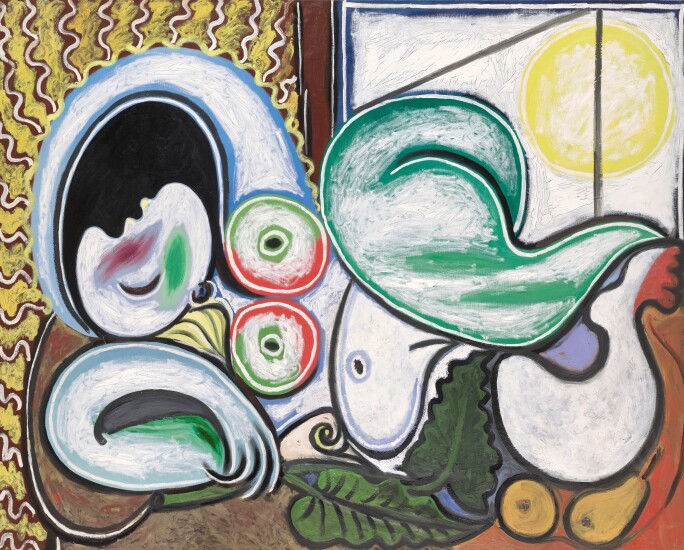
Picasso purchased the eighteenth century Château de Boisgeloup in 1930 and the location proved instrumental to Picasso’s output in the years that followed. Boisgeloup enabled Picasso to experiment with a variety of media and it was here that he installed a printing press and worked on a series of monumental sculptured heads, also inspired by Marie-Thérèse. In the first few months of 1932, Picasso alternated between his Parisian studio on Rue la Boétie and Boisgeloup. As John Richardson writes: ‘Picasso spent most of this spring at Boisgeloup. While the wife stayed in Paris during the week looking after Paulo, the mistress would move into the château. Weekends, she would go home to Maisons-Alfort, and Olga would take over again […]. Picasso’s impersonation of a country gentleman was mitigated by self-mockery. He enjoyed playing the role, impeccably disguised in tweed suits […]. In public, Picasso would match his behavior to his cost.mes . Snapshots taken over these weekends make it clear that when a nanny or governess was around, or friends came to visit, family life at Boisgeloup could not have been more conventional. Paintings tell a very different story’ (J. Richardson, A Life of Picasso, London, 2007, vol. III, pp. 471-472).

By 1933, however, Picasso was spending an increasing amount of t.mes at Boisgeloup and having announced his new mistress to the world in the paintings shown at his retrospective in the summer of 1932, he could now fully immerse himself in their life together there. Often he painted her engaged in quiet domestic acts, such as reading or seated before a window, but more often than not his depictions were of her as a reclining nude, looking back to the odalisques of the past and reinvigorating them with his unique painterly vision. In the calligraphic black lines and almost abstract formal qualities of the present work, Picasso alludes to the Japanese woodblock prints that had created a stir in early twentieth century Paris. Indeed Walter appears repeatedly in works of the period with a mollusk-like resemblance (figs. 3-5) that directly connects to portrayals of women in erotic Japanese prints and is hinted at in the present work.
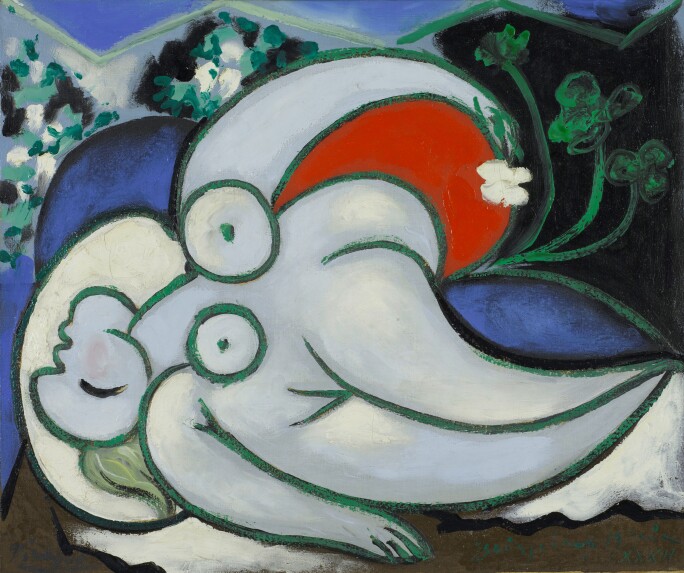
Femme endormie is test.mes nt to the creative rebirth that the artist underwent at Boisgeloup in the presence of his new mistress. Rays of light appear to emanate from her figure and the entire composition brims with energy and colour. With its combination of erotic and oneiric imagery, Femme endormie occupies an important space in the artist’s work in the early 1930s.
Playfully dedicated 'Pour Bibi Souvenir Souvenirs’, Femme endormie was presented to Margaret Dudensing, more commonly known as Bibi. Bibi, alongside her husband Valentine Dudensing, co-owned the Valentine Gallery in New York and they were both instrumental in bringing Picasso’s work to America in the 1930s as well as sponsoring some of the first exhibitions of the twentieth century Parisian avant-garde art in partnership with Pierre Matisse. Picasso exhibited his masterpiece Guernica for the first t.mes
in America at their gallery in 1939. Pierre Matisse introduced the Dudensings to numerous members of the French artistic milieu and Bibi drew the attention of many of them, modeling for Man Ray, Jules Pascin and Carl Van Vechten. Picasso dedicated the present work to Bibi in the summer of 1933 and the work remained in her collects
ion for the rest of her life.