Executed in 2018, Rashid Johnson’s Untitled (Color Men) stands as an outstanding example of the artist’s expert synthesis of materiality and autobiographical narrative, presented within a broader socio-cultural framework. In terms of materiality, Johnson’s iconic use of black soap and wax, both mediums of profound symbolic resonance, extends beyond pure aesthetics, invoking a larger dialogue with cultural history and identity. Black soap, sourced from West Africa and celebrated for its restorative and moisturizing properties, carries with it a multi-faceted connotation of healing and resilience deeply rooted in African diasporic traditions and culture. Yet, in Johnson’s hands, this traditionally nurturing substance transforms into a medium of turbulent, visceral expression - his energetic drips and splatters taking after the Abstract Expressionist gestural tradition. “The materials I’ve used over the last five to 10 years were things that were close to me, that reminded me of certain aspects of my experience growing up – for example, the relationship I had to Afrocentrism through my parents in the late ‘70s and early ‘80s. My mother would always have shea butter around, and she wore dashikis. I was celebrating Kwanzaa, hearing the unfamiliar language, Swahili, and seeing black soap and chew sticks around the house, things that were about applying an Africanness to one’s self” (Rashid Johnson quoted in Christopher Stackhouse, Rashid Johnson, Art in America, 2012. Online).

In Untitled (Color Men), Johnson masterfully channels the medium’s symbolic weight into his semi-autobiographical exploration, where personal narrative intertwines with the collects ive memory of the African American experience. The use of black soap is particularly evocative of Johnson’s upbringing in Chicago where he engaged with Afrocentric philosophies, thus delivering a confluence where individual and collects ive histories converge. The central figure in Untitled (Color Men) is deliberately abstracted, its anonymity embodying both the artist’s personal introspections and the collects ive anxieties of a broader socio-political unease.
The abstracted visage - striking in its brilliant yellow hue and framed by stark black tile and a pseudo-border marked by chaotic, swirling black splatters - radiates with a psychological intensity. The nameless, faceless figure universalizes the scene, transforming it into an emblem of shared anxiety and vulnerability. Johnson subverts yellow’s typical warmth, turning it instead into a symbol of inner turmoil surrounded by black which heightens the unease and suggests an encroaching darkness that contrasts with the sterile, clinical associations of the tile. This anonymous figure thus encapsulates an intersection of Johnson’s recurring themes: the Black experience in America, the fluidity between abstraction and figuration, and the interrogation of personal identity through art.
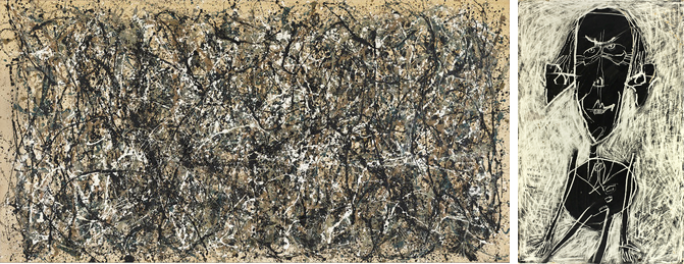
Right: Jean Dubuffet, Portrait of Henri Michaux, 1947. The Art Institute of Chicago, Chicago. © 2018 Artists Rights Society (ARS), New York / ADAGP, Paris.
Untitled (Color Men) seamlessly extends from Johnson’s renowned Anxious Men series, described by Johnson as a cathartic exercise rooted in personal transformation while absorbings the socio-political upheavals of contemporary America in an African American context. Over t.mes , these scrawled, expressive, and abstracted faces have evolved into a powerful motif within Johnson’s oeuvre, distilling a profound emotional impact. As such, Untitled (Color Men), stands as a pivotal moment within Johnson’s body of work, its visceral intensity highlighting his unyielding commitment to exploring the complex intersections of art, identity, and collects ive history. “My mother is an African history professor so she would have these kinds of materials around the house. When I got older I started to see how things like shea butter and black soap were African products that really speak to an African-American audience … I thought about what these materials must.mes an to the people that are using them and came to the conclusion that they were a way to culturise oneself in Africanness as you’re exploring or looking for an identity, especially in a country that has had such a complicated history with the people … There’s an absurdity to it, but it’s also really poetic” (Rashid Johnson quoted in Paul Laster, An interview with Rashid Johnson: “I was more African before going to Africa”, 2016. Conceptual Replica Handbags s (Online)).

