“It might be a dog, a woman, or whatever. I don’t really care. Of course, while I am painting, I see a woman or a bird in my mind, indeed, very tangibly a woman or a bird. Afterward, it’s up to you”
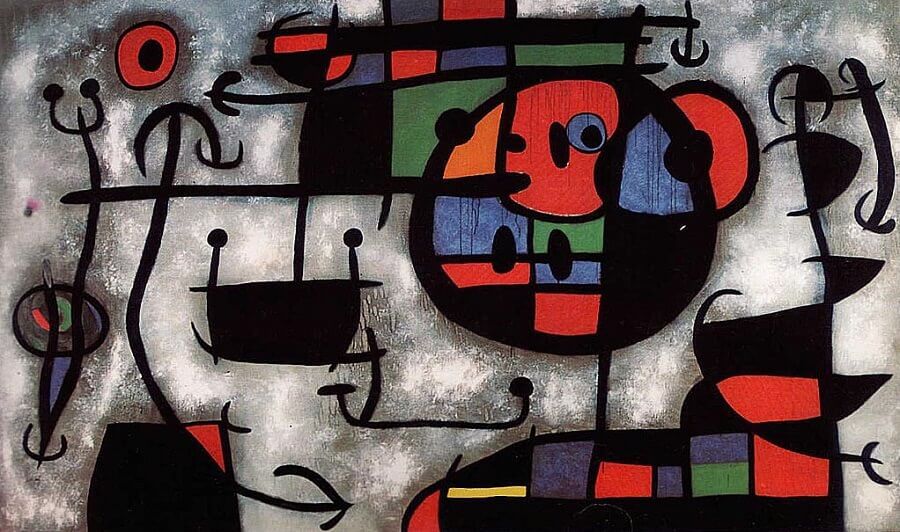
Marrying a bold application of pure color with his signature black line, reminiscent of Japanese calligraphy, Portrait d’une jeune fille is a vivacious composition from Miró’s mature years. Demonstrative of this Eastern influence (Miró had his first retrospective in Japan just two years prior) the present work also responds to the growing influence of Abstract Expressionism, while recalling many of the artist’s most salient motifs from the early 1940s. Portrait d’une jeune fille reveals an artist who remains unfalteringly experimental in his desire to push painterly boundaries, and yet irrevocably loyal to his unique visual lexicon.

Although never an official member of the Surrealist group, Miró imbued his brushstrokes with a spontaneity similar to the automatism favored by André Breton. These lines formed a defining feature of Miró’s work and in the present composition they can also be linked with the rise of Abstract Expressionism. Miró first became acquainted with the Abstract Expressionists while visiting Alexander Calder, Yves Tanguy and Marcel Duchamp in New York in 1947. Several of the painters from this movement credited Miró as their stylistic inspiration. Miró, in turn, was profoundly moved by their technique and aesthetic beliefs: "… it showed me the liberties we can take, and how far we can go, beyond the limits. In a sense, it freed me" (Miró quoted in J. Dupin, Miró, New York, 1993, p. 303).

Consequently, his work from the 1950s onwards responded to the enthusiasm and innovations in painterly expression generated by the Abstract Expressionist movement. The spontaneous application of paint in the present work presents a dynamic and textured backdrop upon which Miró’s forms sit. For Miró, however, form could never be entirely abstract and in this sense he remained true to his style. Compositions such as Portrait d’une jeune fille, remain rooted in the representational: “For me a form is never something abstract; it is always a sign of something. It is always a man, a bird, or something else. For me painting is never form for form's sake” (Miró quoted in M. Rowell, Joan Miró, Selected Writings and Interviews, Boston, 1992, p. 207). Artists such as Jasper Johns took an almost opposite position. For Johns his imagery derived from “things the mind already knows,” such as the American flag or the shape of a target (see fig. 1). Both approaches may lead to similar results, as the target-shape at lower center of Portrait d’une jeune fille suggests.
Miró’s 1960s Paintings in Museums: A Selection




All images © 2021 Successió Miró / Artists Rights Society (ARS), New York
Balancing the kaleidoscopic application of paint with an elegant calligraphic line, Portrait d’une jeune fille demonstrates an exploration of the medium’s versatility and Miró’s deep understanding of his craft. The result is a beautifully oneiric image, synthesizing Abstract Expressionism with his distinctly poetic iconography. The symbolic use of color and form, tethered to the representational encapsulates the freedom marveled at by Alberto Giacometti when he viewed Miró’s work: “For me, it was the greatest liberation. Anything lighter, more airy, more detached, I had never seen. In a way, it was absolutely perfect. Miró could not put down a dot without it being in just the right place. He was so much a painter, through and through, that he could leave three spots of color on the canvas and it became a painting” (quoted in Exh. Cat., Paris, Centre Georges Pompidou, Joan Miró, 1917-1934: La Naissance du monde, 2004, p. 212).
Never before appearing at auction, the present work has been held in the same private collects ion since 1969.


