
"When the light hits the ocean there is kind of a grey light on the water. […] Indescribable tones, almost. I started working with them and insisted that they would give me the kind of light I wanted. […] I got into painting in the atmosphere I wanted to be in. It was like the reflection of light. I reflected upon the reflections on the water, like the fishermen do."
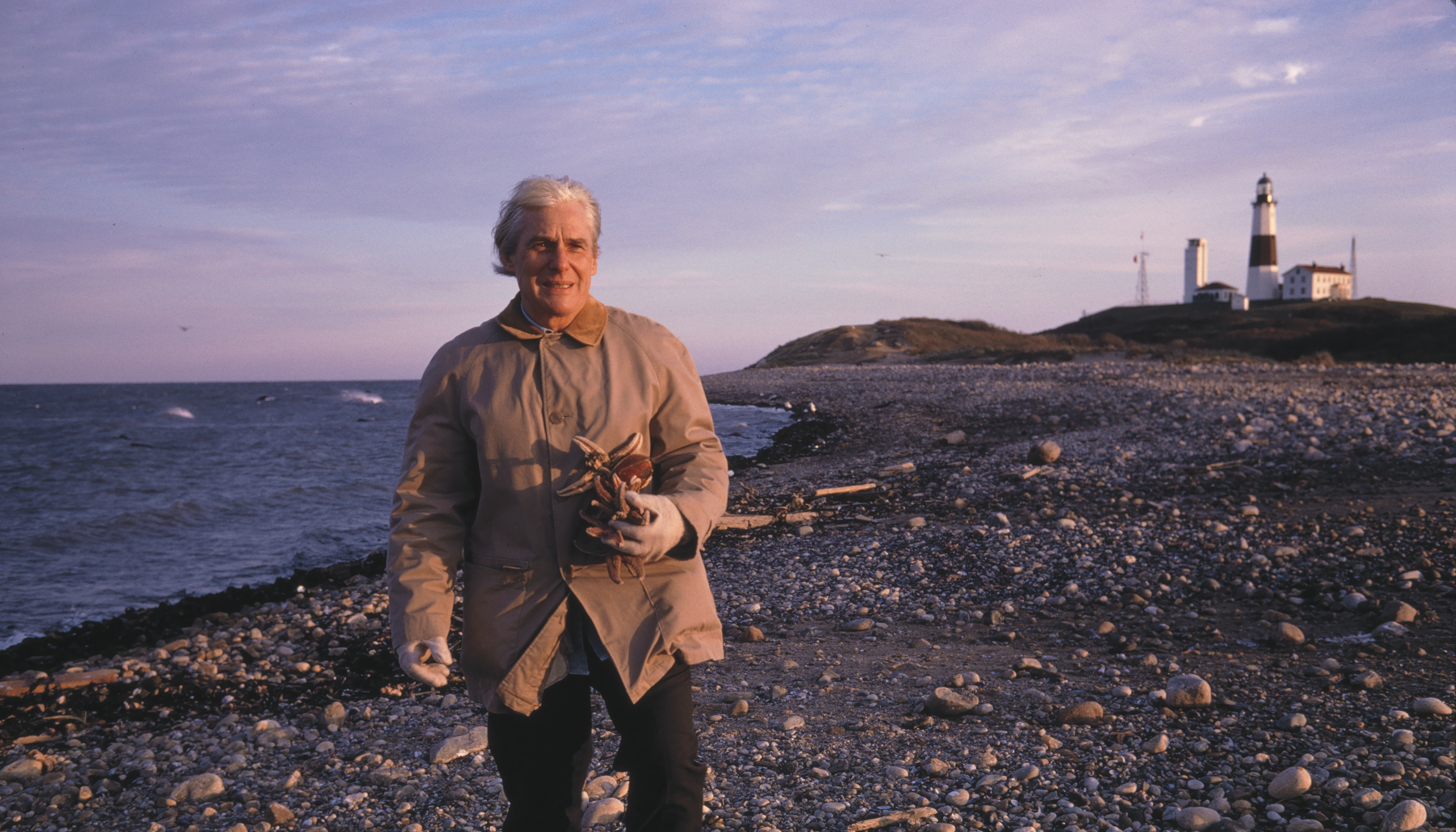
Enveloping the viewer in churning layers of vivid hues, Montauk II beams with the sun-drenched brilliance of Willem de Kooning's beloved East Hampton. In 1962, de Kooning began building his home and studio there, permanently moving to the area in 1963, not far from Montauk. Montauk II epitomizes the spirit of the artist's coastal refuge, where the transition from the densely populous city streets to the tranquility of nature and its nostalgic similarities with the Netherlandish landscape of his youth inspired a refreshed course of experimentation in the artist's practices. Following his move, de Kooning's palette shifted to reflect the nature of his surroundings. This transition is exemplified in the palette of Montauk II, in which de Kooning captures the subtle hues of an end-of-day summer light reflecting across the local beaches; the canvas resounds with the artist's virtuosic capacity for rendering sensory delight and atmospheric potency in oil paint. Of the five known paintings titled Montauk I-IV that de Kooning executed in 1969, two are held in important international collects ions. Montauk I is in the collects ion of the Wadsworth Atheneum in Hartford, Connecticut, and Montauk IV is held in the collects ion of the Stedelijk Museum in Amsterdam. Montauk II is distinguished by its exceptional coloration, composition and painterly dynamism, resulting in a remarkable exhibition and publication history.
Willem de Kooning's 1969 Montauk Paintings


Arriving at a pivotal moment of deep contemplation in the artist's career, Montauk II richly captures the atmospheric lushness and tranquility of its eponymous coastal environs. As the title emphasizes, Montauk II exemplifies de Kooning's focus upon and interest in this specific place of sea and land; here, the artist is already addressing what will become his preoccupations in the 1970s, where the landscape becomes the main inspiration for his abstraction, in combination with the figuration that he explored so viscerally during the mid-1960s. Within the present work, one feels the history of the decade and a window into de Kooning's main achievements in his important 1970s renaissance. The summer of 1952 marks the t.mes when de Kooning began to ensconce himself in the rural serenity of Eastern Long Island. By the early 1960s, the east end revealed itself as a new aesthetic inspiration for de Kooning. De Kooning self-designed his studio to be surrounded by nature and saturated with a balanced light, a vast difference from the dissonant setting of Manhattan urban life.


Immersed in the serene environment of Long Island, de Kooning was captivated by the reflections of light on the ocean and across the coast. A revelation of inspiration within his oeuvre, de Kooning's works of this period are saturated with a verdant radiance. Describings the effect of this luminosity, de Kooning recalled to critic Harold Rosenberg: "When the light hits the ocean there is kind of a grey light on the water. […] Indescribable tones, almost. I started working with them and insisted that they would give me the kind of light I wanted. […] I got into painting in the atmosphere I wanted to be in. It was like the reflection of light. I reflected upon the reflections on the water, like the fishermen do." (Willem de Kooning quoted in: Harold Rosenberg, "Interview with Willem de Kooning," Art News 71 (September 1972): 54-59.)


With a striking chromatic dynamism and exceptional handling of paint, Montauk II emanates the interior luminescence and vitality of the sea, sand, sun and surf. The textured and dynamic surface of the canvas evidences de Kooning's new sense of kinetic freedom activated by the liquid properties of oil paint thinned with newly formulated media. Each gesture and vibrant hue exemplifies de Kooning's unrivaled mastery of abstraction. Glistening ribbons of ardent red strikingly contrast with the greenery of swaying sea grass to invoke the raucous, unt.mes d beauty of Edenic flora. Undulations of sea green swell into luscious swathes of teal, a rush of waves cresting and crashing with unrestrained force against the shore. Jubilant yellow passages that proclaim the radiant heat of the summer are counterbalanced by cooling, delicate swirls of sky blue and cloudy white. Such polychromatic intensity and fluid grace attest to de Kooning's prowess as a colorist, demonstrating his profound admiration for the Post-Impressionist master Henri Matisse and his visionary investigations of sublime light and color. Bold passages of paint appear simultaneously fluid and suspended in motion across the landscape, a continuation of de Kooning's career-long dialogue between improvisation and control.
"Yet space in de Kooning's art is that of tactile movement, not optical perspective. Turn Montauk II on its right side, and a standing figure appears at the new right edge, previously the top."


Amidst this riot of impassioned hues, de Kooning's iconic figural forms dissolve and rematerialize. Swathes of fleshy tones, and suggestions of limbs, are contained by deep rose contours. These bodies slip across the picture plane and between foreground and background, diffusing the painting with a sense of transcendent weightlessness. Describings the figuration of Montauk II, art historian Richard Shiff expounds, "The final vertical orientation…seems arbitrary—a chance orientation. A figure appears to lean precipitously toward the right, diagonally, without a depicted means of support. The body may be reclining, which would explain the hint of diagonal recession. Yet space in de Kooning's art is that of tactile movement, not optical perspective. Turn Montauk II on its right side, and a standing figure appears at the new right edge, previously the top." (Exh. Cat., New York, Pace Gallery, Willem de Kooning, The Figure: Movement and Gesture, 2011, n.p.) In contrast to de Kooning's single female figures in his Woman paintings of the 1950s, the present figures ethereally languish and luxuriate within the effervescent landscape. The sensuous tactility and sprawled postures of these renderings reflect de Kooning's experience with clay figures to be cast in bronze that began the same year as the execution of Montauk II. These figures teem with vitality, encapsulating the singular way in which de Kooning breathes life into flattened and abstracted forms.


An explicit celebration of place, Montauk II invokes the unmistakable aura of harmony and vitality inherent to the natural world. The present work pulls oneself into a bucolic interlude of personal joy and memory, rapturously immersing the viewer in the light, sound, and scents of East Hampton all while remaining resolutely abstract. In emotional poignancy and atmospheric immediacy, the present landscape rivals those of de Kooning's Impressionist forerunners. For its dazzling palette, virtuosic handling of paint, and heroic command of compositional form, the present work reveals the essential ambition of de Kooning's aesthetic practice: the artist did not strive for resolution in his works, but instead sought to capture the variable quality of life. In so doing, Montauk II unwaveringly reinforces one of the most compelling attributes of de Kooning's prodigious and lauded oeuvre: his enduring, unrelenting insistence upon exploration, freedom, and growth.
Metamorphosis: The Willem de Kooning Decades collects ion


