


"In his studio Basquiat was now at work on a large triptych that would be a memorial to Warhol. It was built out of a wooden door in the center hinged to two other wooden panels on either side… On the door in the center is scrawled the word 'perishable,' repeated in fainter letters below and mostly hidden by more black paint strokes, illustrating how perishable was not just Warhol's life but everyone's. Basquiat titled the piece Gravestone."
Shocked and devastated by the tragic, unexpected death of Andy Warhol in February 1987, Jean-Michel Basquiat immediately turned back to his practice, creating among the most urgent, impassioned, and defining works of his mature oeuvre: Gravestone. Emblazoned twice with the word PERISHABLE, Gravestone represents a watershed moment of reflection and reckoning in Basquiat's personal life and artistic development. Shattered by the loss of his friend and former collaborator, Basquiat paid homage to Warhol through a profound reconstitution of the artistic idiom that defined his early found support works of the early 1980s before his meteoric critical ascension. Here, Basquiat fashions three wooden panels together, realizing a pseudo-altarpiece in metallic hues which operates as both a tribute to Warhol and an existential commentary on the transience of life. An extraordinary and poetic monument and radically self-conscious expression of his own mortality, Gravestone from 1987 is utterly singular in Basquiat's revolutionary oeuvre.

Employing three hinged found-wood panels as his support, two a stunning metallic and one a mahogany that calls attention to the medium itself, Basquiat evokes a canonical art historical model—the triptych altarpiece—and reconstructs the historical and religious gravitas with which it is associated. Basquiat's work harkens back to iconic Renaissance examples of this tripartite format, conjuring the metaphysical juxtaposition of heaven and hell in Hieronymus Bosch's The Garden of Earthly Delights, the solemnity of the Mérode Altarpiece, and the sobriety and magnificence of the polyptych Ghent Altarpiece as well as contemporary reconstitutions of the format in the works of Francis Bacon and others. Although overt religious references seldom appear in Basquiat's oeuvre, here, we see the artist foreground the cross in commemoration of Warhol's personal history, a devout Catholic, and the role of religious iconography in Warhol's own practice, particularly his final decade.


Evoking the great triptychs of the art historical canon, Basquiat's composition suggests a dichotomy between redemption and reckoning with the inevitability of mortality. Basquiat adorns the leftmost panel with a beaming yellow cross, evoking Warhol's iconic large-scale crosses of the 1980s and a black tulip. The skull and heart on the rightmost panel operate as memento mori—the perennial reminder of the impermanence of mortal existence and the constant threat of death which Basquiat inserts throughout his oeuvre. Richard D. Marshall writes of the motif: "Basquiat used painterly gesture on canvas, most often depicting skeletal figures and masklike faces that signal his obsession with mortality, and imagery derived from his street existence…" (Richard Marshall, "Repelling Ghosts," in: Exh., Cat., New York, Whitney Museum of American Art (and traveling), Jean-Michel Basquiat, 1992, p. 15) The central panel of Gravestone is emblazoned twice with the word PERISHABLE. Utilizing erasure as a form of reinforcement, Basquiat scrawls over the second PERISHABLE as well as over the skull and heart, emphasizing the most salient features of his composition. Merging iconography from his own practice with that of Warhol's, Basquiat eternalizes their collaboration and foregrounds the obsession with tragedy and fascination with mortality that permeates each of their respective work.


Dennis Hopper, Andy Warhol (with Flower), 1963
Gravestone was created in direct response to Warhol’s unt.mes ly death on February 22nd, 1987, following complications caused by gallbladder surgery. The two artists were friends throughout much of Basquiat’s career, as underscored by their numerous collaborations; Basquiat was devastated by Warhol’s death in losing a dear friend and an artistic inspiration. Gravestone is at once a memorial to Andy Warhol and a t.mes less monument contemplating loss, sorrow, and the fugacity of life.

Rogier van der Weyden, Seven Sacraments Altarpiece, 1445–50
The present work, in its tripartite construction using two doors and a headboard, takes the form of an altarpiece. Altarpieces take its form from the Christian tradition of placing an adorned panel above the altar at churches, often depicting religious figures or other biblical references.

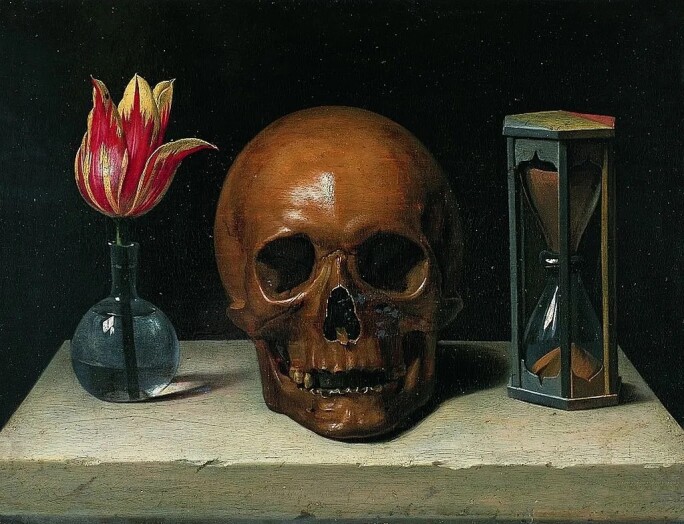
Philippe de Champaigne, Vanitas (Allegory of Human Life), 1646
The skull, masked by vigorous and gestural brushstrokes of yellow and orange along with a red heart in the right panel, is a central motif that repeatedly surfaces in Basquiat’s oeuvre. At t.mes s interpreted in connection with Haitian voodoo and at others with the Western art historical tradition of memento mori, the motif highlights Basquiat’s preoccupation with contemplating death and the fragility of life, further poignant in Gravestone considering the death of his dear friend and his own unt.mes ly death to come in less than a year.

Andy Warhol, Cross, 1982
Prominently featured on the leftside of Gravestone is a bright yellow cross—immediately reminiscent of Andy Warhol’s Cross of 1982—as a subtle nod to not only the traditions of Western ecclesiastical funerary traditions but also Warhol’s complex relationship with Catholicism throughout his whole life.

Jean-Michel Basquiat, Madonna, 1985
The usage of a headboard in the present work invokes an earlier work titled Madonna, in which the artist used a child’s bed to make a work dedicated to Pree—the daughter of jazz saxophonist Charlie Parker who died at the age of two. Gravestone underscores the significance of non-traditional media in his practice, which he used from very early on in his career in the early 1980s.




When Basquiat and Warhol were first introduced to one another in 1982, Basquiat was a young street artist working as SAMO, who had only just emerged into the mainstream, and Warhol had already reigned the New York art scene for two decades. Bruno Bischofberger orchestrated the fateful introduction, which would change the course of each of their careers independently and permanently intertwine their legacies. Warhol recalled in a diary entry in October 1982: "Down to meet Bruno Bischofberger (cab $7.50). He brought Jean-Michel Basquiat with him. He's the kid who used the name 'Samo' when he used to sit on the sidewalk in Greenwich Village and paint T-shirts…he was just one of those kids who drove me crazy…" (Andy Warhol quoted in: Pat Hackett, ed., The Andy Warhol Diaries, New York 1989, p. 462) During this infamous encounter, as Bischofberger recalls, "...Basquiat asked Warhol if he could hand the camera over to me to take a double portrait of the two artists, so he gave me his camera and I made a few shots of the two together, in his name… Basquiat did not want to stay and said goodbye… one, at most one and half hours later, when Basquiat's assistant appeared with a 150 x 150-cent.mes ter work on canvas, still completely wet, a double portrait depicting Warhol and Basquiat… The painting was titled Dos Cabezas." (Bruno Bischofberger, "Collaborations—Reflections on the Experiences with Basquiat, Clemente, and Warhol" in: Exh. Cat., Paris, Donation Louis Vuitton, Basquiat X Warhol: Painting 4 Hands, 2023, p. 69) This watershed day not only inaugurated a revolutionary artistic dialogue, and eventual partnership, but also a personal relationship which would propel each of their careers.

Channeling the explosive energy and electric charge of downtown New York through a radical visual vernacular, Basquiat offered a fresh and contrarian perspective that exhilarated Warhol; and Warhol offered Basquiat access to a vast network that cemented his critical ascendancy. As fellow artist Ronnie Cutrone recalled, "Their relationship was symbiotic... Jean-Michel gave Andy a rebellious image again." (Ronnie Cutrone quoted in: Victor Bockris, Warhol: The Biography, Cambridge 2003, pp. 461-62) Between 1984-85, their relationship was immortalized in a series of paintings first exhibited at Tony Shafrazi Gallery in which the artists fused their practices, adding illustrations in sequence to produce joint paintings which would become known as the Collaborations. While distinctly executed in Basquiat's visual vernacular, Gravestone also functions as an extension of this groundbreaking series. Basquiat borrows one of Warhol's motifs, the cross, and positions it in dialogue with his own: the skull. (Dieter Buchhart, "Basquiat x Warhol: A Dialogue in Contradictions in: Exh. Cat., Paris, Donation Louis Vuitton, Basquiat X Warhol: Painting 4 Hands, 2023, 27)
"The death of Warhol made the death of Basquiat inevitable, somehow Warhol was the one person that always seemed to be able to bring Jean-Michel back from the edge. Always when Jean-Michel was in the most trouble it seemed that Andy Warhol was the person who he would approach…. After Andy was gone there was no one that Jean-Michel was in such awe of that he would respond to."
Gravestone harkens back to Basquiat's earlier works in which the artist often utilized found objects as his supports, building upon the exploration of media and representation central to Jasper Johns' Neo-Dada works and Robert Rauschenberg's Combines. Like Johns and Rauschenberg, Basquiat dissolved the arbitrary boundaries between painting and sculpture, recontextualizing found materials within his compositions. But unlike his predecessors who operate with subversive intentions to recontextualize the mundane, Basquiat's use of found supports derives from an essential and irrepressible need for expression. Gravestone, like the artist's seminal early works, Pork (1981), Untitled (Refrigerator) (1981) or Portrait of the Artist as a Young Derelict (1982), epitomize Basquiat's idiosyncratic methodology and the urgency of his production, transgressing the arbitrary boundaries of materiality in Contemporary art. Perhaps awakened to his own mortality at the death of Warhol, Basquiat turned back to his foundational years and the form of production that characterized his practice before he encountered Warhol. Further testifying to the significance of Gravestone, the work was acquired by celebrated collects or, dealer, scholar, and editor of the artist's catalogue raisonné, Enrico Navarra, in 2002. First exhibited at Galerie Yvon Lambert in Paris the year after its execution in 1988, Gravestone is a triumph of Basquiat's singular artistic practice and a seminal monument to one of the greatest symbiotic relationships of Contemporary art.

