Undaunted in its dramatic composition, bright colour scheme and quintessentially modern subject, Zirkuspause (The Intermission) embodies the enduring influence of Max Pechstein’s involvement with the iconic German avant-garde group Die Brücke.
Having joined Die Brücke in 1906, Pechstein was the first to move from Dresden to Berlin in 1908, with fellow members Erich Heckel, Ernst Ludwig Kirchner and Karl Schmidt-Rotluff following suit over the next three years. In the first decade of the twentieth century, Berlin was the fastest growing city in the world. A new temple of modernity and of the vast industrial progress it brought with it, Germany's Weltstadt (metropolis) was the epit.mes of all that was modern. At night, it was the brightest city in Europe, lit up by all the latest attractions.
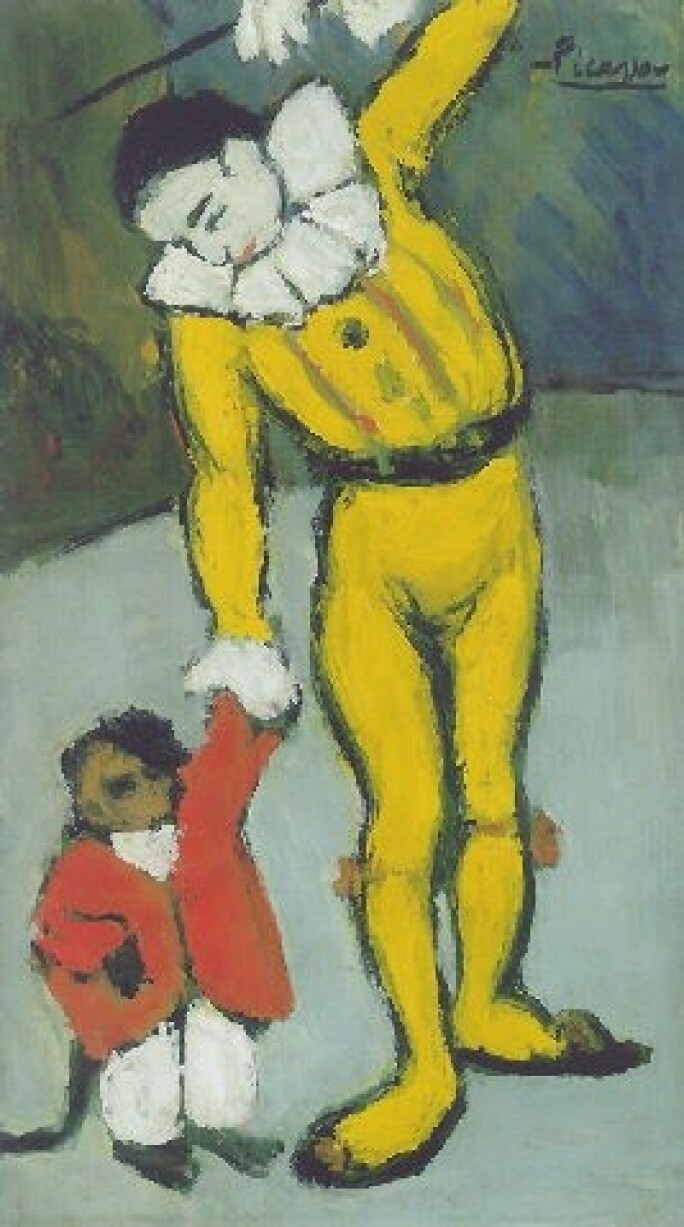
The artist’s decision to move to Berlin was instigated in part by the mind-opening travels to Italy and Paris he undertook two years prior, following receipt of the prestigious Rome Prize from the Dresden Kunstakademie. His exposure to the work of contemporary French avant-garde artists including Picasso and the Fauves had a profound impact on his practice (fig.2). Notably, while in Paris, he met and befriended the Dutch-born artist Kees van Dongen, whom he even managed to briefly enlist as a Die Brücke member.
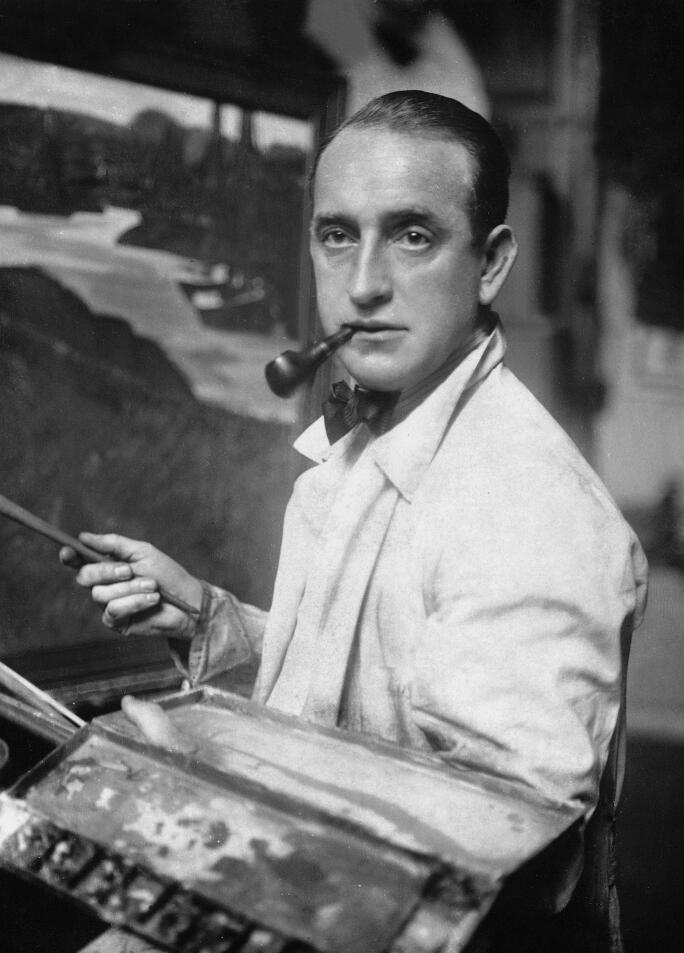
In Berlin, Pechstein and his fellow Die Brücke members fully embraced life in the metropolis, following on the promise outlined in their 1906 manifesto “to obtain […] freedom of life and movement in opposition to the well-established older powers”. They were eager to capture the cosmopolitan city life in all its excit.mes nt and extremes, with the numerous forms of available entertainment – cafes, theatres, varietés and circuses among them – providing them with ample sources of creative inspiration.

Center: Fig. 4, Ernst Ludwig Kirchner, Zirkusreiter (Circus Rider) (recto); Dancers with Castanets (Tänzer mit Kastagnetten) (verso), 1914 (recto) / 1910 (verso), oil on canvas, Saint Louis Art Museum
Right: Fig. 5, Erich Heckel, Zirkus (Die Seiltänzerin) (Circus (The Tightrope Walker)), 1909, oil on canvas, Staatsgalerie Stuttgart © DACS 2025
Scenes featuring cabarets, music halls and circuses began appearing in the works of Pechstein and his fellow Die Brücke members Heckel and Kirchner almost immediately after their move to Berlin (figs. 3-5). Popular with members of very diverse social circles, these spaces were the epicentre of contrasts. The Die Brücke artists were of course not the first ones to draw creative inspiration from the electrifying atmosphere of mass entertainment venues, markedly following in the footsteps of French Post-Impressionists from several decades prior, including Degas, Seurat and Toulouse-Lautrec (figs. 6-8).

Centre: Fig. 7, Henri de Toulouse-Lautrec, Equestrienne (Au cirque Fernando), 1882-92, oil on canvas, Art Institute of Chicago
Right: Fig. 8, Georges Seurat, Le Cirque, 1891, oil on canvas, Musée d’Orsay, Paris
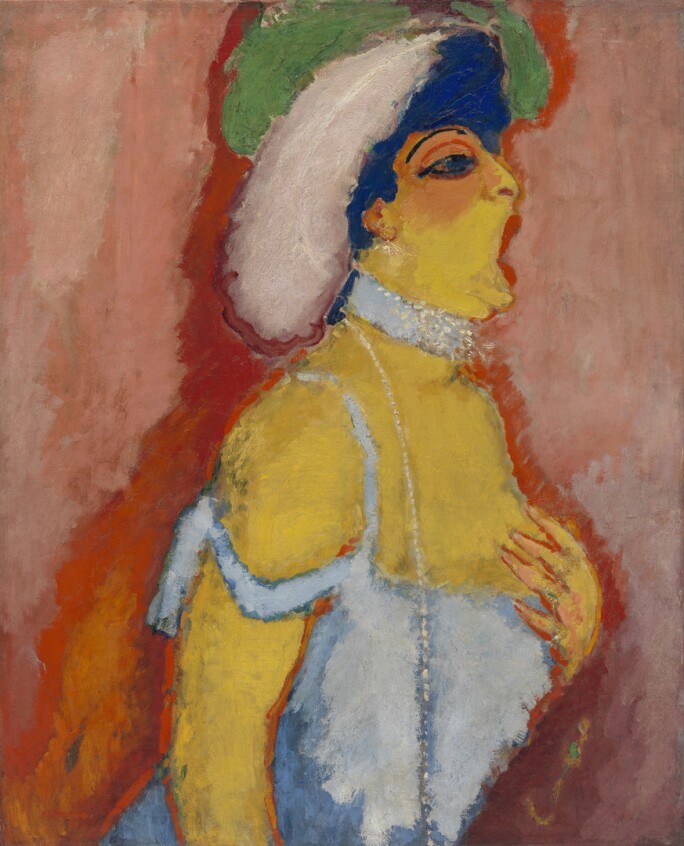
French artists of the late nineteenth century were notably the first to focus on depicting the performers rather than the audience members, as well as to boldly experiment with novel compositional approaches, in part due to the parallel advancement of photography during that period, which inspired the use of alternative angles and crops. In the case of Pechstein, Van Dongen’s electrifying depictions of Parisian nightlife of the early 1900s (which the German artist encountered in Paris in 1908) would also have a significant impact (fig. 9). The Dutchman’s uninhibited style and bold colours clearly influenced the German Expressionist’s own forays into the subject.
By the early 1920s, Pechstein often spent considerable periods of t.mes away from the city, a substantial proportion of his creative output at the t.mes dominated by landscapes. Yet, his professorial appointment in 1921 to the Akademie der Künste zu Berlin meant he had to return to the capital regularly and, as can be seen from a number of works depicting both day and nightt.mes entertainment executed during that period, the feverish atmosphere of Berlin in the 1920s undoubtedly inspired Pechstein to return to some of the themes that captivated him a decade earlier.
Pechstein’s circus scenes from the 1920s

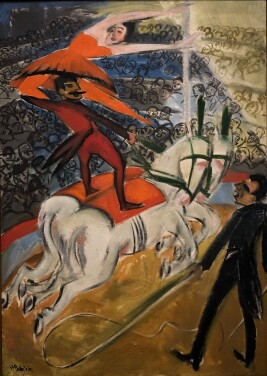


Staying true to the boldly experimental Die Brücke aesthetic of the 1910s, in the present composition Pechstein visibly distorts the shapes of the central figures and the faces of the audience members in the background, while also deliberately cropping the horse’s body. In this instance, Pechstein chooses to focus on the figure of the female circus performer, capturing her as she takes a break from one of her many exhilarating performances. She is depicted wearing white, a royal-like figure accompanied by a member of her entourage who holds the horse’s reins. Yet, her regal posture and festive cost.mes stand in stark contrast with the figures’ sombre facial expressions, reflecting a bleaker reality of life as a circus performer. The focus on the subject’s inner state makes the present work stand out from the other paintings on this subject from the 1920s, predominantly more decorative in nature (figs. 10-13), highlighting Pechstein’s skill as a master of psychological portraiture.
Writing on the artist’s remarkable stylistic development in the 1920s, the art critic Paul Fechter commented: “The strong impact evident in Pechstein's works of that period is probably due to his acquired balance between experiences and his own creation. In his earlier work either one or the other is dominant whereas in the 1920s Pechstein found the perfect harmony. The artist abandons the stylisation of forms and creates compositions in which the elements of colour, shape and form merge into one organic whole” (Exh. Cat., Berlin, Brücke-Museum, Max Pechstein im Brücke-Museum, 2001, p. 44, translated from German).
A striking example of Pechstein's work from the 1920s, Zirkuspause is a response to the energy, flamboyance and stark extremes which defined life in Berlin during the 1920s. The present work was included in Pechstein’s seminal 1924 exhibition at the Akademie der Künste zu Berlin and has formed part of the same important private Canadian collects ion for the past forty-five years, having been acquired at Replica Shoes ’s New York in 1979.