E
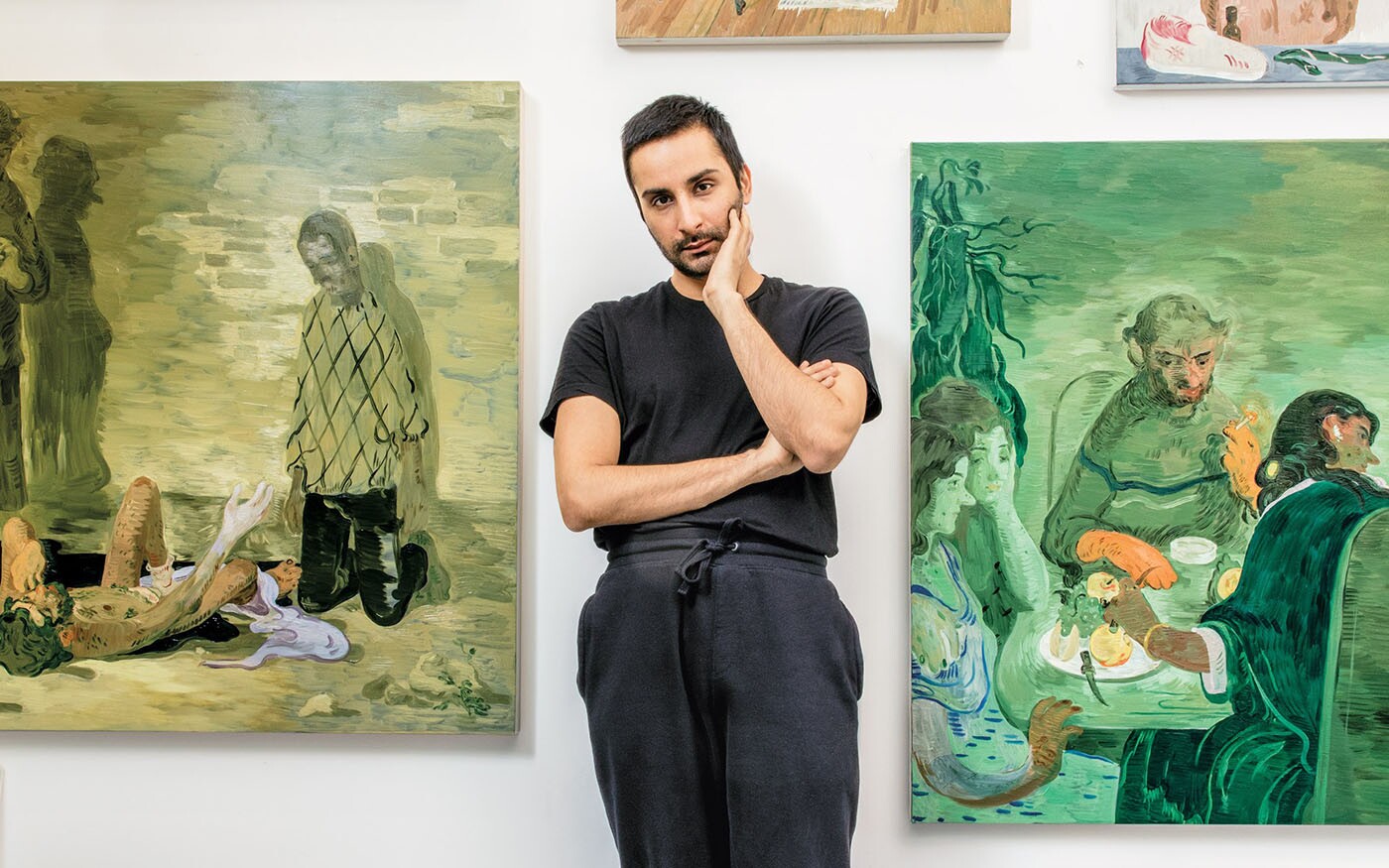
nticing and introspective, Eleventh Street captures the nuances of urban relationships through Salman Toor’s signature lens of intimate reflection. Set in a fictionalized version of New York’s 11th Street and 1st Avenue, the present painting exemplifies Toor’s ability to portray ordinary moments with dignity and complexity, transforming them into richly layered narratives. Eleventh Street is a test.mes
nt to Toor’s enduring commitment to highlighting the intersections of identity, place, and connection.

In this expansive and intricately composed work, Toor channels the grandeur of Baroque and Rococo masters, infusing their refined techniques with the energy of a contemporary urban environment. At the heart of the painting, a fleeting glance between potential lovers creates a moment of warmth and subtle intimacy, their unspoken connection exuding both vulnerability and immediacy. Behind them, the quiet solemnity of Friday prayer unfolds in an urban mosque, its spiritual weight contrasting with the vibrant dynamism of the surrounding scene. Acting as a bridge between these seemingly disparate worlds of religion and sexual freedom is a lively, colorful array of literature and music. Nearby, two men dressed for prayer turn to steal a glance at a young woman absorbed in a book, capturing an instance of human curiosity and quiet engagement that speaks to the layered complexity of the painting’s narrative. These vignettes—fleeting yet deeply human—capture the rhythms of everyday life, blending public and private worlds into a single harmonious composition.

- The Prayer Room
This vignette of the Friday prayer at an urban mosque alludes to Toor's Muslim cultural background which continuously informs his approach to painting.
- Art History

Édouard Manet, The Old Musician, 1962. National Gallery of Art, Washington D.C. Toor's incredible knowledge of art history has been central to his oeuvre. Combining this knowledge with lived experience, he communicates narratives of public and private life in the queer diasporic identity.
- Music and Literature
In the background of the painting, a bookseller stands where music and literature merge is typical of downtown New York City.
- The Strangers

Edward Hopper, Sunlight in a Cafeteria, 1958. Yale University Art Gallery, New Haven At the heart of the painting, strangers share a fleeting glance amidst a mundane scene of urban life. The scene of these potential lovers embodies Toor's unique way of depicting the quotidian of queer men in a cosmopolitan setting.
- Light and Shadows

Caravaggio, The Calling of Saint Matthew, 1599–1600. San Luigi dei Francesi, Rome Toor’s use of light and shadows echoes Caravaggio’s dramatic chiaroscuro technique. The sense of spontaneity of Toor’s figures also recalls the Baroque master’s ability to bring a sense of immediacy to his compositions.
- Rococo

Jean-Antoine Watteau, Pilgrimage to the Isle of Cythera, 1717. Musée du Louvre, Paris Fragonard's Rococo paintings capture moments of courtship within an idyllic setting. These interaction interactions between the figures are akin to the connections seen in Toor's painting
- Eleventh Street
A fictionalized version of a New York street, the city serves as a central theme in Toor's work, providing a canvas for the imagined lives of its residents that he brings to life.


While the present work is not autobiographical, it draws from Toor’s lived experiences between New York City and South Asia, weaving together his cultural background to create an intimate portrait. This interplay of cultural references and personal themes imbues the painting with a quiet yet profound sense of belonging. Through Eleventh Street, Toor navigates the complexities of his adopted American culture and his native Pakistani heritage, crafting a progressive commentary on identity, community, and cultural exchange.
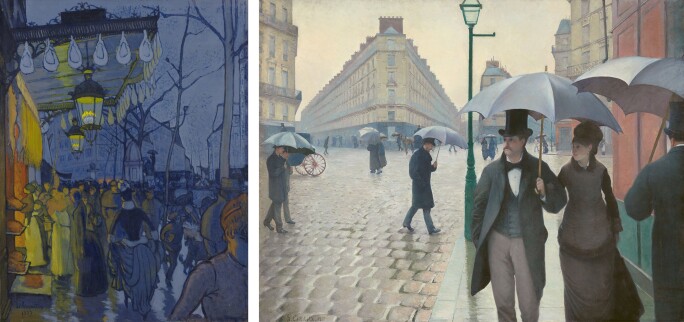
RIGHT: Gustave Caillebotte, Rue de Paris, temps de pluie, 1877. Art Institute of Chicago
Toor’s technique, characterized by tender, gestural brushstrokes and a muted yet evocative palette, imbues the painting with a sense of t.mes lessness. His approach recalls the intimacy and depth of Old Master paintings, particularly in the use of soft light and carefully rendered details. At the same t.mes , Toor’s work remains firmly contemporary, with subtle urban elements like graffitied walls, scattered trash, and an orange traffic cone grounding the scene in the present. This balance between historical inspiration and modern subject matter allows Toor to craft a visual language that is both rooted in tradition and reflective of the complexities of contemporary life.

By juxtaposing disparate elements—a mosque, urban booksellers, a subtle romantic moment—Toor creates a layered narrative that celebrates both cultural intersectionality and individual humanity. The painting’s contrasts—light and shadow, intimacy and anonymity, religion and liberation—reflect the dualities inherent in urban life. Each figure is rendered with care, their gestures and expressions hinting at untold stories. Toor invites viewers to linger on these moments, to trace the interplay of relationships and environments that make up the painting’s world.
Ultimately, Eleventh Street is more than a snapshot of urban life; it is a meditation on the beauty of connection, the dignity of ordinary moments, and the power of art to assert presence and humanity. Through the present work, Toor continues his project of rewriting the canon, centering marginalized figures and their stories with tenderness and care. In doing so, he creates a space where everyday lives are not only seen but celebrated.

