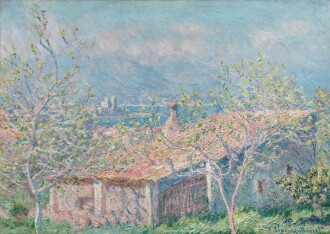
"I'm working from morning to evening, brimming with energy... I'm fencing and wrestling with the sun. And what a sun it is."
In early 1888, Monet set off for the French Riviera, soon landing in the easterly town of Antibes. Settled just above the coastline near the Plateau de la Garoupe, the artist became engrossed in his surroundings. For an artist accust.mes d to painting views of misty London and the outskirts of Paris and the rugged north of France, the blazing light of Antibes provided endless new opportunities and pictorial challenges (see fig. 1).

The canvases which resulted from this prodigious period capture myriad views of the region, numbering nearly forty pictures in total. Of this body of work, Antibes vue de la Salis distills the finest qualities of Monet's campaign, capturing the resplendent effect of the Mediterranean light upon the water, the Château Grimaldi in the distance and the grand sweep of foliage at the fore. The present work belongs to a limited series of four works painted from the same vantage point and of roughly the same scale; two work now belong in museum collects ions, those of the Toledo Museum of Art (W. 1168) and the Philadelphia Museum of Art (W. 1170).
Daniel Wildenstein distinguished the location of this discrete series within his broader Antibes period: “Monet moved closer to the sea, to the part of the Gardens of La Salis which adjoins the Plateau de la Garoupe. From this position, further to the east, the tower of the Château Grimaldi hides that of the cathedral. The Fort Carré is further to the right. The foreground is occupied by olive trees” (Daniel Wildenstein, Monet, Catalogue raisonné, vol. III, Cologne, 1996, p. 44).
“In order to paint [Antibes] one would need gold and precious stones. It is quite remarkable."
The four paintings of this view show differing t.mes s of the day, yet all emphasize the tonal contrast between the nearby trees and the distant shoreline. According to Joachim Pissarro, the present work and W. 1169 were executed just at the break of dawn, when the leaves at right are barely touched by sunlight and the town in the background is still bathed in the cool purpley hues of the early morning.
Explore the Series: Antibes vue de la Salis


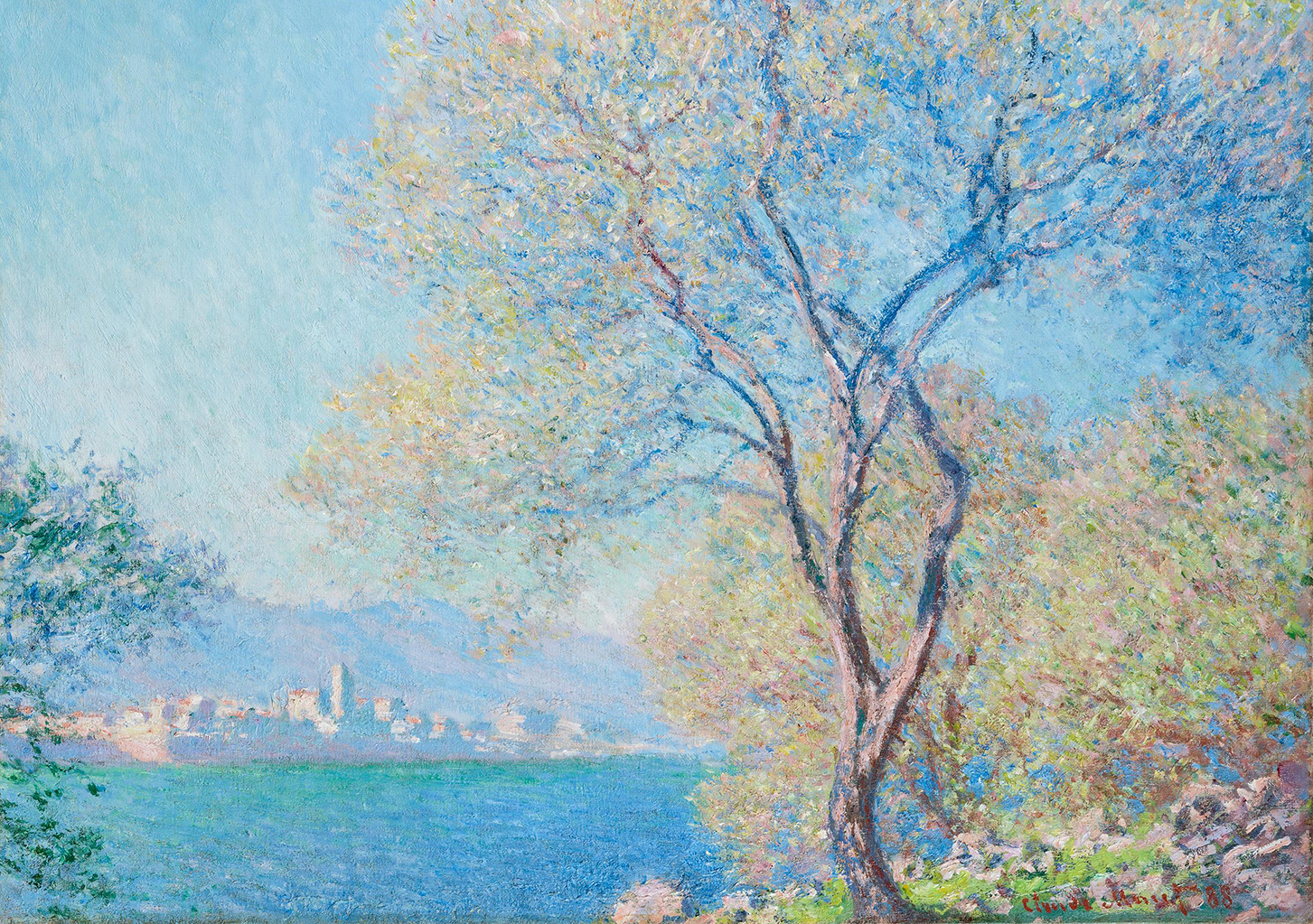

As its title suggests, the Philadelphia Museum of Art’s Antibes, le matin (W. 1170) captures a gentle morning scene, drawing particular attention to the green sea and the light tones of the foliage and dappled sunlight below. The Toledo Museum of Art’s version (W. 1168) is the starkest in contrast to the other three, depicting the Gardens of La Salis in the broad afternoon daylight under a bright blue sky.
"Monet’s formula was to use endless variations and pictorial contrasts to create rich webs of harmonies, contrasts and echoes, which these four pictures admirably demonstrate.”
As also evidenced by his output from this period, Monet's frequent letters attest to the artist's invigorated state of being during this t.mes and in awe of his surroundings. In a letter to Auguste Rodin in early February, Monet likened the act of painting at Antibes to a physical challenge, stating that he was "working from morning to evening, brimming with energy... I'm fencing and wrestling with the sun. And what a sun it is" (Claude Monet quoted in Robert Gordon and Andrew Forge, Monet, New York, 1983, p. 123). His sent.mes nts carried over in his letters to his partner, Alice Hoschedé, to whom he conveyed his simultaneous ecstasy and exhaustion. Writing on February 1, 1888, Monet stated:
“I am weary, having worked without a break all day; how beautiful it is here, to be sure, but how difficult to paint! I can see what I want to do quite clearly but I’m not there yet. It’s so clear and pure in its pinks and blues that the slightest misjudged stroke looks like a smear of dirt. Anyhow, I’m hard at it and when I’m working away like this I’m bound to come up with something. I’ve fourteen canvases under way, so you see how carried away I’ve become.”

"Is Monet conscious, as he paints, of the strange affinity between perfumes, sounds and colors? He must be. His brushstrokes make the Mediterranean sound like the murmurs of lovers... [The Antibes paintings] bestow a warm, scented caress."'
The short, directional brushwork so deftly utilized in the present composition anticipates the experimental techniques of the Neo-Impressionists. In fact, Signac was so inspired by Monet’s earlier works that he credits Monet with the start of his artistic career: “It was a visit to an exhibition of Claude Monet’s works in June 1880 that unveiled [Signac’s] calling as a painter. ‘What was it that made me start painting? It was Monet or perhaps seeing reproductions of paintings in La Vie moderne. The thing that attracted me to this artist was the revolutionary nature of his work’” (quoted in Exh. Cat., Fondation de l’Hermitage, Lausanne and Museo d’arte della Svizzera Italiana, Lugano, Signac, Reflections on Water, 2016-17, p. 11; see fig. 2).

The radiant hues and calibrated contrasts between light and shadow in Antibes vue de la Salis also foreshadow the great series pictures which would follow after Monet's return to Giverny. Exemplified by the Antibes works,
Monet's method of working on multiple canvases at once would serve the artist throughout his career, with similar site-specific studies resulting in some of his most renowned canvases. Just two years after the completion of the present work, Monet would embark upon arguably his most defining series, his Meules, or haystacks (see fig. 3).
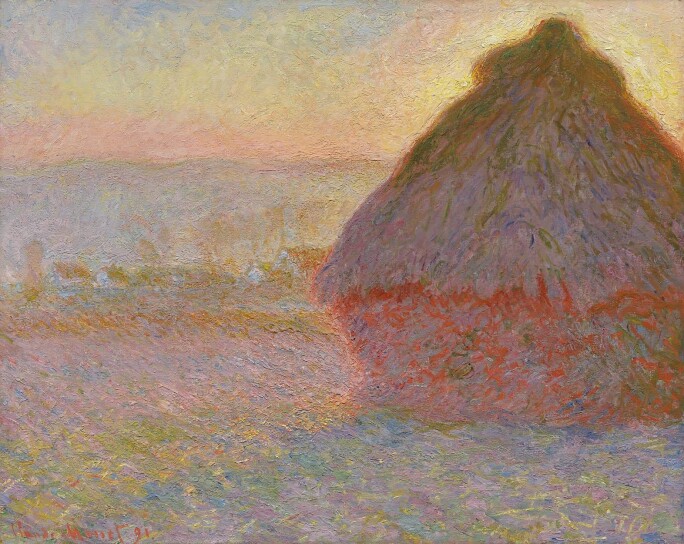
On the transformative quality of the artist’s work, Gottfried Boehm writes: “Monet’s artificial nature captivates us. It is painted light, inherent in the colored matter of the pictures, while opening up living vistas. It is the power that does not.mes rely illuminate things like a floodlight, but places the visible, the motif—rivers, seas, hills, rocks, trees—in its own light and allows it to come into view” (Exh. Cat., Fondation Beyeler, Basel, Monet: Light, Shadow, and Reflection, 2017, p. 36).
The Motifs of 1888: Monet in Antibes