“In his intimate interiors of this period, Vuillard’s artistic sensibility is at its most sophisticated. These paintings, which evoke his life in a visual shorthand, both depict familiar rooms and convey his feelings towards the characters who peopled them. His pictorial construction, likewise, is at its most complex; the meaning of these works, nearly a century after their creation, remains elusive.”
The 1890s represent a pivotal moment in Vuillard’s practice, when the theme of domestic interiors for the first t.mes took centre stage within his artistic output. While many of Vuillard’s works dedicated to this subject offer glimpses into the quotidian life he observed around him – be it his mother and sister busy with the corset-making business they ran from home, or the two of them dining or resting – a selection of paintings from this decade references specific events in the artist’s life. La soirée familiale, dating from 1894-95, belongs to the second category. One of the most striking and emotionally charged paintings from this critical period, it is also one of the most intimately autobiographical in the whole of Vuillard’s œuvre.

The year 1893 saw the marriage of Vuillard’s best friend and fellow Nabi painter, the charismatic and impassioned Ker-Xavier Roussel to Vuillard’s sister Marie, a reserved woman seven years Roussel’s senior. The marriage was largely instigated by Vuillard himself, who, having witnessed Roussel’s lack of seriousness when it came to his private life – and the dramatic implications it was beginning to have – saw in this union a way to redirect his best friend towards a more settled path.

Right: Fig. 3, Édouard Vuillard, La causette, 1893, oil on canvas, The National Galleries Scotland
However, the union proved to be bitterly mismatched due to the dramatic differences in Ker and Marie’s temperaments. As the author of Vuillard’s catalogue raisonné Guy Cogeval writes, “After the loss of Marie’s child on 13 December 1894, the young couple’s relationship began to unravel. In his ‘autobiographical notes’, Vuillard describes the year 1895 as one of ‘complications in the Roussel household'. In fact, from the beginning of 1891, Roussel had been carrying on a passionate liaison with France Ranson’s sister Germaine. By the spring of 1895, Roussel’s repeated absences and bad temper were becoming a burden for the Vuillards” (A. Salomon and G. Cogeval, op. cit., 2003, p. 341).
“The room and the people in it seem to be in the grip of that diffuse feeling of uneasiness that Symbolist poets usually associate with the coming of twilight.”
The present work captures, with great visual acuity, this dramatic period in the artist’s family’s life coming to its culmination. Vuillard is deeply aware of his sister’s despair, conveying it through her dramatic pose and the domestic objects positioned as if closing in on her, a visual metaphor for the feeling of entrapment she must have felt when faced with the reality of her situation. At the same t.mes , Vuillard manages to portray the dejection felt by his best friend, pictured as a shadowed silhouette hunched over in the foreground of the composition.
Scholar Kimberly Jones has noted that Vuillard records the present scene “with the unflinching candour of a disinterested observer, rather than as an active participant who had in fact been the orchestrator of the ill-starred marriage” (Exh. Cat., Vuillard, op. cit., p. 155). In this sense, the composition of La soirée familiale bears a strong resemblance to a theatre scene, with both the artist and the viewers observing the happenings on the stage as if from a distance. Vuillard pays particular attention here to the arrangement of figures within the composition, their dramatic, telling poses conveying a sensation of loud silence that permeates the scene. This is further heightened by the dramatic lighting which, while highlighting the faces and figures, at same t.mes , casts shadows over other compositional elements, adding to the overall sense of dramatic tension.
The parallel with theatre is important to note here, as it reflects Vuillard’s earlier work in theatre design. His affiliation, beginning from the 1880s, with the Nabis group exposed him to the cross-section of the avant-garde, including members of the Parisian theatre community who commissioned him to design production sets for plays by Henrik Ibsen and Maurice Maeterlinck, two pioneering playwrights who revolutionised the world of theatre in the nineteenth century.
“Vuillard's experiments in the theatre, as he adapted them to his painting, were not only important – they were crucial.”
Cogeval draws strong parallels between the psychologically charged realism of Ibsen’s plays and some of Vuillard’s interior compositions: “The most important thing to remember about the whole of his theatrical experience is that he transposed the principles of his stage sets into his own painting: sloping planes, transparent screens across the proscenium arch, an obsession with suffocating atmospheres infected by fear, where lamps take forever to go out. His protagonists, whether seamstresses, apprentices, clients or members of his family, give bodily substance to Ibsen's creations” (ibid.).
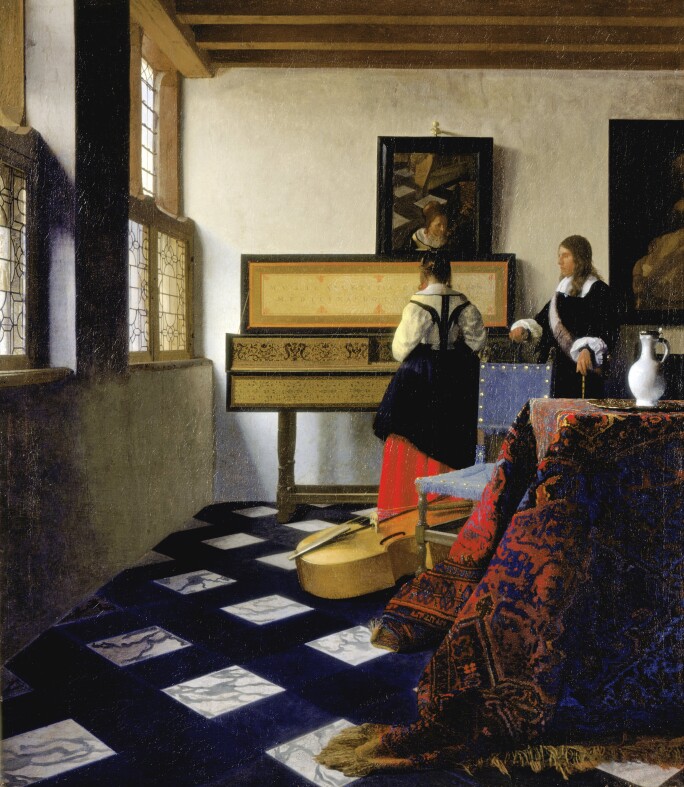
In their subtle sense of drama and the powerful play of shadow and light, Vuillard’s works from this period likewise draw on the wider art-historical tradition of scenes of domestic interior (fig. 4). As Jones remarks on this, “Vuillard's interiors are deeply resonant works, strikingly modern yet steeped in an artistic tradition that stretches back to the seventeenth century. Dutch genre painting, with its modest subjects, often rigorous arrangement of form, and bold contrasts of light and dark, was a key influence on Vuillard. He was especially drawn to the work of Johannes Vermeer, Jan Steen and Gerard Dou, which he knew from his regular visits to the Musée du Louvre and from a trip he made to Belgium, Holland and London in the autumn of 1892” (K. Jones in ibid., p. 130). Jones likewise connects Vuillard’s reflections on modern domesticity to that of his contemporaries, in particular, Degas, the “compositional audacity and psychological complexity” of whose paintings undoubtedly influenced Vuillard (figs. 5 and 6) (ibid.).
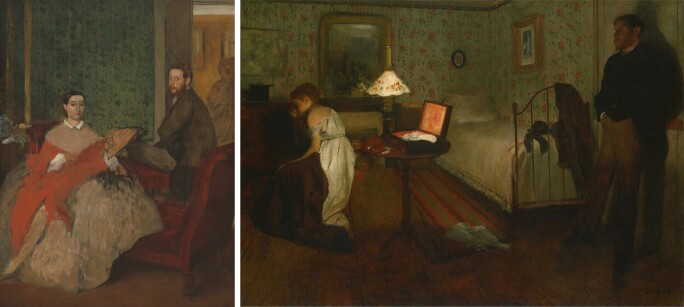
Right: Fig. 6, Edgar Degas, Intérieur (Le Viol), 1868-69, oil on canvas, Philadelphia Museum of Art
One of the most important works by Vuillard from a critical period in his œuvre, La soirée familiale is striking in its degree of emotional intensity, achieved, as is often the case with his best works, through highly nuanced and subtle compositional means. Exhibited widely throughout its history, the present work’s importance is further highlighted by the fact that it stayed in the collects
ion of its first owner, the celebrated dealer and art historian César de Hauke, for well over fifty years.