
“The Homages operate like doors – physically, optically, psychologically, and metaphorically. They are entrances, exits, and thresholds, beginnings and endings. Somet.mes s it is not clear on which side of the door we are. The door opens both out and in, onto the past, the present, and onto an endless, inescapable hall of doors…. And the possibilities are both limited and limitless, just as Albers conceived of his paintings…”
J osef Albers’ Homage to the Square is one of the most recognizable and iconic bodies of work of the Twentieth Century. Mesmeric symphonies of color and form, the paintings vary widely, from subtle variations to exuberant paintings filled with stunning internal contrasts. Study for Homage to the Square: Juxtaposed from 1957, executed only seven years after the inception of the series, presents such contrasts with energetic spring greens encased by shadowy, illusionistic grays. Its evocative title is evident in Albers’ playful choice of pigments which generate perplexities entirely through color relationships. While many of Alber’s compositions from the Homage to the Square series feature minimal concentric squares, the present work is distinctive in its inclusion of angled, directional lines which imply three-dimensional space on a two-dimensional surface. Bursting with an internal luminosity and curious perceptive intrigue, Study for Homage to the Square: Juxtaposed is a quintessential model of Albers’ belief in the primacy of color and his experiments with the chromatic spectrum.

Born the son of a craftsman in Bottrop, Germany in 1888, Albers was exposed to artisanal skills which would continue to bleed into his practice for years to come. Albers began his career in print-making and stained glass, studying at the pioneering Bauhaus school in 1922. Spearheaded by Walter Gropius, Bauhaus was famous for educating its students in both the traditional Replica Handbags s as well as so-called “craft” disciplines, expanding the definition of modern artmaking. Albers was soon enrolled in Johannes Itten’s “preliminary course” in which he instructed students in his own color theory principles. After only a few years, Albers himself lead the course and would spend the next decade at the school. In 1933, amid growing Nazi presence in Germany, Josef and his wife Anni emigrated to the United States where he was appointed a teaching position at the newfound Black Mountain College in North Carolina. There, he would establish himself as a key influencer on the next generation of artists in America, helping to cultivate the practices of Cy Twombly, Ruth Asawa, and Robert Rauschenberg. In 1949, Albers left Black Mountain College for his final teaching position as Director of the Design Department at the Yale University graduate program. There, he would begin his seminal and culminating series, Homage to the Square, which was not only most critically lauded in his career, but also one of the most pivotal and influential in the history of Contemporary art.
“Colour, in my opinion, behaves like man … in two distinct ways: first in self-realisation of relationships with others. In my paintings I have tried to make two polarities meet … independence and interdependence..."

At the core of Albers’ philosophy is the unwavering belief that color must be felt and understood in terms of its effect on the psyche. Study for Homage to the Square: Juxtaposed perhaps best embodies this belief, presenting a hypnotizing spatial illusion which both retracts and protrudes subject to various perspectives. Painted in careful layers of oil on hardboard, the bold green center emanates outward as if light-filled in graphic transitions, providing a fascinating insight into our perception of color and space through rigid geometry. As the title suggests, the juxtaposition between the mesmerizingly simple yet theoretically complex composition creates a captivating visual experience of light and depth.
Few artists have exhibited such a steadfast fascination with color as Albers. As a result, Albers has remained one of the most important contributors to the field of color theory in the years since the 1960’s. His text Interaction of Color, first printed by Yale University Press in 1963, has sold over a quarter of a million copies and is as essential today as it was when it was published. The artist’s obsession with mastering color theory stemmed, it seems, from a desire to control color’s infinite effects. Albers remarked, “Color is the most relative medium in the world. I can kill the most brilliant red by putting it with violet. I can make the dullest gray in the world dance by putting it against a black. I can do as I please with color. It behaves as I mean it to. I know where I am going, and I am the man in charge.” The Homage to the Square series is the result of Albers’ deep-seated desire to control his art by choosing exactly how his paintings–and the colors within them–will behave.
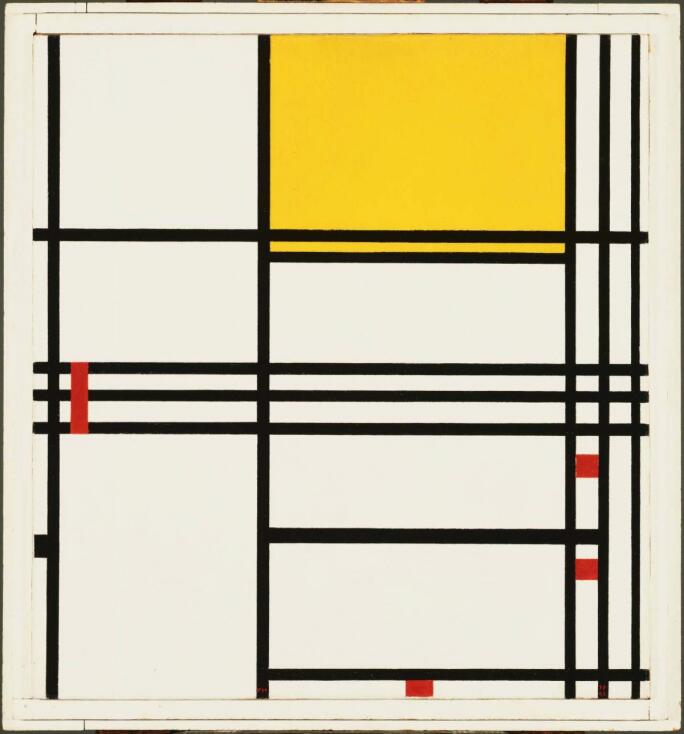
“Every perception of color is an illusion…We do not see colors as they really are. In our perception they alter one another. For example; two different colors can look the same or two identical colors can look different: opaque shades can look transparent and definite shapes can become unrecognizable. This play of colors, this change in identity, is the object of my concern. It leads me to change my color tool, my palette, from one picture to the next.”
Despite the apparent order and constancy of the Homage to the Square series, Albers’ deft mastery of color enables paintings which are constantly shifting, evolving, and moving before the viewer. Thus, as the viewer stands in front of Study for Homage to the Square: Juxtaposed, they enter a space that is entirely unique – a space created, and controlled, by Albers himself. Indeed, Albers’ remarkable influence as an artist and teacher affirms his own observation about the totality of color’s influence: “Once one has had the experience of the interaction of colour, one finds it necessary to re-integrate one’s whole idea of colour and seeing in order to preserve the sense of unity... When you really understand that each colour is changed by a changed environment, you eventually find that you have learned about life as well as about colour” (Josef Albers, cited in: Exh. Cat., Washington D.C., Washington Gallery of Modern Art, Josef Albers: The American Years, 1965, p. 28).

