
“I wanted to get in touch with nature. Not painting scenes from nature, but to get a feeling of that light that was very appealing to me, here particularly… I got into painting in the atmosphere I wanted to be in.”
Distinguished by its painterly conviction, tactile physicality, incandescent lyricism, and exceptional rarity, Untitled, circa 1979 is an utterly unique masterwork of Willem de Kooning's oeuvre and of Abstract Expressionism. Executed during a singular period of intense introspection and experimentation for the artist, the present work is one of only a select handful of canvases created during the late 1970s, which are among his most highly sought-after works and bespeaks a seminal moment of transition in his practice. Untitled epitomizes the richly worked surfaces of his 1970s paintings while also foreseeing the refined, compositional lyricism of his late masterworks from the 1980s. Here, the master painter’s elusive forms rendered in liquid, pliable paint oscillate between the almost figurative elements and steadfastly abstract, the composed and the agitated—all with the storied brilliance of his vibrant color palette. Paintings from this moment are rare and the coloration of Untitled is singular, not only in its chromatic brilliance but in its saturated blue, green, and yellow palette, a combination of hues not used elsewhere in this way within de Kooning’s oeuvre. Still, the marvelous choice of colors in Untitled embodies de Kooning’s expression of nature, and in particular, the sea and sky near his studio in Springs, East Hampton. In its richly worked surface and coloration, Untitled immediately recalls the late Nymphéas of Claude Monet, and in particular that Impressionist master’s depiction of water mirroring the changing atmosphere of the sky. Resplendent with the luminescence of Monet’s Nymphéas and the layered coloration of Gerhard Richter’s famed Abstrakte Bilder, this painting is an unparalleled embodiment of the possibilities of paint, at once quintessentially de Kooning and yet unlike anything else in his oeuvre. As his wrist, arm, and body became one with the rhythms of his brush or palette knife, the artist enacted a spectacular material incursion onto his canvas surface, resulting in unrestrained expression that encapsulates the full genius of de Kooning’s inimitable aesthetic.
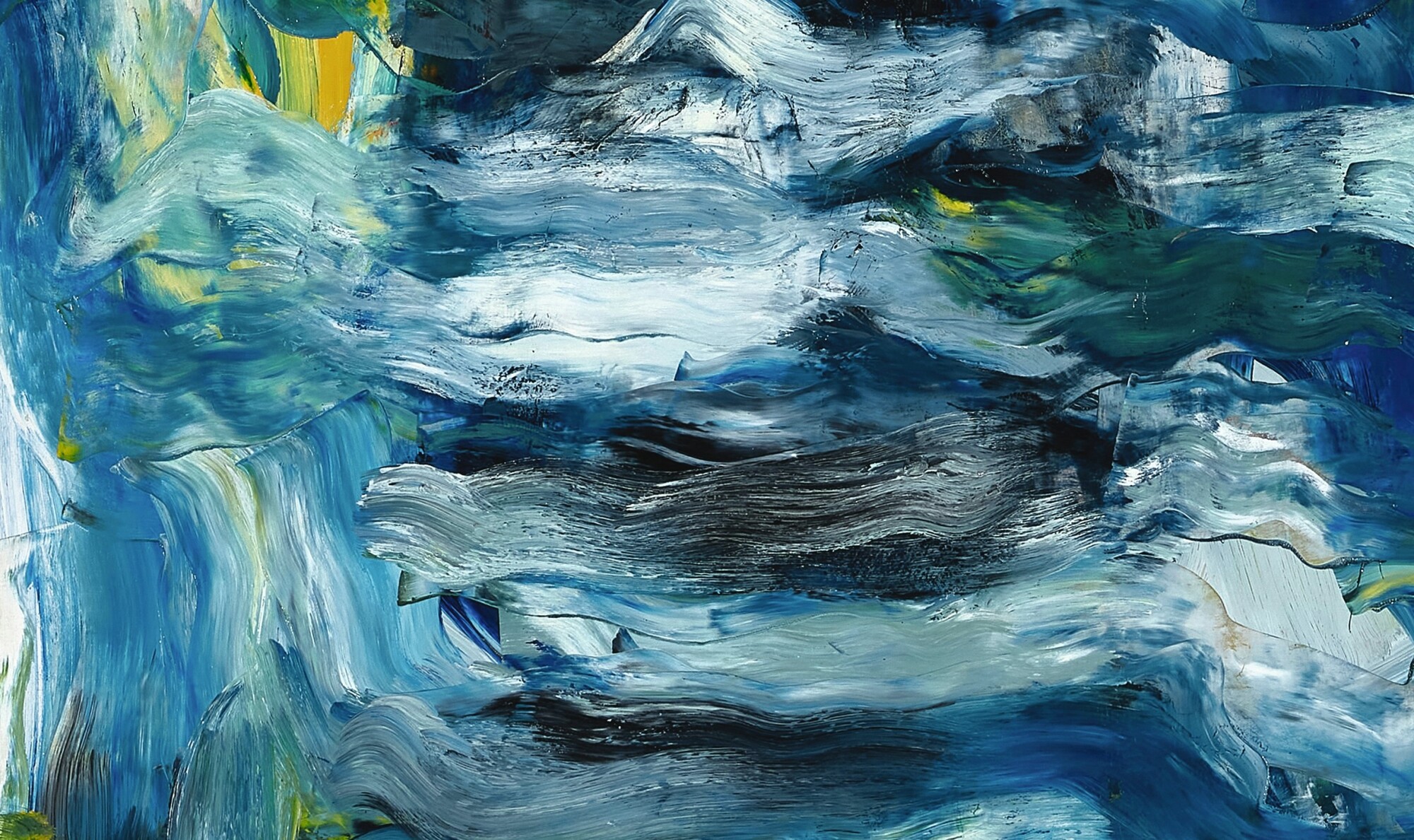

Through the lush impasto and exceptional handling of paint, de Kooning creates a surface which appears freshly created. To achieve this effect, de Kooning masterfully employed many tools and techniques, including brushes and scrapers, producing the densely rich and textured surface of Untitled. The lustrous, aqueous texture of Untitled is complemented and emphasized by its oceanic palette, as de Kooning fuses color and gesture. Focusing his energy on the quality of paint application and the composition of his surface, de Kooning thinned his oil paint with combinations of water, kerosene, benzene or safflower oil to add fluidity to the paint, facilitating a more rapid stroke. Using unorthodox methods of applying and removing paint with spatulas and knives, particularly the taper’s knife, de Kooning defined his composition through motion, energy and action, allowing a variety of planes of pigment to coalesce in and out of each other across the canvas. De Kooning has used the term “fitting-in” for this characteristic. He speaks of it in Cézanne: “that’s where modern art came from,” and in Cubism. “The way I do it, it’s not like Cubism, it’s like Cézannism, almost.” (Willem de Kooning quoted in interview by Judith Wolfe, November 16, 1980, in Judith Wolfe, "Glimpses of a Master," in Willem de Kooning: Works from 1951-1981 (East Hampton: Guild Hall Museum, 1981), 16.)

Here we see de Kooning moving towards the looser, ribbon-like fluidity of the 80s works that would follow. The liquid smears of sensuous blue and white tones that ripple across the surface are glossy and lavishly applied, building into crests and waves of impasto as they merge and roil into one another. While the scattered drips and paint flecks through the left side of the composition evoke the method of Jackson Pollock, the blended and scraped passages of canary yellow along the right edge foreshadow the beauty of Richter’s later squeegee technique. As these wide pulls of paint elide into the hazy swathes of blue and green, one also glimpses occasional flashes of fiery crimson, burning like embers through a fog. Like a sun-drenched beach, Untitled invokes the glistening, unt.mes d brilliance of sunlight dancing upon the Atlantic Ocean, the jubilant yellow churns swirling into the aquatic forms like eddying waves.


"The loosening of fit, and its consequences, in de Kooning’s 1978-80 paintings, then, was part of a perennial, alternating pattern of expansion and contraction, for the artist as natural as breathing, and not to be thought unexpected."


In the mid-1970s, landscapes replace women as a dominant theme in his paintings and de Kooning fervently threw himself into painting abstractions influenced by his rural surroundings in Long Island. Though he had long alternated between figuration and abstraction, de Kooning’s artistic output was largely characterized by a similar method of working and reworking his compositions, painting, sanding, drawing, layering, scraping, rotating the canvas and repeating the process. In 1975, his experimentation with that pliant and tactile medium reinvigorated his style, culminating in the luscious gestural abandon that defined the landscapes of his “annus mirabilis,” 1977. Within just a few short years, an astounding aesthetic shift would take place: he would exchange those sensuous, heavily impastoed surfaces for luminous expanses of tonally shifting hues, gracefully layered with ribbons of unafraid hues, forging the new pictorial space that would occupy him for the rest of his career. The relatively few canvases produced during the years of 1978-80 represent a crucial conceptual bridge and exploration of styles, manifesting all the teeming energy of the preceding work yet realizing the compositional mastery and elegant refinement of his culminating corpus. As summarized by esteemed curator and historian John Elderfield in an extended analysis of the present work:
“The long, swiped brushstrokes roughly align with the edges of the canvas in a manner that makes them seem more aggregated than artfully composed. This explicit engagement with the geometry of the pictorial support marks an important compositional change from the works of the mid-1970s. […] The loosening of fit, and its consequences, in de Kooning’s 1978-80 paintings, then, was part of a perennial, alternating pattern of expansion and contraction, for the artist as natural as breathing, and not to be thought unexpected”

Among the greatest heroes of Abstract Expressionism, de Kooning spent the early part of his career in Manhattan, keeping company with peers Jackson Pollock, Adolph Gottlieb, Barnett Newman, and Arshile Gorky. Like Pollock and Gorky, de Kooning began occasioning East Hampton by the summer of 1952, escaping the urban commotion in favor of the rural quietude. By 1963, he had moved entirely out of New York City, immersing himself instead in the light-filled and soothing environment of eastern Long Island. He was struck anew by its beauty in the 1970s, remarking “When I moved into this house, everything seemed self-evident. The space, the light, the trees—I just accepted it without thinking about it much. Now I look around with new eyes. I think it’s all a kind of miracle” (Paul Hellmann, "De verloren zoon zit goed," Algemeen Dagblad, December 24, 1976, English translation in Willem de Kooning: Paintings (Washington D.C.: National Gallery of Art, 1994), 197). Inspired by this fresh vision, de Kooning’s paintings became intimately concerned with his surroundings: “I wanted to get in touch with nature. Not painting scenes from nature, but to get a feeling of that light that was very appealing to me, here particularly… I got into painting in the atmosphere I wanted to be in” (Harold Rosenberg, “Interview with Willem de Kooning,” ArtNews 71, No. 5, September 1972, p. 57). Although Untitled remains resolutely abstract, it nevertheless evokes the essence, memories, and experience of de Kooning’s oceanic and peaceful surroundings. The glimmer of sunlight on the ocean, a rush of waves crashing onto the sand, the bright bloom of beachside rosebuds—all encapsulated by the present work—captivated and seduced de Kooning, reminding him of his home in Holland. Enveloping the viewer in a riot of brilliant hues, the undulating collisions of line and form within Untitled reproduce the unmistakable aura of chaos and tranquility inherent to the natural world.


Uniting painterly bravura and sculptural physicality to richly capture the sundrenched lushness of East Hampton, Untitled evokes an emotional poignancy that rivals the iconic landscapes of de Kooning's Impressionist forebears. John Elderfield noted Untitled’s “Claude Monet-like” qualities (John Elderfield quoted in: Exh. Cat., New York, The Museum of Modern Art, de Kooning: A Retrospective, New York 2011, p. 447); indeed, this painting brings to mind the words of Jean-Louis Vaudoyer when, upon viewing Monet’s Nymphéas, he remarked: "None of the earlier series…can, in our opinion, compare with these fabulous Water Landscapes, which are holding spring captive in the Durand-Ruel Gallery. Water that is pale blue and dark blue, water like liquid gold, treacherous green water reflects the sky and the banks of the pond and among the reflections pale water lilies and bright water lilies open and flourish. Here, more than ever before, painting approached music and poetry. There is in these paintings an inner beauty that is both plastic and ideal" (Jean-Louis Vaudoyer quoted in La Chronique des Arts et de la Curiosité, 15 May 1909, p. 159, translated from French). Rendered with the full force of de Kooning’s inimitable painterly lexicon and sure compositional command, Untitled possesses a profound inner beauty that confirms this unique masterwork as a peerless paragon of the artist’s inventive genius.
Metamorphosis: The Willem de Kooning Decades collects ion


