
Royal collects ion
A n elegantly delineated triumphant figure, Jean-Michel Basquiat’s Standing Man from 1981 captures the allusive mélange of artistic concepts and cultural ideals that undergird the artist’s practice. Executed when Basquiat was just 20 years old, the present work is one of the artist’s earliest mature drawings, exhibiting the visual nuance and conceptual rigor that would define the coterie of warriors, skeletal figures and expressive heads that would follow.

The Metropolitan Museum of Art, New York
© 2020 Estate of Pablo Picasso / Artists Rights Society (ARS), New York
Drawn with a gestural flair, Basquiat’s figure is broad-shouldered and frontal, a pseudo-cubist composite of various archetypes and art historical references. In the present work, the subject is constructed of variegated geometrics passages, simple shapes and lines and arcs which coalesce to become both anatomical and schematic. While recovering from a car accident as a youth, Basquiat was given a copy of Gray’s Anatomy by his mother, and the formative text would prove to be influential on his later practice. In Standing Man, the subject is depicted as if through an X-ray, their spinal cord visible through their broad exterior, bespeaking this early influence. A Frankenstein-esque composite of forms, the figure’s left hand appears stiff and solid while his right hand is a loose amalgam of arcs and lines in the vein of Picasso’s early Cubist drawings. As a keen student of Art History, “Picasso’s work gave Basquiat the authority and the art historical precedent to pursue his own brash and aggressive portraits” (Richard Marshall, “Repelling Ghosts,” in Jean-Michel Basquiat, Exh. Cat., Whitney Museum of American Art, New York, 1993, p. 16). While Basquiat’s nod to Picasso is just one strand of the complex web of influences contained within the present work, it testifies to his singular skill in the realm of cultural production. Figurative, abstract, restrained and free-wheeling, Standing Man testifies to Basquiat’s affinity for “distilling his perceptions of the outside world down to their essence and in turn, projecting outward through his creative acts" (Fred Hoffman, "The Defining Years: Notes on Five Key Works," in Basquiat, exh. cat., Brooklyn Museum, New York, 2005, p. 129).
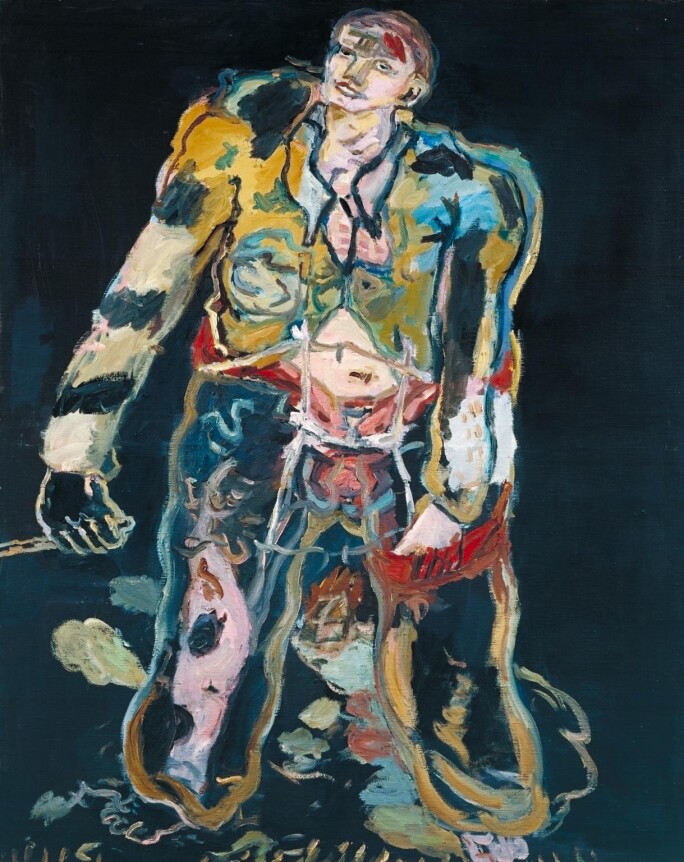
Tate, United Kingdom
© 2020 Georg Baselitz